
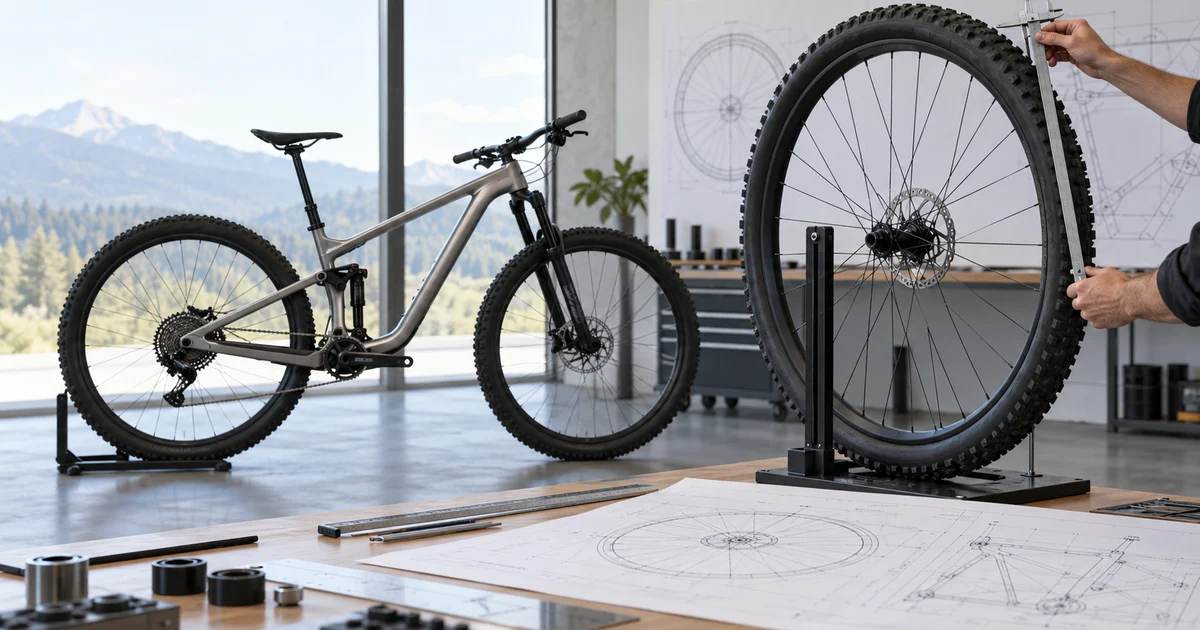
Conceptual illustration created for this article. It is not a photograph of a certified production 32-inch bicycle or a Tyride project.
A new wheel size is a system decision. A bicycle brand considering 32-inch wheels needs more than a promising prototype rim. It needs compatible tires, rims, forks, frames, brakes, packaging, test evidence, and replacement stock to arrive on a coordinated schedule. The procurement question is therefore not simply “Who will quote a 32-inch wheel?” It is “Can we support the complete bicycle after launch?”
Key takeaways
- Treat a supplier request, a prototype, and a production commitment as three different milestones.
- Specify the tire and rim interface by controlled dimensions and documents, not the informal “32-inch” label alone.
- Set launch gates for testing, service parts, tooling ownership, and production changes.
- Confirm suppliers’ current release dates in writing; a public product roadmap is not an allocation guarantee.
What the July 2026 discussion did and did not establish
A July 2026 r/32inchbikes post shared a purported translation of a Dutch cycling interview and claimed that requests for 32-inch components had gone to suppliers. When this article was checked on October 25, 2026, the linked interview as then accessible discussed future Scott products but did not contain the quoted 32-inch passage. We cannot tell from the available pages whether the Reddit excerpt referred to another version or another source. Therefore the supplier-order claim remains unverified and is not a basis for a purchasing decision.
The supplier side provides a stronger, narrower signal. On its current 32-inch tire page, Schwalbe lists G-ONE RS PRO and G-ONE RX PRO gravel tires in 50-686 and 55-686 sizes and states availability from April 2027. That is a manufacturer’s public plan, not a guaranteed allocation to any OEM buyer. Request written confirmation for the exact model, region, volume, and delivery window before placing a bicycle-production order. Other tire makers and segments may follow different timetables.
This distinction protects an OEM team from building a schedule around a forum headline. Community discussion can point to a question worth investigating. Supplier documents, samples, and purchase terms determine what can actually be built.
Wheel interface is the set of dimensions and mating features that let the tire, rim, hub, brake, and frame work together. Release gate is a documented decision point that must be passed before a project moves to the next stage. Service stock is the replacement inventory reserved for repairs after bicycles reach riders. The three concepts help separate a promising prototype from a supportable product.
Freeze the wheel interface before requesting prices
“32-inch” is a consumer-facing size description, not a complete procurement specification. The RFQ should identify the intended tire designation, bead-seat diameter, rim profile, internal width, bead type, tire construction, target pressure range, tube or tubeless configuration, and approved tire-rim combinations. Include the axle, hub, rotor, spoke count, spoke length, and wheel-build requirements where relevant.
The applicable reference documents should be selected with the engineering team. ISO 5775-1:2023 addresses bicycle tire designations and dimensions; ISO 5775-2:2021 addresses rims. These standards establish a vocabulary and dimensional framework. They do not approve a particular prototype tire-rim pairing on their own. The component makers must state which combinations they support.
Tyride’s bicycle parts compatibility checklist is useful once a candidate system has a defined bill of materials. For a new wheel size, add a controlled interface sheet that names every mating part and its revision. If one supplier changes a rim profile, the tire and wheel validation plan may need to change as well.
Use five release gates for the supply chain
The following gates are an editorial decision tool for an OEM project. They are not a statement that every 32-inch design must follow one universal timeline.
| Gate | Evidence the buyer should request | Decision |
|---|---|---|
| Interface | Controlled tire and rim dimensions; approved pairings; complete wheel drawing | Is the system technically defined? |
| Prototype | Installed bicycle samples; clearance and handling review; recorded component revisions | Does the assembly work on the intended frame and fork? |
| Validation | Applicable wheel, rim, and bicycle test reports with identified samples | Has the actual configuration been tested? |
| Production | Signed specifications, capacity and delivery plan, tooling and change terms | Can approved parts be made repeatedly? |
| Service | Replacement tire, rim, spoke, wheel, and fork availability plan | Can a rider repair the bicycle after sale? |
For the validation gate, ISO 4210-7:2023 is the current ISO wheel and rim test-method reference in the bicycle safety series. The complete bicycle’s applicable requirements depend on category and market. A test report should identify the version, sample, method, result, and any deviations. A generic certificate that does not identify the tested configuration cannot answer whether your wheel assembly passed.
Model launch cost as a system cost
A new wheel size may create separate tooling, sample, test, packaging, and service-stock costs. Compare supplier quotations at the program level:
Program cost = approved components + tooling + validation + launch inventory + service inventory + logistics and change exposure.
This is a planning equation, not a market benchmark. It helps expose costs hidden by a low rim quotation. A brand may have a competitively priced wheel but still lack a reliable replacement tire. Conversely, a higher initial quote may include clearer tooling ownership, test records, and replenishment terms. Ask suppliers to price those items separately so purchasing and engineering can see the trade-offs.
The service question matters before launch. A rider with a damaged tire or rim does not benefit from a complete-bike delivery schedule if replacement parts cannot be ordered separately. Maintain service part numbers and availability for the life of the product program. Tyride’s component sourcing service can support coordination of a multi-category purchasing list, but each proposed supplier’s capability still needs project-specific verification.
Put change control in the supplier conversation
An emerging platform is likely to evolve between prototype and production. Define which changes require written approval: tire casing or bead construction, rim profile or material, spoke pattern, hub interface, fork clearance, brake interface, or assembly method. Link each approved change to a drawing revision, test decision, and production lot. Keep old and new parts distinguishable for service teams.
When asking for a quotation, include an expected annual volume and a smaller pilot quantity. Ask the supplier to state its minimum order for the exact configuration, the sample lead time, the earliest production date, and the notice period for component changes or discontinuation. A promise about “32-inch parts” is not enough until it names the actual parts.
A practical next step for OEM buyers
Start with one controlled wheel-system sheet, not separate messages to tire, rim, and frame suppliers. List every interface, identify who owns the drawing, and mark each item as concept, sampled, tested, or production-approved. Then ask each supplier to sign off on the assumptions that affect its part.
If you are comparing potential component sources, send the wheel-system sheet and intended launch market through Tyride’s contact page. The useful first conversation is about the complete specification, the available evidence, and the service plan. Those documents will reveal whether a proposed 32-inch program is ready for a pilot order or still belongs in development.
Editorial note: The Reddit post points to public industry discussion, not verified purchase volume. Availability and technical requirements should be rechecked with component makers for the exact configuration and market before any order is released.