
A commercial e-bike fleet purchase starts with the work each bike must do, not with a unit-price spreadsheet. An RFQ, or request for quotation, is the buyer’s written request for a price and a clearly defined product. A fleet is a group of bikes managed to support one business or service. Delivery operators should define routes, payloads, rider shifts, charging access, service coverage and replacement needs before comparing models. Then they can test a representative bike, confirm the supplier’s support plan and release the order in stages where the project allows it.
That sequence matters because the purchase price is only one part of fleet cost. A bike that is unavailable, poorly matched to its route or difficult to repair can disrupt daily operations even when its quoted price looked attractive.
Key Takeaways
- Specify the delivery task, route, payload and operating hours before requesting quotes.
- Compare total operating requirements, including batteries, service, spares and downtime.
- Validate a representative configuration with riders and mechanics before committing to a larger order.
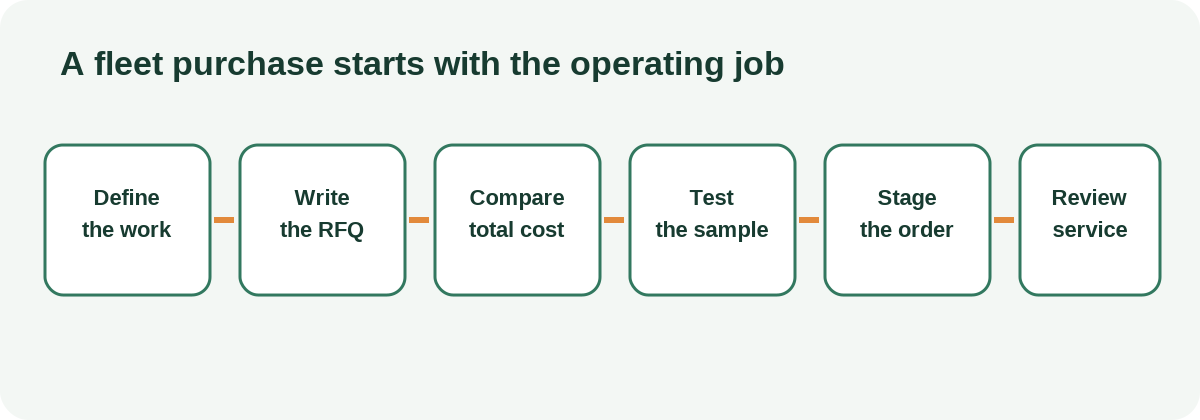
1. Write the operating brief before the RFQ
A useful request for quotation (RFQ) describes the operating environment in measurable terms. Include the typical route length, surface, gradient, weather exposure, load dimensions, payload, daily shifts, parking conditions and who will maintain the bikes. Separate must-have requirements from preferences so suppliers can quote comparable configurations.
For cargo work, specify the actual load, not just the word “delivery.” A front box, rear rack, child-carrying setup and tool-hauling configuration place different demands on the frame, tires, brakes, battery and accessories. Ask each supplier to identify the approved payload and explain how that figure applies to the complete setup.
Also define what “available” means to your business. If each location needs a bike at the start of a shift, list that service requirement. If a small number of bikes can be shared across shifts, explain how that affects the quantity. Avoid adding an arbitrary spare percentage without usage or repair data. Instead, record how many bikes are down, why they are down and how long parts take to arrive during the pilot.
For components that need to remain consistent across a model or fleet, document the exact specification and approved revision. Tyride’s bicycle components sourcing service can be a relevant route for buyers coordinating several component categories, while the bicycle saddle OEM specification guide explains how posture, shell, rails and materials shape a saddle specification. The UK Department for Transport’s national e-cargo bike grant evaluation records 197 bikes procured by 103 organisations, a reminder that the same broad category serves different operating contexts and should be specified by task. Those totals describe one funded UK scheme; they are not a fleet-size benchmark. See the evaluation.
2. Compare a complete operating package, not just bike prices
A fleet quote should make visible the items that affect uptime and replacement cost. Ask suppliers to separate the bike, battery, charger, delivery, assembly, training, warranty, service, spare parts and software or fleet-management fees. Confirm whether the quoted configuration is standard production or includes custom branding, components or tooling.
The Energy Saving Trust’s Ecofleet case shows why operating context belongs in the evaluation. Its published account says the London delivery business purchased 20 cargo e-bikes after receiving grant support. It reports 60 to 65 deliveries per day by bike compared with 12 by van for that operation, and notes that each bike carried a spare battery. These are case-specific figures from Ecofleet’s routes and setup, not a guaranteed result for another fleet. The useful procurement lesson is to test the bike, payload, battery plan and route together. Read the Ecofleet case study.
A Department for Transport evaluation offers a broader procurement signal: its grant scheme supported 103 organisations to procure 197 e-cargo bikes. The evaluation surveyed 45 organisations, so its findings describe respondents rather than every funded buyer; among respondents, 55% said they would not have bought an e-cargo bike without grant support. For a buyer, this reinforces the value of testing affordability assumptions and recording what would change the purchase decision. Read the national scheme evaluation.
Ask suppliers for a clear bill of materials and the method used to identify replacement parts. For a saddle or another fit-sensitive component, record model, dimensions, materials, rail or mounting interface, color, branding, packaging and inspection criteria. Tyride’s bicycle saddle products show examples across e-bike, road, mountain and other categories; the product page is a starting point for discussion, not a substitute for approving a fleet-specific sample.
3. Test the actual job with riders and mechanics
A demo ride on an empty bike cannot validate a loaded delivery configuration. Select a representative model and test it on typical routes with the intended payload, accessories and work schedule. Record rider feedback, range under the tested conditions, charging turnaround, braking, handling, punctures, service steps and parts that wear or loosen.
A January 2024 LinkedIn update from a delivery-bike operator described positive rider feedback about comfort and a battery-swap process. The company said it had 20 active riders and planned to scale to 100 by the end of January, then add another 100 through a second production round by the end of March. Those were the company’s stated plans in the post, not independently verified results. Still, the example highlights a useful pilot question: does the operating process, including battery handling and rider comfort, work before the next production batch is released? See the LinkedIn update.
Include mechanics in the test. Ask them to inspect common adjustment points, diagnostic access, brake and tire service, battery removal, connector access and the time needed for routine repairs. Record which tools and training are required. If two configurations are being considered, use the same routes and work tasks so the comparison is meaningful.
4. Use staged orders when operational risk is still unknown
A staged order can limit exposure while the buyer learns about rider fit, route conditions, service requirements and seasonal performance. The first release should be large enough to test the range of real jobs, but small enough that identified problems can be corrected before the next batch. Agree on the decision points for moving to the next stage: accepted samples, documentation, production slot, inspection results, delivery dates and parts availability.
Do not assume every supplier can reserve capacity or hold the same price across phases. Confirm in writing which specifications, costs, lead times and commercial terms are fixed, and which may change. For custom components, ask whether future reorders use the same tooling, material, color and packaging specification. Tyride’s bulk saddle purchasing guide covers MOQ, sample terms and the cost trade-offs that affect repeat orders. A staged field test can precede a much larger purchase: Croatia Post tested e-bikes for six months and then procured 180 for postal deliveries. That is a specific public-sector case, not a recommended order size, but it illustrates the value of linking the next release to evidence from real operations. Read the European Commission case study.
5. Build support and end-of-life terms into the purchase
Before the purchase order is signed, assign responsibility for warranty claims, diagnosis, replacement parts, shipping, training and end-of-life handling. Set a simple reporting format for downtime, repair cause and time to return to service. Use those records to update the next batch specification instead of relying on memory or anecdotal feedback.
Reddit can surface operational details that a quote will not. In a January 2024 r/bikecommuting discussion, a rider said their city’s winter bike-share pilot could remove the need to buy a separate winter bike, because the shared bikes suited snowy conditions and avoided wear on the rider’s own bicycle. That is one rider’s account, not a purchasing study, but it points to questions a fleet buyer should ask about weather, tires, maintenance and seasonality. Read the Reddit discussion.
Tyride focuses on bicycle saddles and component sourcing rather than supplying complete delivery bicycles. Buyers can review Tyride’s sourcing and OEM/ODM support when the project includes saddle development or coordinated parts procurement. For a broader specification workflow, see how B2B buyers specify and source bicycle saddles.
Commercial e-bike fleet purchase checklist
Fleet uptime means the share of planned operating time when a bike is ready for its assigned work. Set the baseline from your own pilot records; there is no single target that fits every route or operation.
Before approving a bulk order, confirm that the file contains:
- An operating brief with routes, payloads, shifts, weather and service locations.
- A comparable quote with bike, battery, charger, parts, shipping and support itemized.
- A sample and test record from riders and mechanics using representative loads.
- A defined inspection, acceptance and nonconformance process.
- A phased delivery and reorder plan, with written price and lead-time assumptions.
- Named owners for warranty, training, service, parts and end-of-life handling.
A fleet purchase is ready when the buyer can explain why each configuration fits its job and how the bikes will stay available after delivery. Fleet uptime is the share of planned operating time when a bike is ready for assigned work. Total operating cost is the purchase price plus the costs to charge, maintain, repair and replace the bikes. For a component-focused RFQ, contact Tyride with the application, quantity, specification, destination and target delivery window. Learn more on the About us page. For pilot design and phase gates, continue with the e-bike fleet pilot guide.
Research method: This guide combines a public Energy Saving Trust business case, one company-authored LinkedIn fleet update and one Reddit rider discussion. The LinkedIn page does not expose an exact publication date; its inclusion in the January 2024 window is inferred from the post’s stated end-January and midyear 2024 schedule. The Reddit comment is an individual experience. Neither social post is used as a market-wide estimate.
Editorial note: Tyride’s editorial team prepared this guide from the linked public sources. Company claims and user comments are attributed as individual accounts, not presented as independent performance studies.