
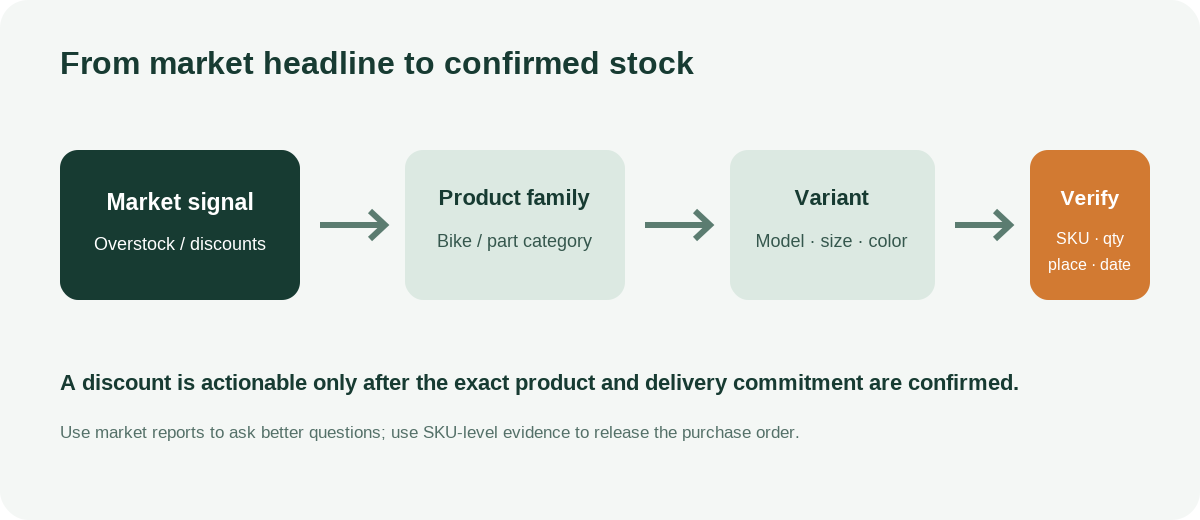
A bicycle market can have too much inventory overall and still be short of the exact model, size, color or component a buyer needs. For a distributor or bicycle brand, the useful question is not “Is the market overstocked?” It is “Can my supplier deliver the approved specification, in my quantity, to my destination, on my schedule?”
That distinction matters when a tempting discount appears. A large order can reduce the quoted unit price while increasing cash tied up in the wrong variants. The safer approach is to verify inventory at SKU level, compare the complete offer and separate confirmed demand from speculative demand.
Key Takeaways
- Industry-wide inventory trends do not prove that a particular SKU is available.
- Reddit discussions from July 2024 show buyers debating both discount-heavy inventory and local stockouts; these are anecdotes, not market statistics.
- Request written confirmation of model, revision, quantity, location and ship date before treating a discount as a buy signal.
- Keep uncertain variants in a trial or replenishment plan instead of letting a volume tier determine the order mix.
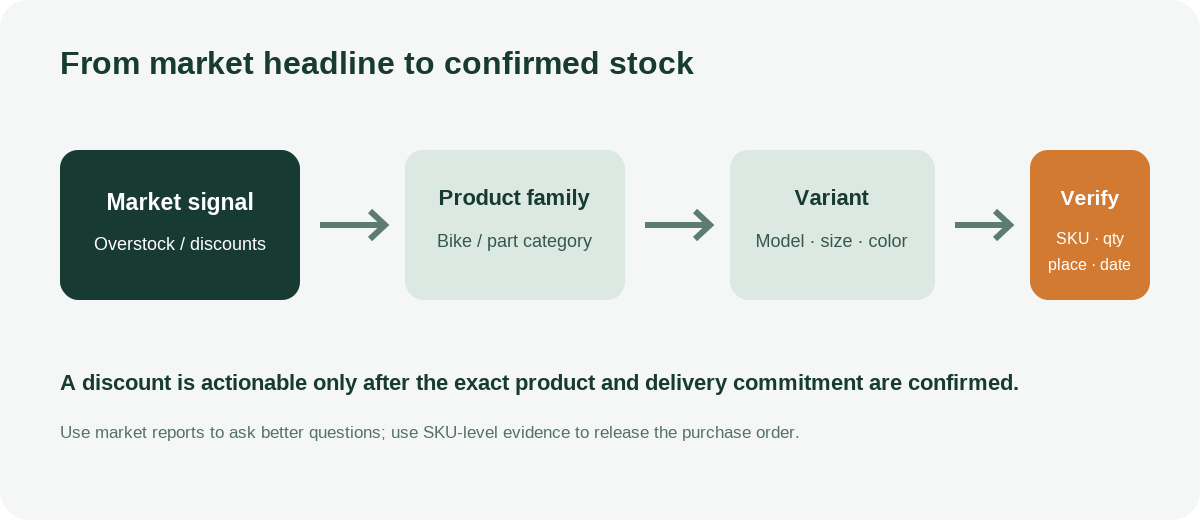
SKU means a stock-keeping unit: one uniquely identified product variant used for purchasing and inventory tracking. A model with three sizes and two colors can represent six separate SKUs if each variant is stocked independently.
Inventory-to-sales ratio means the value of stock relative to sales over a stated period. It describes an aggregate relationship, not the exact variants, condition or location available to an individual buyer.
Why overstock and shortage can exist at the same time
Inventory is not one interchangeable pool. It is distributed across manufacturers, wholesalers, retailers and locations. It is also divided by product family, model year, size, color, specification and sales channel. Excess stock in one category cannot automatically fulfill demand in another.
The U.S. Census Bureau defines an inventories-to-sales ratio as a relationship between end-of-month inventory value and monthly sales; the measure is useful for a broad retail view, but it does not identify product variants or stock at a particular supplier (Census Bureau definitions). A ratio can help describe a retail category, but it cannot answer an individual SKU availability question.
A July 3, 2024 Reddit thread in r/MTB drew discussion around a prediction that unsold pandemic-era bikes would lead to continued discounts. Replies complicated that forecast: commenters described certain models and sizes as already sold out, and disagreed about whether the best deals were still ahead (Reddit discussion). The thread is useful as a record of buyer sentiment, not as audited evidence of manufacturer inventory.
A week later, a separate r/bicycling post described difficulty finding selected road bikes in local shops and on brand websites. The discussion included different accounts of store and regional availability (Reddit discussion). Taken together, the posts illustrate why aggregate market commentary is a weak substitute for a line-by-line stock check.
Independent reporting from the same period provides broader context. In May 2024, the Associated Press reported that bike manufacturers were discounting excess stock after pandemic demand slowed, while also describing how the earlier shortage had affected shops (Associated Press report). That reporting supports the existence of an industry inventory correction; it does not establish availability for any individual SKU or supplier.
For B2B buyers, “overstock” and “available” should be treated as separate claims. Ask which precise items are being discounted, where the units are physically located, whether the stock is current production or a prior revision, and whether the supplier can reserve the offered quantity.
Verify the item before comparing price
A fair comparison starts with a controlled specification. For each line, record the supplier SKU and manufacturer part number, product revision, color or size, material, packaging, unit of measure and any required compliance or fitment data. If the item is a saddle, define the intended application and the physical features that affect fit. If it is a branded component, clarify whether the offer is authorized retail stock, OEM stock or a third-party alternative.
Then ask each supplier to quote the same specification and quantity bands. Separate available-to-ship stock from future production. Request the quote expiry date, stock location, dispatch window and the process for approving substitutions. If a supplier can only offer a similar product, treat that as a separate line for engineering and commercial review, not as an automatic replacement.
Tyride’s bicycle component sourcing service describes its wholesale, sampling and sourcing support. Confirm the exact terms for your specific product and order in writing. For a broader qualification process, use the supplier checks for low-cost bicycle parts as a checklist for identity, compatibility, samples and delivered cost.
Landed cost means the buyer’s product acquisition cost after quoted freight and other agreed delivery charges are included. State which charges are excluded; taxes, inspection, storage and warranty exposure may need separate calculation. For U.S.-bound bicycles, the Consumer Product Safety Commission lists requirements in 16 CFR Part 1512 (CPSC bicycle guidance); buyers should confirm product-specific applicability rather than assume every component has the same compliance scope.
A discount is only valuable when the stock can sell
A volume discount should be compared with the cost of owning the extra units. The relevant questions include expected sell-through, storage, working capital, markdown exposure, currency and freight costs, and the cost of replenishing a faster-moving variant later.
For example, suppose a supplier offers a lower unit price if the buyer adds stock of a slow-moving color. The discount is not automatically a saving: compare the amount saved on units already planned with the cost of holding, storing or marking down the additional units. This is a decision example, not a supplier quote or typical discount.
Use a simple scenario table before accepting a price break:
| Question | What to confirm |
|---|---|
| What is discounted? | Exact SKU, revision, color and size |
| Is the inventory real and reserved? | Quantity, warehouse location and reservation period |
| What is the delivered cost? | Product price, packaging, freight, duties and other quoted charges |
| What happens if it is wrong? | Inspection window, shortage process, defect remedy and return allocation |
| Can the mix change? | Variant-level MOQ, split shipment and substitution approval |
A low unit price does not justify buying a slow-moving variant unless the business case still works after landed cost and realistic sell-through are considered. Tyride’s bulk saddle guide to MOQ, samples and true cost explains why quantity mix, sample charges and acceptance terms belong in the same comparison.
The Associated Press reported that post-pandemic excess inventory led bicycle makers to discount products, while documenting different outcomes for individual shops (AP report). A later review in BIKE described warehouses that remained full alongside shortages in selected popular models (BIKE market review). These sources describe market context, not the stock of a particular component supplier.
The BIKE review reported that a July 2024 dealer survey found 75% of respondents described unusually full warehouses; the report does not provide the survey sample size in the article (BIKE market review). The Associated Press also cited Circana’s report that U.S. bicycle sales grew 64% to $5.4 billion in 2020 (AP report). These figures describe different periods and measures, and neither identifies current availability for a specific SKU.
For another market-specific view, Forbes reported that U.K. bicycle sales reached 1.45 million units in 2024, down 2% year over year, based on data from the Bicycle Association (Forbes report). These national complete-bike sales figures are context, not a component demand forecast.
Separate market signals from your own demand
Use market reports and forum conversations to form questions, not to create a forecast by themselves. For each SKU, look at your own orders, quotes lost due to availability, customer inquiries, seasonality and confirmed commitments. Mark the confidence level of each input so a forecast does not hide guesswork behind a single total.
One practical method is to divide a purchase plan into three groups:
- Repeat demand: items supported by recent sales or recurring customer programs.
- Limited trial: new variants for which a small sample or pilot is justified, but full-volume demand is unproven.
- Special order: products to buy only after a buyer or customer confirms the specific requirement.
This approach lets the buyer use a favorable price where demand evidence is strong without forcing the whole purchase into the same risk category. Tyride’s first stock order planning guide shows how to classify stock lines and keep a replenishment allowance.
Use a written release checklist
Before releasing the purchase order, confirm that the quote, approved sample and purchase order describe the same goods. Verify quantities by variant, tolerances or fitment where relevant, production or stock status, delivery date, shipping term, payment milestones and remedies. Document who can authorize a change and how the buyer will inspect the shipment.
The goal is not to predict the whole bicycle market. It is to make each commitment traceable: what was ordered, what evidence supported the quantity, what the supplier promised and what happens if delivery differs. That discipline is especially useful when market headlines point in opposite directions.
Use this release sequence for each order:
- Freeze the approved product specification and variant matrix.
- Obtain a dated stock or production commitment for each line.
- Compare price, freight scope, MOQ and defect remedies on the same basis.
- Approve any substitutions in writing before production or dispatch.
- Reconcile received quantities and inspection results against the PO.
Keep the quote, sample approval, purchase order and inspection record together. If the shipment contains a different revision or variant, the record makes it easier to identify the discrepancy and resolve it without confusing it with normal inventory movement.
Frequently Asked Questions
Does a bicycle industry glut mean buyers should place larger orders?
No. A broad oversupply signal does not establish demand for a specific variant. Check your sales and commitments, verify the exact inventory offered and compare the full cost of holding additional units.
Can a Reddit discussion prove that a supplier has stock?
No. A Reddit post is a buyer or community account. It can reveal questions worth asking, but it does not verify a supplier’s inventory, production capacity or delivery promise.
What should a buyer request before accepting a discounted offer?
Ask for the exact product identity and revision, quantity by variant, stock location, reservation period, quote validity, delivery schedule, shipping terms and written substitution and defect procedures.
Make the order match the evidence
Market conditions can create opportunities, but a purchase is only attractive when the units match the product plan and the supplier can document the offer. Start from SKU-level demand, verify availability and compare total delivered cost. Then use discounts as one input in the decision, not as the reason to buy.
For a sourcing discussion, send Tyride the product specification, target quantities and destination through its component sourcing service.