
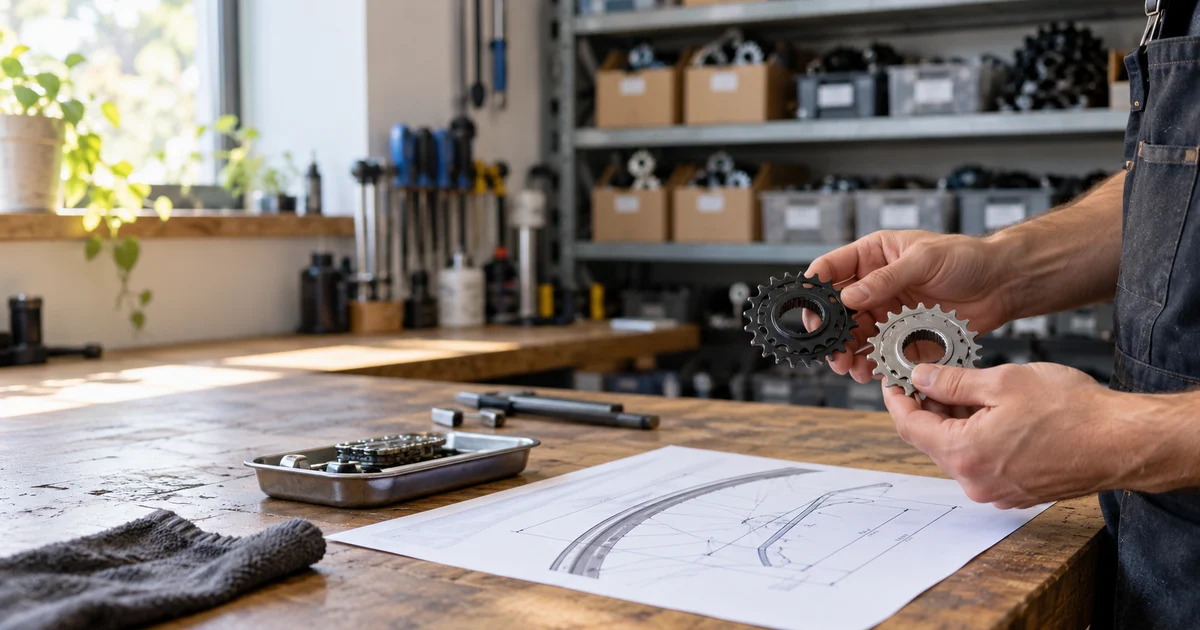
Illustrative image created for this article. It does not depict a specific Reddit repair or a verified Tyride facility.
A replacement part can be technically identifiable and still be unavailable when a rider needs it. For a bicycle brand, distributor, or repair shop, that is a procurement problem as well as a service problem. The response is to define the exact part, identify acceptable supply routes, and decide which parts merit planned stock before a failure occurs.
Key takeaways
- Record an exact manufacturer part number and interface before seeking an alternative.
- Separate fast-moving service items from rare parts that cause long vehicle downtime.
- Approve substitutes through compatibility evidence and a physical fit check, not a similar product photograph.
- Keep lead time, order minimum, revision, and end-of-life status in the same service-parts record.
Two Reddit cases show different shortage problems
In a July 2026 r/BikeMechanics discussion, a shop sought two 20-inch, 48-hole BMX rims. The poster said its usual distributors lacked a suitable option and that another rim had been delayed at BTI. The shop had bought at retail to complete the job. This is one shop’s account, not evidence of a market-wide BMX rim shortage. It does show a practical failure mode: a low-volume specification can fall outside the stock held by a shop’s ordinary distributors.
A different July 2026 r/CargoBike post described a cracked Gates CDC rear sprocket on a Tern GSD. The owner’s local shop expected a backorder until mid-August. A commenter located a listing elsewhere, and the owner said their mechanic confirmed the part before ordering it. Again, one story cannot establish general availability. It illustrates why a current distributor feed and an approved alternate purchase route matter when a bicycle is out of service.
The buyer’s lesson is narrower than “stock everything.” A 48-hole rim and a hub-specific belt sprocket have different demand patterns. Both need unambiguous specifications and a documented recovery route.
Service SKU is the exact replacement item a repair team can identify, order, and install on a defined bicycle configuration. Approved substitute is an alternative that has passed the buyer’s compatibility and fit checks for that configuration. Reorder point is the stock level that triggers a new purchase under the buyer’s own demand and lead-time assumptions. These definitions keep a service discussion tied to decisions that can be recorded and checked.
Define the part before comparing sellers
For each service SKU, build a record that a mechanic can use without reconstructing the original purchase order. Start with the bicycle model and year, the component maker, the exact part number, and any revision or serial-number condition. Add drawings, dimensions, finish, installation notes, and an image of the markings on the installed part.
The Gates example shows why product-family language is insufficient. Gates’ published product guide lists different enviolo-fit sprocket tooth counts and CDX or CDC product lines. A listing headed “enviolo sprocket” does not by itself confirm the exact system, tooth count, and mounting arrangement. Confirm the bicycle’s configuration against the component maker’s current documentation before purchase; the cited guide is a reference, not a live stock list.
The same discipline applies to rims. “20-inch BMX rim” leaves out hole count, bead-seat diameter, intended tire, width, brake interface, and the loads expected on the wheel. ISO’s bicycle tire designation standard and rim standard illustrate why controlled dimensions matter more than an informal inch label. The exact approved configuration still comes from the component makers and the target bicycle.
Tyride’s existing bicycle parts compatibility checklist provides a broader interface review. Keep this service record focused on the specific installed assembly and replacement route.
Classify inventory by downtime and replaceability
An inexpensive part is not automatically a good stocking candidate. A buyer should judge how often the part is needed, how long replenishment takes, whether another approved SKU exists, and how much downtime its absence causes. Do not assign a universal reorder quantity from a Reddit story; use your own service history.
| Service-parts class | Typical signal | Procurement response |
|---|---|---|
| Routine consumable | Repeat use across many bikes | Set a reorder point from observed demand and supplier lead time. |
| Low-volume critical part | Few failures, but a bike cannot return to service | Hold a small service reserve if the cost of downtime justifies it. |
| Interchangeable component | An alternate has been technically approved | Store both part numbers and the conditions under which either may be used. |
| Proprietary or aging part | Limited suppliers or uncertain continuation | Ask for end-of-life notice, a last-time-buy plan, and a repair route. |
This is a decision framework, not a demand forecast. For example, a shop may stock common brake pads but order a rare 48-hole rim only after confirming the build. A brand supporting a cargo-bike fleet may make a different decision for a specific sprocket if a failed unit removes a revenue-generating bicycle from service.
Set a substitution gate before a shortage
When a required part is unavailable, a tempting response is to order the closest-looking item. That can turn a supply delay into a compatibility or safety issue. The substitute should pass four checks before approval:
- Document identity. Obtain the maker’s part number, drawing, revision, and written compatibility statement for the target assembly.
- Compare the complete interface. Check dimensions, material, mounting, adjacent components, and any maker-specified conditions.
- Fit and test a sample. Have a qualified mechanic install the candidate on the actual assembly and record the outcome.
- Control the change. Identify which bike models and serial-number ranges may use the substitute, and separate old and new stock.
For headset parts, Tyride’s replacement bearing guide shows how identical headline dimensions can hide different contact angles and surrounding interfaces. The same reasoning applies to other service parts, even though the tests differ.
Write supply continuity into the purchase agreement
For a new bicycle program, service support should be discussed before the first production order. Ask the supplier to identify critical replacement SKUs, expected availability periods, minimum order quantities for service replenishment, and notification rules for design or material changes. Request current drawings and part-number cross-references that can be shared with authorized repair partners.
An effective agreement can also define who pays for a small urgent order, whether service stock may be held separately from production stock, and how a discontinued part will be handled. These are negotiable commercial terms, not promises every supplier will accept. Compare them alongside unit price and lead time. Tyride’s supplier-check guide for low-cost bicycle parts provides the complementary qualification questions.
Finally, make the shop’s process visible to customers. If an order is waiting for the next distributor shipment or needs an urgent freight charge, explain the options and expected dates. The point of the service-parts plan is to replace guesswork with a documented decision that the buyer, mechanic, and rider can understand.
A service-parts request you can send today
Send your supplier one line per part with: bicycle model and year; original component and exact part number; drawing or photographs; required quantity; current stock; lead time; approved alternatives; application and serial-number conditions; and the requested delivery date. Ask the supplier to state any deviation from the original specification in writing.
If your team needs help coordinating multiple component categories, Tyride’s component sourcing service describes its role in comparing requirements and organizing purchasing information. Send the exact service-parts list through the contact page so the next discussion begins with the parts that must fit and the dates that matter.
Editorial note: Reddit cases are examples of individual experiences. They do not measure industry-wide shortage rates. Technical approval must rely on the applicable component maker’s current instructions and the target assembly.