
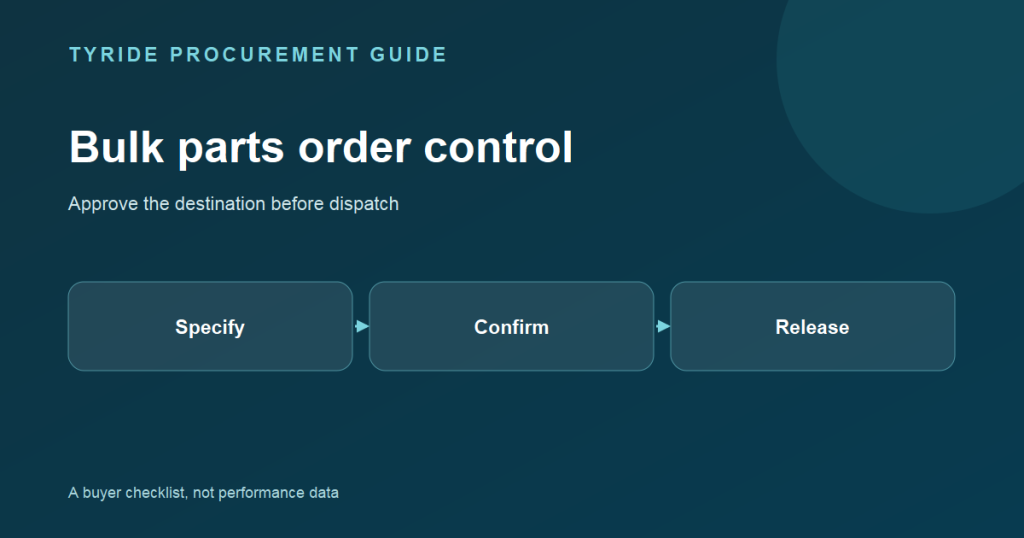
A bulk bicycle parts order can be technically correct and still fail at delivery. A stale account address, unclear ship-to contact or unconfirmed change can send finished goods to the wrong place. For bicycle shops, distributors and OEM buyers, the remedy is a short set of approval gates between quote, purchase order and dispatch. This guide turns those gates into a reusable process for saddles and other components.
Key takeaways
- Treat the bill-to address, ship-to address and contract delivery point as separate fields.
- Approve the order acknowledgement and shipping label data before dispatch, especially after a move.
- Record who can stop, redirect or accept a shipment and how a change is confirmed.
The Reddit order that exposed an address-control gap
In an April 22, 2026 r/BikeShop post, a shop employee said the business had moved and submitted the documents required to update its QBP account. The owner then placed an order worth more than $1,000, assuming the address was current. According to the post, the order went to the old location. Replies offered different experiences with account changes and suggested contacting support or a representative.
This is one unverified shop account, not evidence of a general QBP failure rate. Its purchasing lesson is broader: an account-change request is not the same as a confirmed ship-to change on a particular order. The buyer should verify the destination on the acknowledgement that will drive fulfilment.
For example, a shop could update its account address on Monday while an open purchase order still displays Friday’s old destination. The order should stay on hold until the supplier confirms the new address on that specific order. This example illustrates the control; it is not a second reported incident.
Another April 2026 mechanic discussion compared distributors on routine delivery speed even while praising one distributor’s warranty support. Together, the two threads show why a buyer needs separate checks for normal replenishment, claim handling and exceptions. Neither thread measures an industry-wide delivery rate.
Distinguish four locations on every order
“Delivery address” can refer to different records. Mixing them creates avoidable ambiguity in a bicycle component purchase order.
Ship-to address is the operational destination printed on the supplier’s order and carrier paperwork. Bill-to address is where the invoice goes. Contract delivery point is the named place used with the agreed trade term to allocate delivery duties and risk. One company may use different locations for all three.
| Field | What it answers | Buyer check |
|---|---|---|
| Bill-to | Who receives the invoice? | Legal entity and tax details match the buyer |
| Ship-to | Where should the carrier take the goods? | Full street address, dock, recipient and phone are current |
| Contract delivery point | Where do the agreed delivery obligations apply? | Named place and trade term are complete |
| Return or claim location | Where do defective goods go? | Address and authorization process are confirmed |
For cross-border purchases, the trade term matters as well. The International Chamber of Commerce explains that Incoterms rules allocate delivery tasks, costs and risks. The named place should be precise; it does not replace the operational ship-to contact, dock instructions or carrier label. A buyer should check both the contract term and the address data used for dispatch.
Build a dispatch gate for bulk parts
Use a simple release sequence before the supplier prints labels or hands goods to a carrier. It is especially valuable after a store move, warehouse switch, seasonal pop-up or change in importer.
- Freeze the approved SKU list. Record part numbers, revisions, quantities, packaging and any permitted substitutions. For mixed orders, separate saddles, service parts and accessories by line item.
- Confirm the buyer and destination. Put the bill-to and ship-to details in separate fields. Include the receiving contact, phone, delivery hours and any gate or dock reference.
- Check the order acknowledgement. Match every destination field and line item against the purchase order. A supplier portal profile is not enough if the actual order acknowledgement is wrong.
- Confirm the delivery term. For international orders, record the selected Incoterms rule and named place, plus which party books freight and handles import steps under the agreed contract.
- Approve a pre-dispatch summary. Ask for carton count, gross weight, tracking or booking reference, and the exact consignee data that will appear on documents and labels.
- Release only after a named person signs off. Keep the approval and any later change in the order record.
The first step also protects against product errors. Tyride’s bicycle parts compatibility procurement checklist explains why a revision-controlled parts list and an approved assembly matter before volume ordering. The saddle OEM specification guide provides a more detailed baseline when the order includes custom saddles.
Make address changes an order-level event
When a shop or warehouse moves, update the account profile, but also send a written change notice that lists every open purchase order. Ask the supplier to reply with the new ship-to information for each order and its dispatch status. If a shipment is already booked, identify the party authorized to request a carrier change.
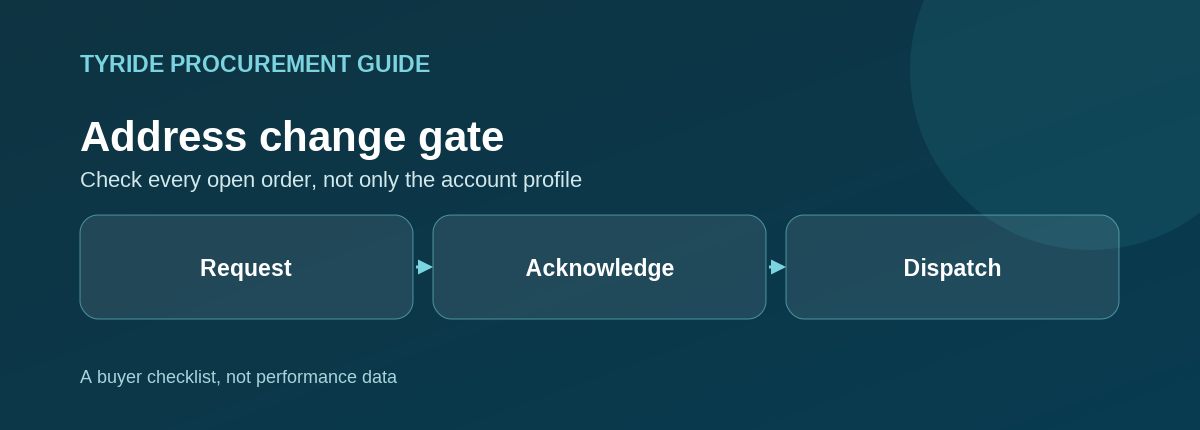
For parcels moving through UPS in the United States, UPS Delivery Intercept says eligible shipments may be redirected before delivery, and fees may apply. Eligibility and available options depend on the shipment. A buyer should therefore contact the shipper promptly rather than assume a carrier can always fix the address after dispatch. Other carriers and freight modes have different processes; check the actual service booked.
A short change notice
Please hold dispatch for PO [number]. Our approved ship-to address is [full address], receiving contact [name and phone], effective [date]. Please confirm the address shown on this order’s acknowledgement and shipping documents, and advise whether any cartons have already been handed to the carrier. Do not release the order until [named approver] confirms the revised details.
The notice is useful because it requests an order-specific acknowledgement. It also makes the stop point clear to both buyer and supplier.
Plan for an exception before it happens
If an order has already moved, the buyer needs an exception record: PO number, carrier, tracking number, old and new addresses, shipment stage, requested action, decision owner, extra cost and final proof of delivery. The possible remedies may include intercept, hold for pickup, return to sender or reshipment. Choose among them using the carrier’s actual options and the contract, rather than assuming one method always works.
Keep product acceptance separate from delivery correction. A carton reaching the correct warehouse still needs the normal count and incoming checks. Tyride’s low-cost bicycle parts supplier checks cover the approved specification, inspection evidence and remedy for nonconforming goods. The shipping exception record should connect to, not replace, that product record.
Copy this purchase-order checklist
| Control | Evidence to retain | Approval owner |
|---|---|---|
| Approved parts and quantities | Signed PO and revision-controlled specification | Product or purchasing lead |
| Correct bill-to entity | Supplier acknowledgement | Accounts payable |
| Correct ship-to and receiver | Order acknowledgement and pre-dispatch summary | Receiving lead |
| Agreed delivery term | Contract or PO with named place | Purchasing or logistics lead |
| Carton and shipment details | Packing list and tracking or booking reference | Logistics lead |
| Change or hold request | Written supplier confirmation | Named order approver |
| Arrival and condition | Receiving count and inspection record | Warehouse or quality lead |
This checklist is a proposed control, not evidence that any one supplier uses it. Adapt the sign-off roles to the size of the business. A small shop may have one person approve several fields, while a distributor may separate purchasing, logistics and receiving.
Frequently asked questions
Is updating a supplier account enough after a move?
No. Confirm the ship-to address on each open order and on the pre-dispatch documents. The shop account discussed above illustrates the risk of assuming an account update has reached a specific order.
Can a carrier always change the address once parts have shipped?
No. The UPS policy cited above limits intercept options to eligible shipments before delivery and notes that fees may apply. Ask the shipper and the booked carrier immediately; do not promise a redirect until it is accepted.
Does an Incoterms rule specify the warehouse door?
The selected rule allocates tasks, costs and risks, and the named place needs to be precise. The ICC guidance cited above does not substitute for a complete operational ship-to address and receiving instructions on the order.
Next step for buyers
Before your next volume purchase, ask the supplier to return an order acknowledgement showing the exact ship-to fields and approved SKU list. If your project includes OEM saddles and complementary components, Tyride describes its manufacturing and sourcing scope on its About page. Send the completed specification and destination details through Tyride’s contact page so its response can be checked against the same purchase-order controls.
Editorial method: The opening case is one dated Reddit account. Operational recommendations are a proposed purchasing workflow; carrier redirect details and trade-term descriptions are linked to UPS and ICC primary sources. No industry-wide error rate is inferred from the Reddit post.