How Posedla Scaled Custom 3D Printed Bike Saddles Through Mass Customization
The Problem Nobody in the Bicycle Industry Truly Solved
For decades, the bicycle industry kept trying to solve saddle discomfort in the same way: offer more choices.
More widths.
More shapes.
More padding options.
More product lines.
Yet cyclists continued to spend years searching for a saddle that felt right.
The contradiction was obvious.
Every rider is unique. Almost every saddle is standardized.
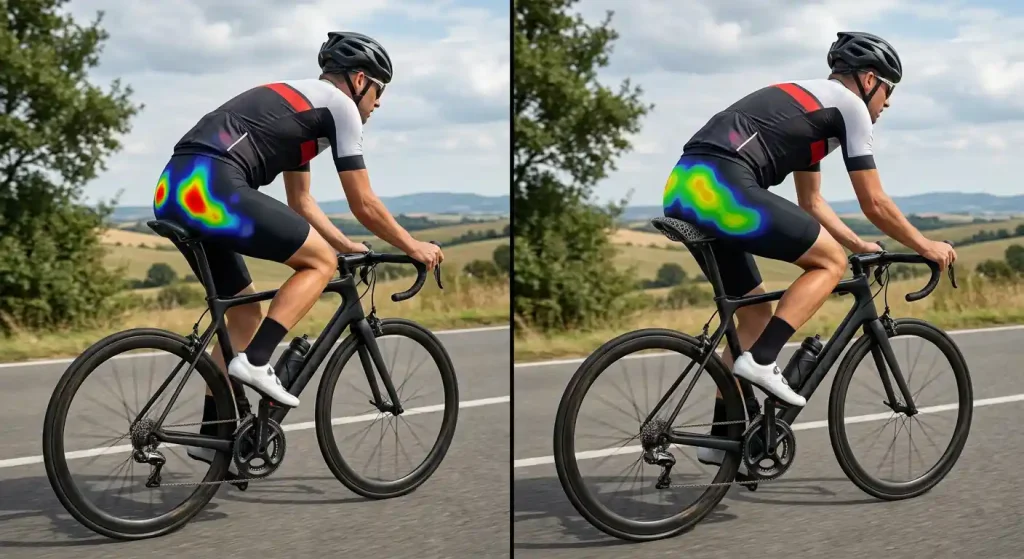
A rider’s comfort depends on a complex combination of anatomy, flexibility, riding posture, bike fit, body weight, riding discipline, and time spent in the saddle. Even among cyclists of similar size, pressure distribution can be dramatically different.
Manufacturers responded by expanding product catalogs. Riders responded by buying multiple saddles.
Neither approach truly solved the underlying problem.
The question was never whether cyclists needed more saddle options.
The question was whether a saddle could be designed specifically for the individual rider without making manufacturing economically impossible.
That question became the foundation of Posedla.
Founded in the Czech Republic by passionate cyclists Martin Ripa and Jiri Duzar, the company set out to build something the industry had discussed for years but rarely delivered: a genuinely personalized bicycle saddle that could be manufactured at scale.
Why Traditional Saddle Customization Never Reached the Mass Market
Before examining Posedla’s solution, it is important to understand why genuine saddle customization remained rare despite decades of innovation.
The obstacle was not creativity.
The obstacle was economics.
Traditional saddle manufacturing depends on standardization.
A typical workflow looks like this:
- Product design
- Tooling development
- Mold production
- High-volume manufacturing
- Global distribution
The model works because every saddle coming out of production is nearly identical.
Customization breaks that logic.
When every rider needs a different saddle, manufacturers face several challenges:
- Individual design requirements
- Increased engineering workload
- Production complexity
- Inventory inefficiencies
- Longer lead times
- Higher costs
Historically, the industry tried to approximate customization through segmentation.
Road riders received one range.
Gravel riders received another.
Men and women often received separate models.
Some brands added multiple widths.
Others experimented with pressure-relief channels.
While these approaches improved fit for certain riders, they remained fundamentally category-based solutions.
A rider was still selecting from predefined products rather than receiving a product designed specifically for them.
The Real Breakthrough Was Not 3D Printing
Many articles about custom saddles focus almost entirely on additive manufacturing.
That interpretation misses the most important part of the story.
The true innovation behind Joyseat was not the printer.
It was the system.
The challenge facing the industry was never simply how to manufacture unique saddles.
The challenge was how to gather rider-specific information, convert that information into engineering data, and then manufacture individualized products repeatedly and efficiently.
Without a scalable method of collecting rider data, customization remains a boutique service.
Without a scalable manufacturing process, customization remains prohibitively expensive.
Posedla’s achievement was creating a complete digital workflow connecting riders directly to production.
How Posedla Turned Rider Anatomy Into Manufacturing Data
The Joyseat process starts long before manufacturing begins.
Each rider provides information through a questionnaire covering factors such as:
- Bike type
- Riding duration
- Riding distance
- Riding position
- Physical flexibility
- Age
- Gender
- Weight
This information is combined with data collected through the company’s “Smiling Butt Kit.”
The kit captures an impression that helps identify sit-bone characteristics and pressure distribution patterns.
Once the data is collected, a proprietary algorithm generates the saddle design.
Instead of selecting a product from a catalog, the rider effectively becomes the starting point of the engineering process.
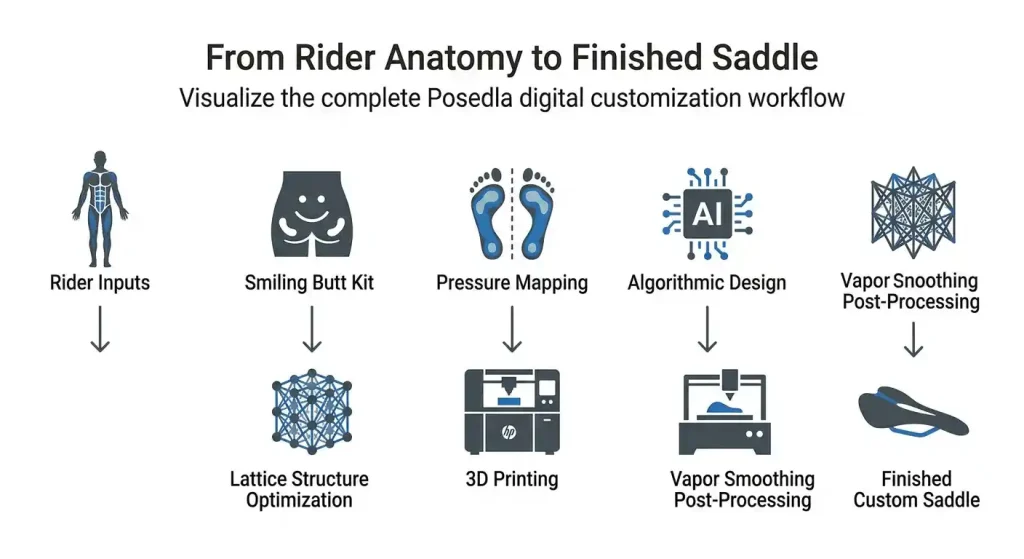
The manufacturing workflow can be simplified into a digital chain:
Rider Inputs → Smiling Butt Kit → Pressure Mapping → Algorithmic Design → Lattice Optimization → 3D Printing → Post-Processing → Final Saddle
This workflow transformed customization from a manual engineering task into a repeatable production system.
That distinction is what separates Joyseat from many previous attempts at personalized cycling products.
Why Additive Manufacturing Finally Changed the Economics
Once rider-specific data could be generated digitally, manufacturing became the next challenge.
Traditional production methods excel when producing thousands of identical components.
They become significantly less efficient when every part is different.
This is where additive manufacturing becomes strategically important.
Posedla partnered with BASF Forward AM and utilized Ultrasint® TPU01 to manufacture lattice-based saddle structures that would be difficult or impossible to produce using conventional methods.
The lattice architecture enables localized tuning throughout the saddle.
Different regions can be engineered for:
- Support
- Flexibility
- Pressure distribution
- Load management
Unlike traditional foam-based solutions, lattice structures can be digitally modified without requiring entirely new tooling.
This dramatically changes the economics of personalization.
The manufacturing platform remains largely the same.
The design changes for every rider.
That is the foundation of scalable mass customization.
The Business Breakthrough: From Ten Weeks to Three or Four
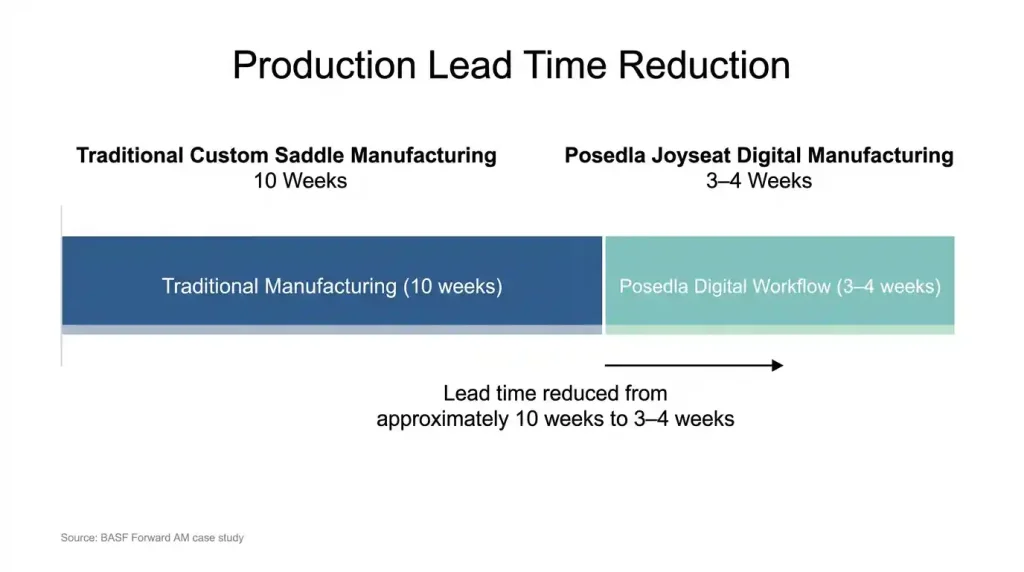
One of the most significant outcomes reported in the original BASF case study was lead-time reduction.
According to the published results, Posedla reduced production times from approximately ten weeks to between three and four weeks while operating at manufacturing capacity.
This achievement is often overlooked because discussions tend to focus on comfort and customization.
From a business perspective, however, lead time is one of the most important metrics in manufacturing.
Shorter lead times can improve:
- Customer satisfaction
- Production planning
- Capacity utilization
- Cash-flow efficiency
- Inventory management
Reducing delivery time by more than half represents a meaningful operational improvement rather than merely a product enhancement.
Joyseat 3.0: How the Business Has Evolved
One weakness of many discussions about Posedla is that they focus exclusively on the original launch.
The company has since evolved its product lineup.
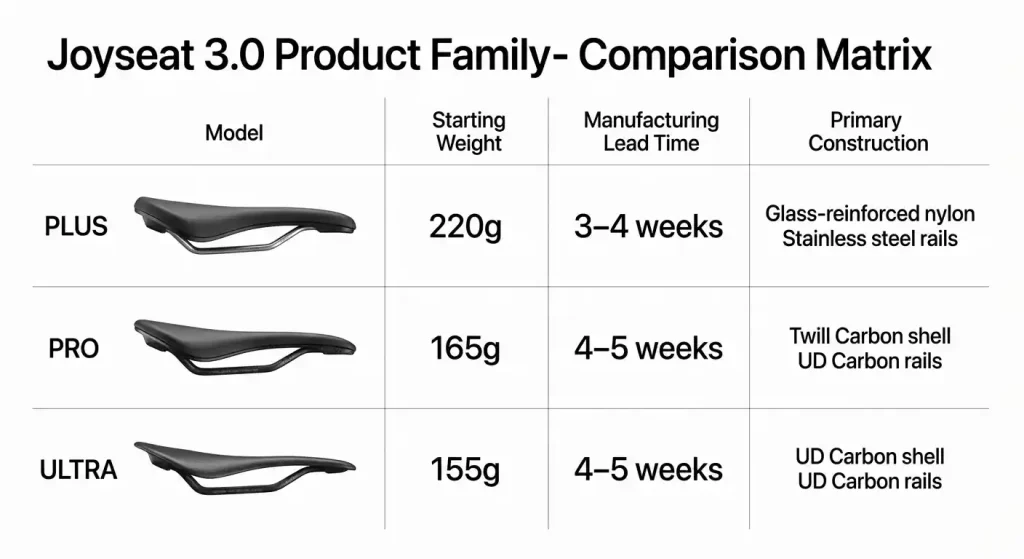
Today, Joyseat 3.0 is offered in three distinct versions: Plus, Pro, and Ultra.
| Model | Starting Weight | Key Materials | Lead Time |
|---|---|---|---|
| Joyseat Plus | From 220g | Nylon shell + stainless steel rails | 3–4 weeks |
| Joyseat Pro | From 165g | Twill carbon shell + UD carbon rails | 4–5 weeks |
| Joyseat Ultra | From 155g | UD carbon shell + UD carbon rails | 4–5 weeks |
These models maintain the same core customization process while targeting different rider priorities, from endurance-focused cyclists to competitive performance riders.
The evolution is significant because it demonstrates that Posedla is no longer testing a concept.
It is building a product family around a scalable manufacturing platform.
A Useful Industry Distinction: 3D Printing vs. Personalization
The cycling industry increasingly markets products as “3D printed.”
However, not all 3D-printed saddles are equally customized.
This distinction is important for both consumers and manufacturers.
| Approach | Manufacturing Method | Personalization Level |
|---|---|---|
| Traditional Saddle | Conventional Manufacturing | Low |
| Multi-Width Saddle Systems | Conventional Manufacturing | Medium |
| Standard 3D-Printed Saddles | Additive Manufacturing | Medium |
| Joyseat | Rider Data + Algorithm + Additive Manufacturing | High |
This framework highlights an important reality:
3D printing alone does not create personalization.
The real value emerges when rider-specific data drives product design.
Without that data layer, additive manufacturing becomes merely another production method.
Material Selection Was Critical to Commercial Viability
Customization only matters if the final product performs reliably.
According to BASF’s published case study, Ultrasint® TPU01 was selected because it combines several characteristics important for saddle applications:
- Strength
- Flexibility
- Durability
- Surface quality
- Weather resistance
- UV resistance
The material also supports scalable production and demonstrates strong compatibility with post-processing technologies.
For a consumer product expected to withstand years of outdoor use, these characteristics are not optional.
They are prerequisites.
Why Post-Processing Became Part of the Competitive Advantage
One often overlooked aspect of additive manufacturing is that the printed component is usually not the final product.
For Joyseat, AMT’s PostPro Vapor Smoothing technology played a crucial role.
The process helps:
- Seal porous surfaces
- Improve surface finish
- Enhance structural properties
- Produce a more refined appearance
The practical impact extended beyond aesthetics.
Following post-processing, the material successfully passed skin-contact testing, irritation testing, mechanical damage testing, and fatigue testing while meeting ISO bicycle saddle requirements according to the published case study.
For riders, those certifications may seem invisible.
For manufacturers, they are essential.
What Independent Reviewers Have Found
One criticism frequently directed at manufacturer case studies is that they rely heavily on internal success stories.
Independent reviews help provide additional context.
In a detailed review of the Joyseat 3.0, Cyclingnews described the fitting process as simple and potentially capable of reducing the trial-and-error saddle purchasing cycle many cyclists experience. The reviewer ultimately concluded that the saddle delivered comfort comparable to their preferred premium saddle, while noting that customization does not automatically guarantee superiority over every existing option.
That observation is important.
The strongest argument for customization is not necessarily that every rider will receive a better saddle.
It is that riders struggling to find a comfortable saddle may have a more systematic path toward finding one.
Where Custom Saddles Still Face Real Challenges
A credible business case should acknowledge limitations as well as advantages.
1. Higher Purchase Prices
Custom products inevitably introduce additional complexity.
Current Joyseat models range from approximately €399 to €599 depending on specification.
That places them firmly within the premium segment of the saddle market.
For many recreational cyclists, the value proposition must justify a significant price premium.
2. Longer Buying Process
Buying a standard saddle can take minutes.
Buying a custom saddle requires:
- Rider assessment
- Smiling Butt Kit measurement
- Data submission
- Algorithmic design
- Individual production
Even with improved manufacturing efficiency, customization remains inherently more involved than off-the-shelf purchasing.
3. Human Bodies Change
This may be the most overlooked challenge.
Cyclists change over time.
Fitness improves.
Flexibility changes.
Bike fits evolve.
Training volume increases or decreases.
A saddle optimized for today’s riding profile may not perfectly match future conditions.
Customization reduces uncertainty.
It does not eliminate it.
The Bigger Lesson for Manufacturers
The broader significance of the Posedla story extends beyond bicycle saddles.
For decades, manufacturers faced a difficult trade-off:
Mass production or personalization.
The economics generally forced companies to choose one.
Posedla demonstrates a third possibility.
By combining:
- Rider-specific data collection
- Algorithm-driven design
- Digital workflows
- Industrial additive manufacturing
- Standardized post-processing
the company created a system capable of producing individualized products at scale.
That concept has implications far beyond cycling.
The same manufacturing logic could eventually influence footwear, protective equipment, medical devices, ergonomic products, and other industries where human anatomy plays a critical role.
Conclusion: The Real Achievement Was Not the Saddle
It would be easy to describe Joyseat as a successful 3D-printed bicycle saddle.
That description is accurate.
It is also incomplete.
The real achievement was creating a manufacturing system that connects individual rider anatomy directly to production.
The breakthrough was not merely the lattice structure.
It was not the printer.
It was not even the material.
The breakthrough was building a repeatable process that transforms personalization from a handcrafted service into an industrial workflow.
Whether custom saddles ultimately become mainstream remains uncertain.
What is already clear is that Posedla has demonstrated something many manufacturers have pursued for years:
Personalization and scalability no longer have to be mutually exclusive.