
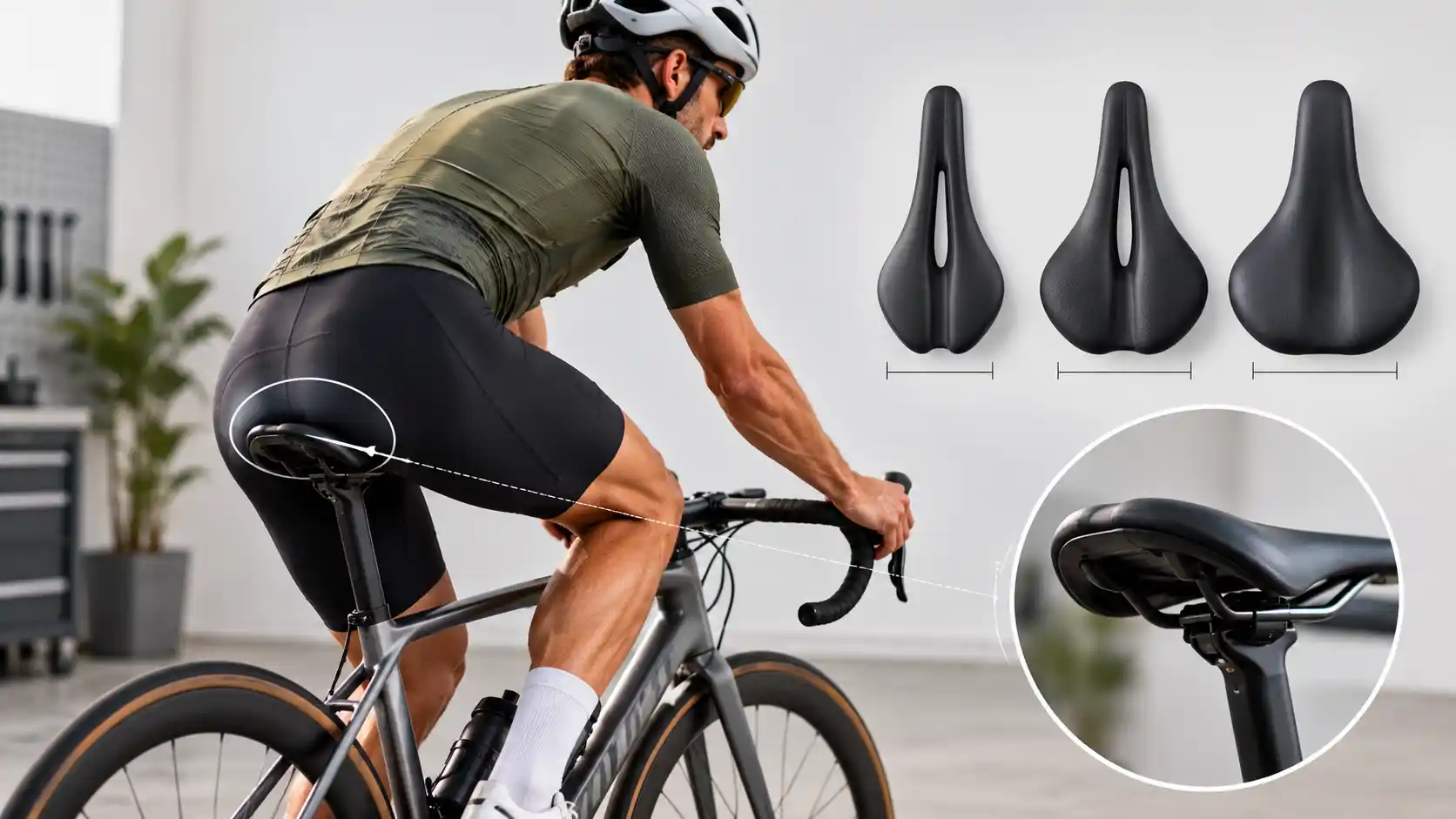
Key Takeaways
- Sit-bone width is a useful starting point, not a complete saddle prescription.
- Saddle shape, riding posture, and position matter as much as nominal width.
- A cutout or thick padding does not guarantee comfort.
- Test one change at a time and increase ride duration gradually.
- Persistent numbness, genital pain, or recurrent skin injury warrants professional attention.
Why Is Saddle Selection So Individual?
Two riders with similar body measurements can prefer completely different saddles. They may rotate their pelvis differently, sit at different angles, move differently while pedaling, or spend different amounts of time seated.
A 2023 narrative review of saddle pressure identified several relevant factors, including sitting time, pedaling intensity and frequency, trunk and hand position, handlebar position, saddle design, saddle height, padded shorts, and rider sex.
This explains why buying a new saddle without checking the rest of the setup can be an expensive guessing game.
Anecdotal evidence from Reddit: In a discussion about an uncomfortable saddle on a new bicycle, a rider described significant sit-bone discomfort after a 27 km ride. Replies suggested different explanations, including saddle width, tilt, reach, and adaptation to cycling.
These personal reports illustrate the problem, but they do not establish a universal diagnosis. The useful lesson is that discomfort should be investigated systematically rather than automatically blamed on the saddle.
Step 1: Identify Exactly Where It Hurts
Before shopping, describe the problem as precisely as possible. Different symptoms can point toward different things worth checking.
| Symptom | What to investigate |
|---|---|
| Sit-bone soreness | Width, support area, riding duration, and saddle position |
| Perineal pressure | Pelvic rotation, reach, saddle shape, and cutout design |
| Numbness | Pressure distribution and riding position; seek medical advice if persistent |
| Inner-thigh rubbing | Saddle wings, width, surface friction, and leg movement |
| Recurrent saddle sores | Friction, clothing, hygiene, and fit |
| Sliding forward | Saddle tilt, reach, and overall weight distribution |
| Pelvic rocking | Saddle height, reach, and pedaling mechanics |
Record when the discomfort begins, whether it disappears after standing, and whether it occurs indoors, outdoors, or only during harder efforts.
Do not assume that every symptom means you need a different saddle. If pain is severe, persistent, or accompanied by numbness or skin breakdown, do not try to solve it simply by riding through it.
Step 2: Establish a Stable Bike Position First
A poorly positioned saddle can make a suitable design feel wrong.
Before testing alternatives, record your current saddle height, fore-aft position, and tilt. Use repeatable reference points so that you can return to your starting setup.
A 2016 study by Verma and colleagues examined 21 recreationally active participants cycling at 100 W for ten minutes in five different seat positions. Upward and backward positions increased discomfort compared with the neutral position in that experimental protocol.
The study does not identify one ideal position for every rider. It does show that changing saddle position can affect discomfort and biomechanics.
Start with a reasonably stable setup, and avoid changing the saddle, stem, cleats, and handlebar height simultaneously.
Step 3: Use Sit-Bone Width as a Starting Point
Sit-bone measurement can help narrow your choices, but it cannot tell you exactly which saddle will be comfortable.
In a 2023 study of bicycle saddle widths in female cyclists, researchers tested four saddle-width options in ten healthy young women. Under the study’s controlled conditions, a saddle approximately 1 cm wider than the measured ischial width improved several pressure-distribution measures.
That is useful evidence, but the study had a small sample and used a specific laboratory protocol. It does not establish a universal formula for every rider, saddle shape, or riding posture.
Use your measurement to identify a reasonable range of widths, then evaluate how each saddle supports you while riding.
What matters is not simply whether the saddle is wide enough. It is whether the usable support area matches your anatomy and position.
Step 4: Choose a Shape That Supports You Without Rubbing
Two saddles with the same maximum width can feel very different because they widen at different points.
- T-shaped saddles generally stay narrower toward the nose before widening more abruptly toward the rear.
- V-shaped saddles generally widen more gradually from the nose toward the rear.
A T-shaped design may be worth testing if you need rear support but experience inner-thigh interference. A V-shaped design may suit riders who prefer a more gradual transition or move around the saddle during a ride.
Neither shape is automatically better. The practical test is whether the saddle supports your sit bones in your normal position without forcing your thighs against its wings.
When comparing designs, check:
- Where your sit bones contact the rear support area.
- Whether your thighs rub during the full pedal stroke.
- Whether you slide toward the nose.
- Whether the usable support area changes when you lean forward.
- Whether a cutout or its edges create pressure.
Do not choose by the advertised maximum width alone. Two equally wide saddles can have very different shapes where your body actually makes contact.
Step 5: Match the Saddle to Your Riding Position
Your riding posture changes how you interact with the saddle. This is why copying another cyclist’s setup—or buying a saddle simply because a professional racer uses it—can lead to disappointment.
Consider three common scenarios.
1. Upright endurance riding and commuting
If you ride relatively upright, pay attention to rear support, thigh clearance, and stability during long periods of seated riding. A wider saddle may be worth testing, but only if its shape fits your pelvis and does not interfere with your legs.
2. Aggressive road cycling and climbing
When you rotate your pelvis forward and ride in the drops, pressure can shift toward the front of the saddle. A short-nose design or a suitable cutout may be worth testing, but neither guarantees relief. Check whether the saddle still supports you when you move between the hoods and drops.
3. Triathlon and sustained aerodynamic positions
If you spend extended periods on aero bars, evaluate the saddle in that actual position. A short-nose or no-nose design may be worth considering when conventional shapes create excessive anterior pressure. However, reducing pressure in one area can increase pressure elsewhere or affect stability.
A systematic review and meta-analysis of strategies for reducing cycling-related perineal pressure screened 2,217 studies, included 22 in the review, and included six in its meta-analysis. It found evidence that no-nose saddles reduced perineal pressure in healthy male cyclists, but they could also reduce stability and increase posterior pressure.
This evidence applies to a specific population and does not mean everyone should switch to a no-nose saddle.
The takeaway is straightforward: test the saddle in the position you actually ride, not just the position in which it feels comfortable while sitting still.
Step 6: Consider Surface Grip, Not Just Padding
The saddle’s surface affects how easily you can move during a ride.
A grippy 3D-printed lattice may help some riders stay in place. For others, it can make small position changes more difficult or contribute to friction against cycling shorts.
Anecdotal evidence from Reddit: In a discussion about the surface texture of 3D-printed saddles, some riders reported little or no clothing wear, while others described damage to bib shorts associated with particularly grippy surfaces.
These are individual experiences, not controlled evidence that all 3D-printed saddles damage clothing. Surface design differs between models, and fit, fabric, and repeated movement can also affect wear.
If surface friction is part of your decision, see our guide to 3D-printed saddles and bib-short wear.
When evaluating a saddle, consider both comfort and freedom of movement. A surface that keeps you planted may be useful in one riding style but frustrating in another.
Step 7: Test One Change at a Time
A useful saddle test is a controlled comparison, not a collection of simultaneous adjustments.
- Record your starting saddle height, tilt, and setback.
- Install the test saddle according to the manufacturer’s instructions.
- Check whether its different rail-to-top height requires a saddle-height adjustment.
- Use the same shoes, cleat position, bib shorts, and familiar route.
- Begin with a short ride and note where any discomfort occurs.
- Increase ride duration gradually if the initial test is comfortable.
- Record when pressure, numbness, rubbing, or instability begins.
- Change only one setting before the next test.
Do not compare two saddles after also changing your stem, cleats, handlebar height, and shorts. If the result improves, you will not know which change helped.
Also confirm rail compatibility before installation, especially with oval or carbon rails. Follow the saddle and seatpost manufacturers’ clamping and torque requirements.
A saddle that feels good for ten minutes is not necessarily suitable for a two-hour ride. Evaluate it over progressively longer rides, but stop if you develop numbness, sharp pain, significant skin irritation, or another concerning symptom.
When Does Professional Saddle Fitting Make Sense?
Professional fitting becomes more useful when several standard saddles have failed, discomfort repeatedly returns, pressure is clearly asymmetric, or your riding position is difficult to stabilize.
Pressure mapping can help a fitter observe where pressure builds while you pedal on your bicycle. It should be interpreted alongside your symptoms, posture, and movement—not treated as a standalone answer.
For example, Fizik’s One-to-One program uses dynamic pressure mapping and individual riding data to create a customized saddle. This is different from purchasing a standard 3D-printed saddle that happens to come in several widths.
Custom equipment can be useful in selected cases, but it is not the first step for everyone. A systematic assessment of your existing setup may identify a simpler solution.
Frequently Asked Questions
Is a wider saddle always more comfortable?
No. A wider saddle can provide more support in some situations, but excessive width or an unsuitable shape can interfere with thigh movement. Consider width, support area, and posture together.
Should a saddle be completely level?
A level position is a reasonable starting point, but the appropriate reference surface depends on the saddle’s shape. Small adjustments may help; excessive nose-down tilt can encourage sliding and increase pressure on your hands.
Why does a saddle feel comfortable for ten minutes but hurt after 45 minutes?
Short rides may not reveal pressure that builds with time or repeated movement. The saddle’s shape, your position, clothing, and riding conditions may all contribute. Record when the discomfort starts and compare setups under similar conditions.
Can thicker padding fix sit-bone pain?
Not reliably. Padding can change how pressure is distributed, but more padding does not automatically provide better support. Check saddle width, shape, position, and your cycling shorts before assuming that a softer seat is the answer.
When should I seek medical advice?
Seek advice from a qualified clinician if you experience persistent numbness, genital pain, urinary symptoms, recurrent or infected sores, neurological symptoms, or pain that continues after riding. Do not rely on saddle adjustments alone to address ongoing symptoms.
Final Saddle-Selection Checklist
Use this order when choosing your next saddle:
- Identify the exact symptom.
- Establish a stable bike position.
- Measure sit-bone width as a starting reference.
- Compare suitable widths and shapes.
- Evaluate support in your actual riding position.
- Consider cutout design and surface grip.
- Confirm rail and clamp compatibility.
- Test progressively longer rides while changing one variable at a time.
- Seek professional fitting or medical assessment when necessary.
The right saddle is not necessarily the softest, widest, lightest, or most technologically advanced. It is the one that supports your body in your normal riding position without creating avoidable pressure, instability, rubbing, or discomfort.
Choose based on fit, test based on real rides, and let your symptoms—not marketing claims—guide the decision.
Sources and Further Reading
Research
- Vicari et al. (2023). Saddle Pressures Factors in Road and Off-Road Cyclists of Both Genders: A Narrative Review.
- Verma et al. (2016). Effect of Seat Positions on Discomfort, Muscle Activation, Pressure Distribution and Pedal Force During Cycling.
- Lin et al. (2023). The Effect of Bicycle Saddle Widths on Saddle Pressure in Female Cyclists.
- Litwinowicz et al. (2021). Strategies for Reducing the Impact of Cycling on the Perineum in Healthy Males: Systematic Review and Meta-analysis.
Rider experiences and product information
- Reddit: New to cycling, finding saddle very painful. Personal experiences; anecdotal evidence.
- Reddit: How grippy or slippery is the covering on a 3D-printed saddle?. Personal experiences; anecdotal evidence.
- Fizik: One-to-One custom saddle program.