
A clearance price can make a bulk bike parts order look irresistible. The decision should still come down to sellable demand, the exact product and variant, total cost to receive and hold it, and the cash you will need for other operations. This five-step buy-or-pass test helps bike shops, distributors, and component buyers check aged or discounted stock before accepting a large amount.
Clearance stock is stock offered at a reduced price, often to move a set item or amount. A bulk order means buying many units or variants at once. Its value depends on how fast the stock sells, whether it fits, and the full cost.
Key takeaways
- A discount is not a saving if the stock cannot be sold or used before it becomes obsolete.
- Check the exact revision, fit, and condition before comparing prices.
- Calculate landed cost and cash tied up, including inspection, storage, and financing.
- Use a small trial or customer commitment when demand is uncertain.
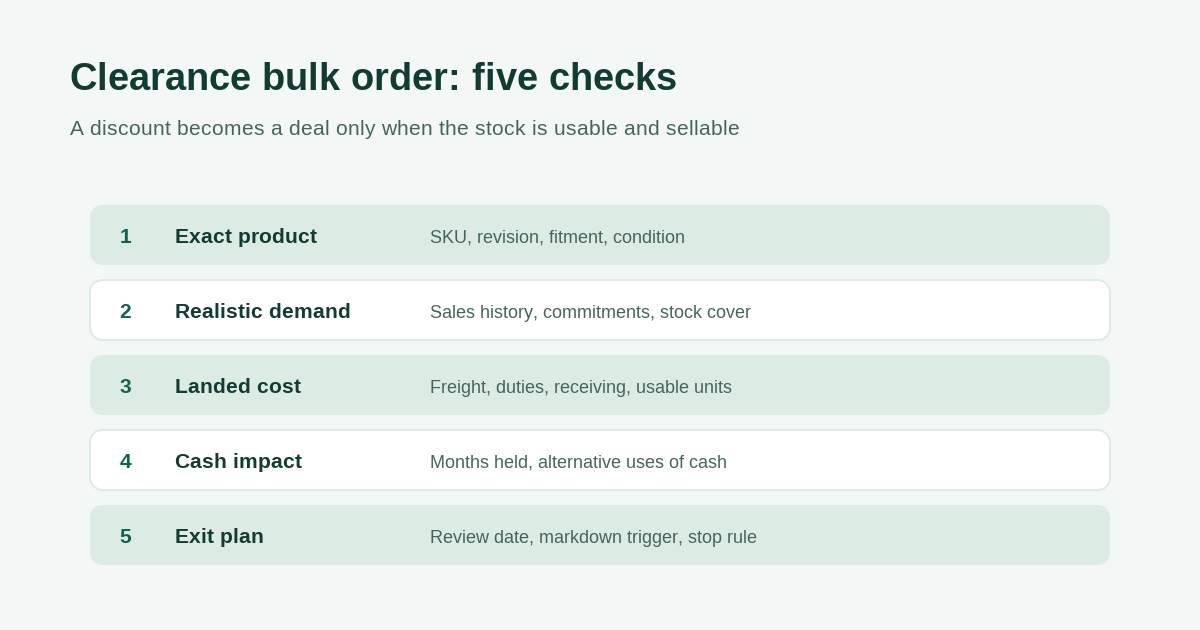
A bike clearance bulk order should pass five buyer checks.
Why clearance stock needs a stricter test
Discounted bike stock can reflect a genuine chance to buy needed products at a lower cost. It can also reflect aging stock, limited sizes, discontinued specs, or a supplier’s urgent need to reduce working capital. A buyer needs to understand which situation applies to the offered SKU.
The pressure was visible in industry reporting during 2024. An Associated Press report in May described U.S. bike sales falling from their pandemic peak as stock returned and demand slowed; some manufacturers were cutting prices to clear excess (AP News). In June, Bike Retailer and Industry News spoke with five supplier executives who described discounts on aging stock and the challenge of moving older stock, while also noting continuing pressure across retailers and suppliers (BRAIN, June 10, 2024). These are period-specific reports, not a description of today’s market.
The customer conversation reflected the same tension. A June 5, 2024 r/cycling post asking why bikes still felt expensive showed 97 votes in the search snapshot, with replies discussing steep discounts on older models and uncertainty about excess stock (Reddit discussion). The votes indicate engagement with that Reddit thread, not the prevalence of a view across the bike market.
The five-step buy-or-pass test
1. Confirm the stock is the product your customers need
Ask for the exact SKU, model year or revision where applicable, size, color, material, fit, packaging, and condition. Request current photographs or a sample for unfamiliar items. For parts, confirm that the offered component fits the systems your customers ride or the product builds you have planned.
Then check restrictions: discontinued parts may be difficult to replenish; certain variants may be non-returnable; and branded goods may have limits on where or how they can be sold. Resolve these questions in writing before treating the stock as interchangeable with your regular assortment.
If the offer involves saddles or other product-specific fit and performance requirements, use Tyride’s bike saddle product catalog to identify the relevant category, and consult the carbon saddle check guide when a carbon configuration is involved. A product page is not a substitute for confirming the offered revision and specs.
2. Estimate realistic sell-through, not hoped-for demand
Use recent sales or repair usage for that exact variant. Compare the proposed units with historical weekly demand, seasonal patterns, booked work, and customer commitments. If the stock is a new category, avoid treating general cycling participation or a popular product type as proof that your shop will sell a specific size, color, or spec.
Calculate a simple cover estimate:
Weeks of cover = offered amount ÷ average weekly units sold or used.
If a clearance offer is 120 units and the shop’s recent sales average six units a week, the offer represents 20 weeks of cover before accounting for stock already on hand. This is an illustrative calculation. If sales are seasonal, use a month-by-month plan rather than a flat weekly average.
Reddit threads can reveal questions buyers are asking, but they cannot replace your own sell-through records. A separate June 2024 Reddit conversation about a 4-to-6-week delivery estimate shows that some consumers may switch to an available alternative when timing matters (delivery-time discussion). That can help frame availability as a sales factor; it does not tell you how many units your own customers will buy.

Add the cost layers that apply to the specific shipment.
3. Calculate the real landed and usable-unit cost
Do not compare the clearance invoice price with a standard product price and stop there. Add known freight, insurance, import charges, brokerage, receiving inspection, relabeling, storage, financing, and potential markdown costs. Then divide total cost by the number of units you expect to be saleable and usable.
Usable-unit cost = total buying and receiving cost ÷ expected saleable units.
Suppose 100 units cost $800, freight and receiving add $150, and you expect 10 units to be unsellable or reserved for claims. The illustrative usable-unit cost is $950 ÷ 90, or about $10.56. Replace every input with actual quotations and the buyer’s documented estimate. If the deal requires a new logistics route, Tyride’s factory-direct versus distributor cost comparison outlines cost categories to normalize across offers.
For imported clearance lots, confirm the delivery rule and named place, and ask which costs or responsibilities sit with the seller and buyer. The International Trade Administration’s Incoterms guidance describes how the rules allocate tasks, costs, and risks. A low unit price does not reveal the full delivered cost by itself.
4. Price the cost of cash and limited flexibility
Money committed to slow-moving stock cannot be used for fast-selling parts, payroll, rent, warranty needs, or a better opportunity. Estimate how long the cash will remain tied up and what could happen if the forecast is wrong.
Ask:
- How many weeks or months of cover will this order create?
- What is the likely resale price if the stock moves slowly?
- Can the supplier split the delivery or let you buy a smaller trial amount?
- Are returns, substitutions, or warranty claims allowed for clearance goods?
- Does the order delay restock of proven core items?
The right comparison is not simply “discount versus list price.” It is expected margin after all costs, adjusted for the time and risk involved. When the seller will not reduce MOQ, ask whether mixed variants or phased releases are possible. Confirm any arrangement in the quotation or order order.
5. Set a clear maximum amount and exit condition
Choose a amount from documented demand and cash limits, not from the discount tier. Before order, define a review date and an action if sell-through misses plan. The action could be to stop reordering, move stock to another channel, bundle it, or mark it down at a defined threshold.
| Decision signal | Buy or pass response |
|---|---|
| Exact SKU matches repeat demand and fitment | Consider buying the amount supported by the sales plan |
| Product is unfamiliar but a sample or small run is available | Test before scaling |
| MOQ creates far more cover than the planning horizon | Negotiate, split, defer, or pass |
| Delivery and import charges are not itemized | Hold the decision until the total cost is clear |
| Stock is aged, incomplete, or revision status is unknown | Require inspection evidence or pass |
| Discount works only if every unit sells at full price | Recalculate with a realistic markdown scenario |
For ongoing restock, Tyride’s first wholesale stock order guide explains how to separate core, trial, and special-order lines. Use that approach to preserve space for proven demand even when a clearance offer looks attractive.
A simple clearance-order worksheet
Before you approve a order, write down the following:
Exact SKU / revision / variant:
Condition and inspection evidence:
Amount offered / supplier MOQ:
Current usable stock / open orders:
Recent weekly or seasonal demand:
Expected weeks of cover after receipt:
Invoice cost / freight / duties / receiving / storage:
Expected saleable units / usable-unit cost:
Cash available after the order:
Required margin at realistic price:
Review date and markdown or exit trigger:
If you cannot complete the key fields, treat the offer as unpriced risk rather than a confirmed bargain. The missing information may matter more than the advertised discount.
Frequently asked questions
How much discount makes a bulk bike-parts order worthwhile?
There is no universal discount threshold. Compare the expected margin after delivery, duties, receiving, storage, financing, and markdowns with the cash and risk of holding the stock. A smaller discount on a fast-moving SKU can be better than a large discount on a slow or obsolete variant.
Should a shop buy clearance items that are below cost?
Only if the product is authentic, in saleable condition, compatible with customer demand, and legally and contractually resalable. Confirm any sales restrictions and calculate the cost to receive and support the units.
Can I use online discussion volume to forecast sales?
No. Reddit votes and comments can surface buyer concerns, but they are not a representative demand sample. Use transaction, inquiry, repair, and stock records for the business forecast.
What if the clearance MOQ is too large?
Ask about a smaller pack, mixed-SKU order, split shipment, or trial amount. If those options are unavailable, compare the forced stock cover and cash use with your operating needs. Passing on a deal can be the more profitable decision.
The best clearance order is one you can explain
A bulk clearance order should pass five checks: product fit, realistic demand, usable landed cost, cash flexibility, and a defined exit plan. Industry reporting and Reddit discussion from 2024 show why discounts and stock pressure became visible topics, but each business still needs to make the decision from its own product, market, and cash data.
When the order is supported by a clear forecast, request a comparable written quote and confirm samples, specs, minimums, and delivery scope. Tyride’s component sourcing service outlines its published wholesale and sample options; buyers can send their requirements through the contact page for project-specific terms.
Tyride shares its company and sourcing background on the About Tyride page.
Editorial note: The Reddit examples are individual discussions, not representative surveys. The AP and BRAIN coverage cited above describes conditions reported in 2024 and should not be read as a current market forecast. The calculations are illustrative only; replace them with actual costs, demand records, and supplier terms.