In this weekend’s 3D Printing News Briefs, Farsoon Technologies has reached 150 global sales of meter-scale metal AM systems. Snapmaker has brought its U1 tool-changing printer to Kickstarter. Brown University researchers have accelerated topology optimization with the SiMPL method. Finally, Fizik has won EUROBIKE Gold for a custom 3D printed saddle program.
Farsoon Technologies Reaches 150 Sales of Meter-Scale Metal 3D Printing Systems
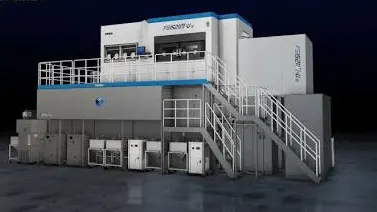
Farsoon Technologies reported 150 worldwide sales of its meter-scale large-format metal 3D printing systems in July 2025, a milestone that is more significant for what those machines are being used for than for the number itself. The company says the systems are now deployed across North America, Europe, and Asia-Pacific, supporting workflows that run from R&D through serial manufacturing. Its flagship FS1521M series accounts for 20 of those sales and offers a build envelope of up to 1530 × 1530 × 1650 mm with as many as 32 × 500 W lasers.
The engineering challenge at this scale is not simply putting more lasers into a larger chamber. Farsoon says the FS1521M addresses wide-area smoke and particle removal with a dual-layer airflow system, while its powder-management architecture reaches 360 L/h of total powder recycling through four 90 L/h modules. Multi-laser calibration is specified to achieve ±0.05 mm precision, and the company’s MES platform can centralize production management for up to 12 machines per operator while reducing reported labor costs by 70%. Farsoon also cites more than 40 certified metal PBF material processes across its broader development portfolio.
Falcontech provides a useful indication of where the technology is heading: the aerospace parts manufacturer has established dedicated production lines containing nearly 40 Farsoon meter-scale metal systems since 2019 for batch manufacturing of end-use parts. That is a different proposition from using a large metal printer as a demonstration machine. The commercial question becomes whether throughput, powder handling, calibration, software traceability, and post-processing can operate as one production system. For large titanium structural components and copper-alloy thermal applications, that systems-level approach is increasingly the real measure of metal AM readiness.
Snapmaker U1 Brings Four-Head Tool Changing to Multicolor 3D Printing
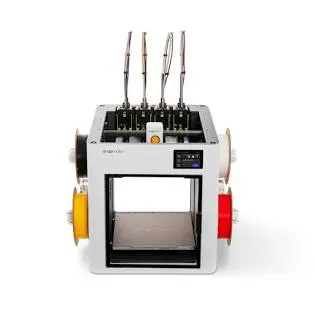
Snapmaker returned to Kickstarter with the U1 in August 2025, bringing a four-toolhead architecture to desktop multicolor and multimaterial 3D printing. The U1 uses a CoreXY motion system, four independent extruders, and the company’s SnapSwap tool-changing mechanism. Its published specifications include a maximum print speed of 300 mm/s, 500 mm/s travel speed, 20,000 mm/s² acceleration, and a 270 × 270 × 270 mm build volume.
The important design decision is not simply the number of colors. Each toolhead has its own nozzle and filament path, so switching materials does not require the printer to flush the previous material through a shared hot end. Snapmaker calls this “Zero Purge,” although the company acknowledges that a small prime tower still remains for pressure stabilization and nozzle wiping. The manufacturer claims up to 80% lower waste in relevant multicolor workflows, while its published product information places a complete tool change at about five seconds. Snapmaker has also tested the locking mechanism through more than 1 million tool changes.
That distinction matters because multicolor printing can turn a visually simple model into a manufacturing-efficiency problem: hundreds or thousands of material transitions can generate substantial purge waste and additional print time. A tool changer attacks the transition itself rather than trying to make purging more efficient. Snapmaker’s timing is also notable. Its first Kickstarter campaign raised $2.28 million in 2017, while Snapmaker 2.0 raised $7.85 million from more than 7,000 backers in 2019. U1 was therefore less a return to crowdfunding for its own sake than another test of whether a technically differentiated desktop workflow can command a large maker audience.
Brown University Researchers Accelerate Topology Optimization with SiMPL
A research collaboration between Brown University, Lawrence Livermore National Laboratory, and Norway’s Simula Research Laboratory has developed SiMPL, a new method intended to reduce the computational burden of density-based topology optimization. The technique addresses a familiar problem in computational design: an optimizer repeatedly modifies a material distribution, analyzes the resulting structure, and continues iterating until the design converges. For difficult three-dimensional problems, Brown University notes that this process can take a week or more even on high-performance computing clusters.
SiMPL stands for Sigmoidal Mirror descent with a Projected Latent variable. Its central idea is to keep density variables within their physically meaningful bounds rather than repeatedly creating and correcting infeasible values. The method maps the conventional material range between zero and one into a latent space extending toward positive and negative infinity, then transforms the resulting variables back into the admissible design range. In practical terms, the algorithm removes one source of unnecessary iteration rather than merely pushing the same optimization loop faster.
The benchmark results are substantial. Brown reports that SiMPL required up to 80% fewer iterations than traditional algorithms in the tested cases, with potential computational savings that could reduce some workloads from days to hours. Brendan Keith, an assistant professor of applied mathematics at Brown, said the method “beats some existing methods by four or five times in terms of efficiency,” arguing that the savings could enable faster design development, lower computing costs, or higher-resolution optimization. The team has also made an implementation freely available to engineers and researchers.
For additive manufacturing, that matters because topology optimization is often only the first half of a digital workflow. The more computationally affordable the optimization stage becomes, the easier it is to explore lattice structures, lightweight brackets, compliant mechanisms, and other geometries that conventional CAD approaches do not naturally produce.
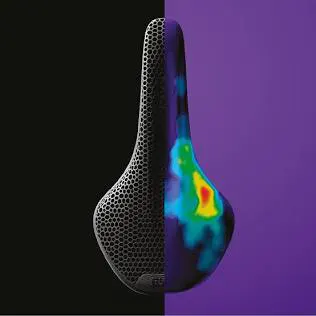
Fizik’s One-to-One Custom 3D Printed Saddle Wins EUROBIKE Gold
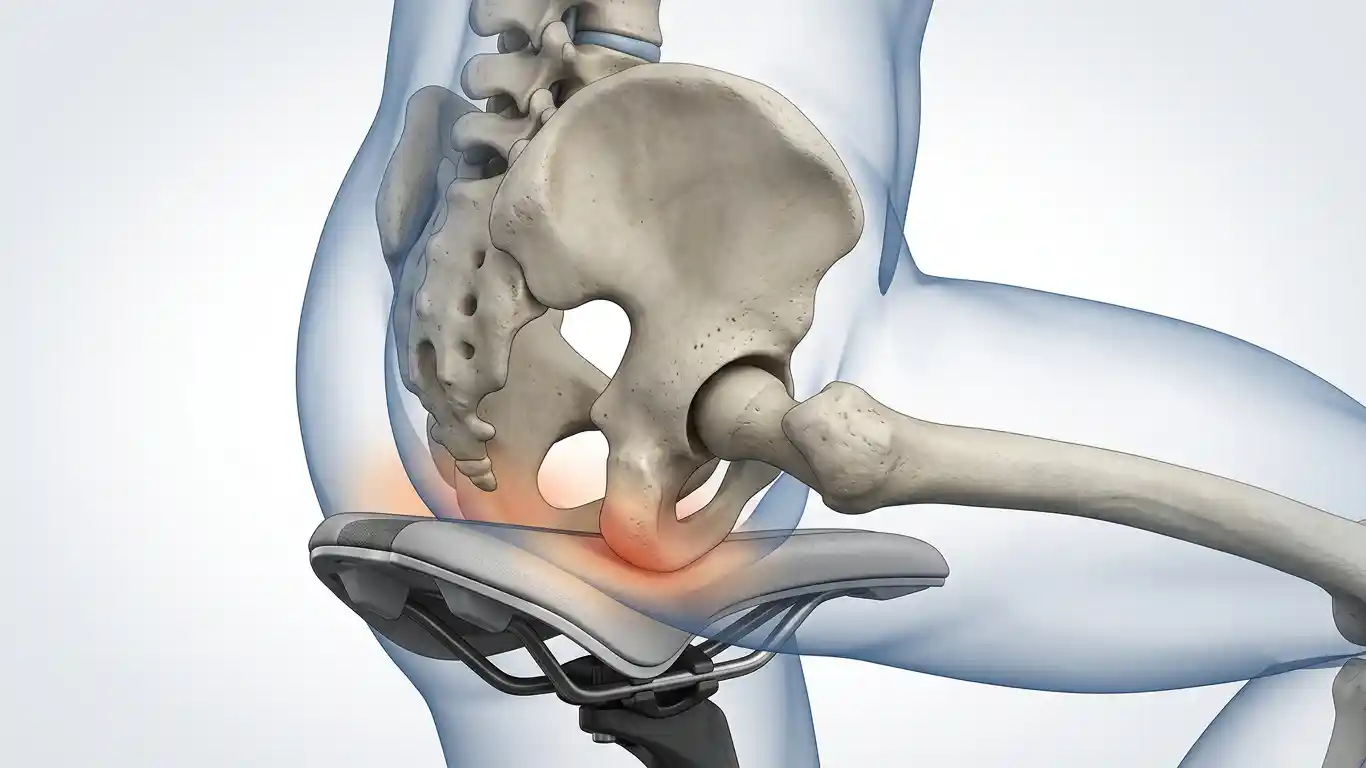
Fizik’s One-to-One custom saddle program won a Gold Award in the Components category at the 2025 EUROBIKE Awards, placing a personalized 3D printed product among the event’s nine Gold-winning innovations. The program combines dynamic rider assessment, pressure mapping, computational design, and Carbon’s Digital Light Synthesis process to create saddle padding tuned to an individual rider rather than selected from a fixed range of standard foam configurations.
The data collection is unusually specific. Fizik developed One-to-One with pressure-mapping specialist gebioMized, using a sensor mat capable of measuring pressure at 64 points across the saddle surface while the rider is actually moving on the bicycle. Measurements can be captured in multiple riding positions, including the tops, hoods, and drops, allowing the system to identify pressure peaks, hotspots, asymmetries, pelvic movement, and stability-related patterns.
That information is then converted into a printable lattice rather than a conventional uniform-density foam pad. Carbon’s software can vary lattice geometry so that some regions provide greater compliance for pressure relief while others are denser and more supportive. The resulting saddle topper is produced using Carbon DLS, a resin-based additive process that uses digital light projection, oxygen-permeable optics, and programmable materials to manufacture complex structures. Fizik says its One-to-One development process took roughly three years of research, development, testing, and validation before becoming a commercial offering.
The EUROBIKE recognition is important beyond cycling. One-to-One is a clean example of where 3D printing becomes commercially useful because every part does not need to be identical. Pressure data changes from rider to rider, the required lattice changes with it, and digital manufacturing removes much of the tooling penalty associated with producing one-off geometries. That makes the saddle a particularly clear demonstration of additive manufacturing moving from customizable production to genuinely data-driven personalization.