
Bulk buying makes sense when the verified price and freight savings exceed the cost of keeping extra stock, and the shop can still identify, receive, and sell the exact parts ordered. A lower unit price alone cannot answer that question. For a small bike shop or distributor, the real decision is how many units to commit to, when to reorder, and which risks are worth taking.
This guide turns a supplier price break into a repeatable buying decision. It focuses on replenishment of known parts, rather than the supplier qualification process covered in Tyride’s guide to vetting low-cost bicycle parts suppliers.
Bulk price break is a lower quoted unit price offered at a stated order quantity. Reorder point is the inventory level at which the shop places its next purchase order. Usable unit cost is total received cost divided by the number of units the shop can actually sell or install. Keeping these terms separate prevents a low quote from being mistaken for a good stocking decision.
Key takeaways
- Compare the cost of a larger order with the cost of holding its extra units until they sell.
- Set a reorder point from actual demand and lead-time records, then add a justified safety-stock allowance.
- Keep part identity and authenticity as approval gates. A cheap lot that cannot be traced or fitted is not a saving.
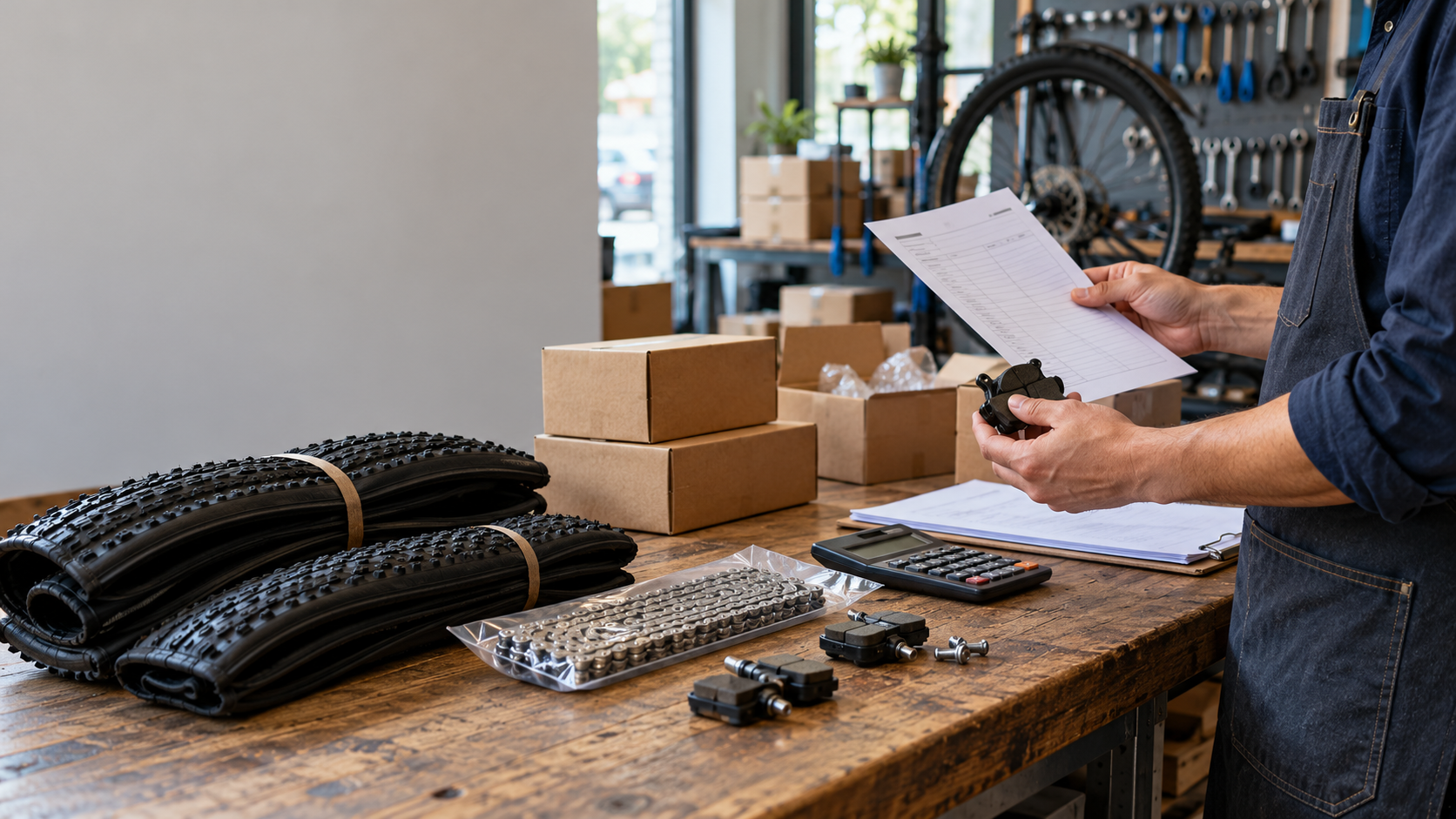
Editorial illustration. The products and paperwork shown are generic and do not depict a Tyride order.
Why the shelf price and shop price can diverge
A May 25, 2026 discussion in r/cycling began with a rider comparing the price of two tires at a local store with a much lower price online. The thread became a debate about manufacturer promotions, wholesale buying power, distributor margins, freight, rent, and inventory. One participant argued that a large online seller can buy hundreds of tires at once; shop participants described the cost of buying smaller quantities. These are individual accounts, not a market-wide price survey. The practical lesson is to compare the same tire and selling conditions before concluding that the difference is pure markup.
For a shop, a useful price comparison has three levels:
| Level | What to include | What it answers |
|---|---|---|
| Quoted unit price | Exact SKU, revision, order quantity, price tier | What is the seller charging for the item? |
| Received unit cost | Product, freight, duties where applicable, inspection and packaging | What did it cost to put the item on the shelf? |
| Usable unit cost | Received cost divided by accepted units, plus a documented remedy allowance | What did each saleable unit actually cost? |
The last line is especially important if batches have missing components, incorrect interfaces, damage, or returns. Tyride’s supplier-check guide explains how to establish a controlled part and inspection basis before calculating usable cost. This article adds the timing and quantity decision.
For fit-sensitive parts, the bicycle parts compatibility checklist identifies the assembly information to capture before substituting one version for another. A price ladder for the wrong fit has no purchasing value.
Step 1: Identify parts that deserve a bulk price check
Start with parts that have repeat demand and stable specifications. A shop might examine its sales and work orders for common chains, tubes, cables, brake pads, or tires. The specific SKU matters: an apparent family of similar parts may have different interfaces, dimensions, or applications. Do not combine incompatible variants just to reach a price break.
Use three questions for each candidate:
- How many units of this exact SKU sold or were used in repairs in each of the last six months?
- How long did replenishment take, from order placement to accepted stock?
- Were any units returned, written off, or discounted because demand or specifications changed?
If demand is sporadic, one low-priced bulk carton can become a shelf of stranded stock. If the part is safety relevant or represented as a branded original, verify provenance before quantity negotiation. In a May 12, 2026 r/bikewrench thread about buying parts, riders disagreed about online channels and plain OEM packaging. A commenter’s belief that an unboxed item is genuine is not supply-chain evidence. Shimano itself warns about counterfeit brake pads and advises purchasing through authorized sellers.
For seats sold on bicycles in the United States, the Consumer Product Safety Commission’s bicycle guidance describes seat and clamp requirements under 16 CFR part 1512. A buyer should confirm the rules that apply to the exact product and market before placing a large order. A lower unit cost cannot compensate for a part that fails the intended use or market requirements.
Step 2: Calculate the price-break hurdle
Before taking a larger tier, estimate the extra cost of carrying the extra inventory. Use your own financing, storage, damage, insurance, and obsolescence assumptions; there is no universal percentage that fits every shop.
Bulk-order benefit = purchase-price saving + freight saving – extra holding cost – expected write-offs – additional inspection cost.
The formula is a decision aid, not an accounting standard. Keep the inputs visible so a buyer can challenge them. For example, suppose a shop expects to sell 40 identical units per month. A supplier offers 40 units at $12 each or 200 at $10 each. Buying 200 at the lower tier saves $400 against buying those 200 units at the $12 tier. The shop must then ask whether the added freight difference, months of storage, cash tied up, and risk of unsold units consume that $400. These figures are illustrative inputs, not observed component prices or a Tyride quotation.
The holding period should use a demand forecast, not a best-case sell-through claim. If the shop sells only 20 per month, the 200-unit purchase covers ten months instead of five. A model change or a new brake interface could then matter more than the unit discount.
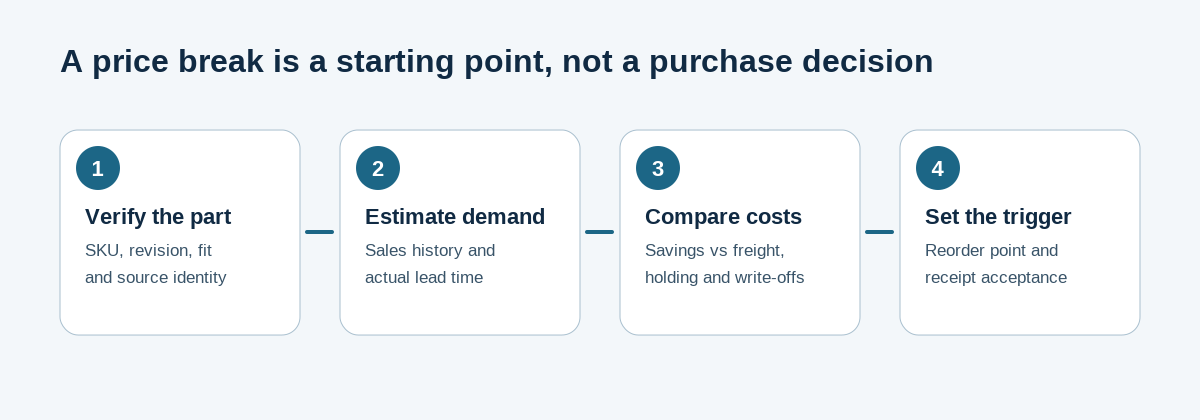
Step 3: Set a reorder point before negotiating quantity
A bulk discount and a reorder point answer different questions. Order quantity is how much to buy; the reorder point is when to buy. A simple starting model is:
reorder point = expected demand during supplier lead time + safety stock
For example, if a shop normally uses 10 units per week and reliable replenishment takes three weeks, expected lead-time demand is 30 units. Safety stock should then be based on observed variation in demand and actual delivery delays. Do not add an arbitrary buffer without reviewing the resulting cash and shelf-space cost.
Track lead time through receipt and acceptance, not just the supplier’s dispatch date. A shipment that arrives quickly but needs sorting, authenticity checks, or rework is not ready to sell. For imported components, put the named delivery term and place on every quote. The International Chamber of Commerce explains that Incoterms allocate transport responsibilities, costs, and risks; a factory price and a delivered quote cannot be compared without normalizing those responsibilities.
Decision method: Review at least one completed purchasing cycle for the same SKU. Record the order date, accepted receipt date, actual quantity used, and unsold balance. Replace each estimate in the worksheet with those records before repeating the larger order. This is an editorial decision framework, not a measured claim about a particular supplier. The examples above use fictional prices to show the arithmetic.
Step 4: Use an order comparison sheet
Use one row per exact SKU and supplier offer. Record actual values where possible and label estimates.
| Field | Small replenishment | Larger price-break order |
|---|---|---|
| Exact SKU and revision | ||
| Quantity and quoted unit price | ||
| Named Incoterms rule and place, if importing | ||
| Freight and import charges | ||
| Inspection and receiving cost | ||
| Accepted or expected usable units | ||
| Months of stock at realistic demand | ||
| Holding and obsolescence estimate | ||
| Remedy for defects or shortages | ||
| Reorder point and expected receipt date |
Calculate both the total cash commitment and the cost per accepted unit. A low cost per unit does not justify an order that strains cash flow or leaves the shop exposed to an obsolete fit. Conversely, repeated emergency orders can hide freight and lost-service costs. Review the decision after the first replenishment cycle and replace estimates with actual sales, lead times, and acceptance results.
When a supplier conversation should go beyond a price list
Ask for a written price ladder at the exact quantities your demand supports. Then request the pack quantity, carton dimensions, production or dispatch lead time, part identification, change-notice process, and the treatment of defective units. If the offer covers several component types, keep each item’s identity and acceptance criteria separate.
For a project that includes saddles, Tyride’s bicycle components sourcing service and saddle product range provide starting points for a defined RFQ. An inquiry should state the part, expected annual volume, first-order quantity, intended market, and target delivery window. If the purchase is for a new saddle design, use the separate OEM saddle specification guide before asking for a volume price.
A quick decision for a busy shop
If the part is new to your shop, test a small order first. If sales are rare, keep orders small. If sales are steady, compare the full cost of both order sizes. Buy the larger lot only when it fits your cash plan and will sell in time. Check the result after receipt. Record delivery days, rejected units, and stock left on the shelf. Those numbers make the next order easier to judge.
The buying rule
Approve a bulk order only after the part is identified, its source and fit are verified, and the discount survives a realistic carrying-cost calculation. Put the reorder point and release criteria in the same purchase record. That makes the next order a decision based on actual demand, rather than another reaction to a price tier.
To compare a defined parts list or discuss a quantity ladder, send Tyride the SKUs, expected volumes, and destination through its contact page.
Learn about us and Tyride’s saddle manufacturing and component sourcing roles. This article was prepared as an editorial buying guide; the Reddit posts are reader accounts, and all numerical buying examples are labeled hypothetical.