Introduction: Why Saddle Fit Has Become a Bigger Concern in Cycling
For many cyclists, the bicycle itself is rarely the cause of discomfort. Modern bicycles are built with advanced materials, precise components, and carefully engineered geometry. Yet, after a certain amount of riding time, many cyclists discover that one small component can determine whether a ride feels enjoyable or exhausting: the saddle.
A rider may experience discomfort after only an hour on the bike, while another cyclist can complete a full-day ride without major problems using a similar-looking saddle. The difference is often not simply the price of the saddle or the amount of padding. The real factor is whether the saddle matches the rider’s body structure, riding position, and cycling habits.
This is why the question “Are custom bike saddles worth it?” has become increasingly common among both experienced cyclists and bicycle brands.
A custom bicycle saddle is designed around the principle that riders are different. Pelvic structure, sit bone width, flexibility, riding posture, body weight distribution, and cycling goals all influence how a rider interacts with the saddle.
For individual cyclists, a personalized bike saddle may provide improved comfort and a better riding experience, especially during long-distance cycling. For bicycle companies, customized saddles create another opportunity: developing unique products that solve specific customer problems instead of competing only on price.
From a bicycle saddle manufacturing perspective, customization is not about adding unnecessary features. It is about improving the relationship between the rider and the bicycle through better design, material selection, and manufacturing precision.
Understanding Why Saddle Comfort Is Difficult to Achieve
Saddle comfort is one of the most misunderstood topics in cycling. Many riders initially believe that discomfort can be solved by choosing a softer saddle. While cushioning plays a role, experienced saddle designers understand that comfort is the result of multiple factors working together.
A bicycle saddle must provide support while allowing efficient pedaling movement. It needs to hold the rider in a stable position without creating excessive pressure on sensitive areas.
This creates a design challenge.
A saddle that is extremely soft may feel comfortable during the first few minutes of riding, but excessive compression can allow the rider’s body to sink too deeply into the saddle. This may increase friction and create pressure in areas that are not designed to support body weight.
On the other hand, a saddle that is too firm or poorly shaped may create concentrated pressure points, causing discomfort during longer rides.
The purpose of a well-designed saddle is not maximum softness. The purpose is balanced support.
The Role of the Saddle as a Contact Point
The bicycle saddle is one of three major contact points between the rider and bicycle, together with the pedals and handlebars.
However, the saddle has a unique function because it supports the rider’s body weight continuously throughout the ride.
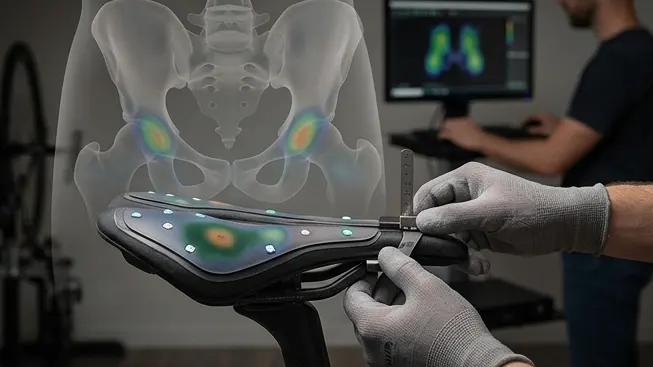
When riding, the rider’s weight is mainly supported by the ischial tuberosities, commonly known as the sit bones. These structures are naturally designed to support the body when seated.
A correctly designed saddle allows these areas to carry the appropriate load while reducing unnecessary pressure elsewhere.
When the saddle does not match the rider’s anatomy, the body begins to compensate. Riders may unconsciously change their position, move forward or backward, or reduce riding intensity to avoid discomfort.
Over short distances, these adjustments may seem minor. Over several hours of cycling, however, they can significantly affect comfort and endurance.
What Makes a Custom Bike Saddle Different?
A standard bicycle saddle is developed for a broad group of riders. Manufacturers typically analyze common riding styles and market requirements to create products suitable for general use.
This approach is practical and allows companies to produce reliable saddles at competitive prices.
However, the average rider does not exist in reality.
Every cyclist has unique physical characteristics. Two riders with the same height and weight may still require completely different saddle designs because their pelvic structure, flexibility, and riding posture are different.
A custom bike saddle focuses on these individual differences.
Instead of designing one saddle for the largest possible audience, manufacturers can adjust specific elements to better match the intended rider.
Custom Saddle Design: More Than Changing Appearance
Many people misunderstand customization as simply changing colors, adding logos, or selecting different surface materials.
In professional bicycle saddle development, customization goes much deeper.
A custom bicycle saddle may involve adjustments to:
- Saddle width
- Rear support area
- Central relief design
- Cushioning structure
- Base flexibility
- Rail material
- Cover material
Each of these factors affects the final riding experience.
For example, a road cyclist who maintains a low aerodynamic position places pressure differently compared with a commuter cyclist sitting upright on an urban bicycle. A mountain biker may need a different balance between freedom of movement and support compared with an endurance road rider.
A professional saddle manufacturer considers these differences during development rather than treating all riders the same.
The Relationship Between Saddle Fit and Cycling Biomechanics
Sit Bone Support and Pressure Distribution
One of the most important principles in saddle design is supporting the rider’s skeletal structure correctly.
The sit bones are designed to carry weight while seated, but their position and width vary significantly between individuals.
If a saddle is too narrow, the sit bones may not receive enough support. This can increase pressure on surrounding soft tissue areas.
If a saddle is too wide, it may interfere with leg movement and create additional friction during pedaling.
This is why saddle width selection is an important part of professional bike fitting.
A suitable saddle allows the rider to maintain a stable position while reducing unnecessary pressure.
Why Pressure Distribution Matters More Than Padding Thickness
Two saddles can have the same amount of foam but feel completely different because their internal structures distribute pressure differently.
Saddle designers consider several elements:
- Shape profile
- Curvature
- Foam density
- Base stiffness
- Relief channel design
- Cover flexibility
A high-quality ergonomic bike saddle is not created by simply adding more material. It is created by controlling how forces move through the saddle structure.
This is also why professional riders often spend significant time testing different saddle shapes rather than choosing products based only on appearance or softness.
Why Long-Distance Cyclists Benefit More From Custom Saddles
For riders who cycle occasionally, saddle differences may not be immediately noticeable.
However, as riding duration increases, small fitting problems become much more significant.
A cyclist completing a long-distance event may spend several hours continuously in contact with the saddle. During this time, even a small pressure imbalance can lead to discomfort.
Common problems experienced by long-distance riders include:
- Increasing sit bone discomfort
- Numbness
- Reduced concentration
- Frequent position adjustments
- Difficulty maintaining consistent effort
This is why endurance cyclists, touring riders, and performance cyclists are often among the first groups to invest in specialized saddle solutions.
A custom saddle does not make the bicycle faster by itself. Instead, it helps the rider maintain a more comfortable and stable position, which can support better performance over longer periods.
Are Custom Bike Saddles Worth the Investment?
The answer depends on the rider’s needs, but customization provides clear advantages for specific groups.
For someone who rides only occasionally for short distances, a standard saddle may already provide sufficient comfort.
However, for cyclists who spend many hours riding, have repeatedly struggled to find a suitable saddle, or require specific performance characteristics, a custom solution can offer meaningful value.
Improved Comfort Through Better Fit
The primary reason riders choose a custom bicycle saddle is better compatibility.
Instead of selecting from limited standard options, customization allows the saddle design to focus on the rider’s actual requirements.
A properly fitted saddle can help reduce unnecessary movement and allow the rider to maintain a more natural position.
This is particularly valuable for cyclists who have already tried multiple saddles but continue to experience discomfort.
The goal is not to find the “softest” saddle.
The goal is to find the saddle that provides the correct support.
Improved Riding Efficiency Through Stability
Comfort and performance are closely connected in cycling. When a rider experiences discomfort, the body naturally tries to reduce pressure by changing position. These small adjustments may seem harmless, but repeated movement can affect pedaling consistency and riding efficiency.
A properly designed saddle helps the rider maintain a stable relationship with the bicycle. This stability allows cyclists to focus on generating power, controlling the bike, and maintaining an efficient riding position.
For performance cyclists, the value of a custom saddle is often not measured by a single dramatic improvement. Instead, it comes from reducing distractions and allowing the rider to maintain a consistent position for longer periods.
This is especially important in endurance cycling, where comfort over several hours can directly influence the overall riding experience.
Materials and Technologies Behind Modern Custom Bicycle Saddles
A custom bicycle saddle is not created only through shape adjustments. Material selection plays an equally important role in determining comfort, durability, weight, and product positioning.
A professional bike saddle manufacturer needs to understand how different materials influence the final product rather than simply selecting materials based on cost.
The right combination of base structure, cushioning material, rails, and cover can create very different riding characteristics.
Foam Technology: Balancing Support and Comfort
Foam remains one of the most common cushioning materials used in bicycle saddle manufacturing.
Polyurethane (PU) foam is widely used because it offers a practical balance between comfort, durability, and manufacturing efficiency. By adjusting foam density, manufacturers can create different levels of support.
Lower-density foam generally provides a softer initial feeling, while higher-density foam usually offers stronger long-term support.
However, foam selection must match the intended application.
A comfort-oriented city bicycle saddle and a performance road saddle have different requirements. The first may prioritize cushioning and vibration absorption, while the second may require a lighter structure and more direct power transfer.
Experienced manufacturers do not choose foam simply because it feels soft during a short test. They consider how the material behaves after hours of riding.
Saddle Rails: Weight, Strength, and Riding Feel
The saddle rail system connects the saddle to the bicycle seat post and plays an important role in overall performance.
Common rail materials include:
- Steel alloy
- Titanium alloy
- Carbon fiber
Steel rails remain popular because they provide durability and cost efficiency, making them suitable for many OEM bike saddle applications.
Titanium and carbon fiber rails are often used in premium products because they can reduce weight while maintaining structural strength.
However, reducing weight is not the only goal.
A premium saddle must maintain an appropriate balance between stiffness and flexibility. A saddle that is extremely rigid may transmit more vibration, while a saddle with controlled flexibility may provide a more comfortable riding experience.
The Development of 3D Printed Bike Saddles
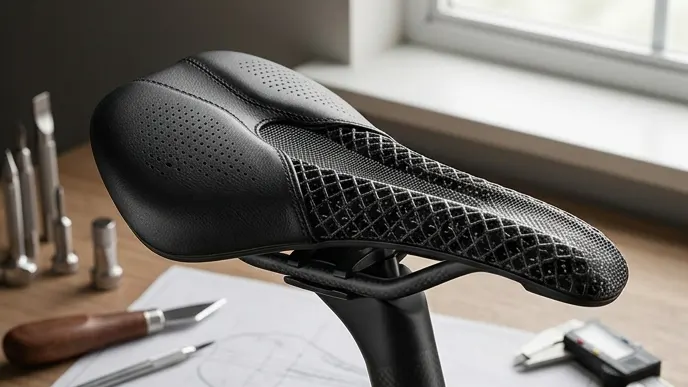
One of the most interesting developments in modern saddle technology is the emergence of the 3D printed bike saddle.
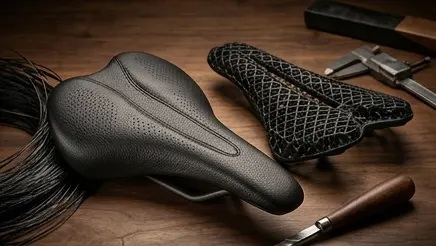
Traditional saddle manufacturing usually relies on foam layers placed on top of a saddle base. While this method has been successful for decades, it has limitations when engineers want to create highly specific support zones.
3D printing provides a different approach.
Instead of using a relatively uniform cushioning layer, manufacturers can create complex internal lattice structures designed to behave differently in different areas.
How 3D Printing Changes Saddle Design
A 3D printed structure can potentially allow engineers to control:
- Support areas beneath the sit bones
- Flexible zones for pressure relief
- Ventilation characteristics
- Overall weight distribution
This technology creates new possibilities for developing a more personalized bike saddle.
However, it is important to understand that 3D printing itself does not automatically create a superior product.
The final riding experience still depends on:
- Saddle geometry
- Rider requirements
- Structural engineering
- Material performance
- Manufacturing quality
A poorly designed 3D printed saddle can still create discomfort.
The technology provides new possibilities, but professional design experience remains essential.
Why Bicycle Brands Invest in OEM Bike Saddles
For bicycle brands, a saddle is not only a functional component. It is also part of the customer’s overall product experience.
In a competitive bicycle market, many products share similar specifications. A unique saddle design can help brands create stronger differentiation and develop a clearer identity.
This is why many companies work with experienced manufacturers to develop OEM bike saddle products.
Creating Differentiated Products
A custom saddle allows a brand to develop products based on specific customer groups.
For example:
A commuter bicycle brand may focus on:
- Daily comfort
- Durability
- Wider support
A performance cycling brand may focus on:
- Lower weight
- Aerodynamic riding positions
- Efficient power transfer
An e-bike brand may require:
- Additional comfort
- Vibration absorption
- Long-term durability
The same saddle design cannot satisfy all these markets.
OEM development allows brands to create products that better match their customers instead of selling generic components.
OEM and ODM Bike Saddle Development Explained
Although OEM and ODM are often mentioned together, they represent different cooperation models.
OEM Bike Saddle Manufacturing
OEM means the brand defines the product requirements and the manufacturer produces according to those specifications.
The brand may provide:
- Product concept
- Target market
- Design requirements
- Branding direction
The manufacturer provides:
- Production capability
- Manufacturing expertise
- Quality control
OEM is often suitable for established companies that already understand their customers and product positioning.
ODM Bike Saddle Development
ODM involves deeper cooperation between the brand and manufacturer.
In an ODM project, the manufacturer may participate in:
- Product concept development
- Structural design
- Material recommendations
- Prototype improvement
- Production optimization
For companies entering the bicycle accessory market, ODM can reduce development difficulties because they can use the manufacturer’s technical experience.
A strong ODM partner does not simply produce products. They help transform ideas into commercially viable designs.
Important Factors When Choosing a Bike Saddle Manufacturer
Choosing the right manufacturing partner is one of the most important decisions for bicycle brands.
A saddle factory should not be evaluated only by production price.
A reliable partner should also demonstrate engineering knowledge, quality consistency, and communication ability.
Manufacturing Experience and Engineering Capability
A professional bike saddle manufacturer should understand the relationship between:
- Rider requirements
- Saddle geometry
- Material selection
- Production processes
Manufacturing a saddle is not only an assembly process.
Small differences in structure, material thickness, and production accuracy can influence the final riding experience.
A supplier with product development experience can help brands avoid common mistakes during development.
MOQ and Production Planning
MOQ (Minimum Order Quantity) is an important consideration, especially for new bicycle brands.
Different customization levels require different production resources.
For example:
A project involving only logo customization usually requires less preparation compared with a completely new saddle design requiring tooling development and testing.
Before starting cooperation, brands should discuss:
- Expected production volume
- Customization requirements
- Development timeline
- Future scaling plans
The ideal supplier should provide solutions that match the brand’s current stage while allowing future growth.
Quality Control and Long-Term Reliability
For bicycle brands, product consistency is critical.
A saddle that performs well in one production batch but varies in another can damage customer trust.
A professional manufacturer should pay attention to:
- Material consistency
- Production accuracy
- Assembly quality
- Product inspection
Long-term cooperation depends not only on manufacturing price but also on reliability.
Custom Bicycle Saddle Cost: What Actually Determines the Price?
There is no single fixed price for a custom bicycle saddle because development requirements vary significantly.
The total cost depends on several factors:
Design Complexity
A saddle using an existing platform with minor customization requires fewer resources than developing a completely new structure.
New designs may require:
- Engineering development
- Prototypes
- Testing
- Production adjustments
Material Selection
Material choices influence both manufacturing cost and product positioning.
Examples include:
- Standard synthetic covers
- Premium microfiber materials
- Carbon rails
- Advanced cushioning structures
Premium materials may increase manufacturing costs but can also support higher product positioning.
Production Quantity
Production volume affects manufacturing efficiency.
Large production runs usually allow better cost optimization, while smaller quantities provide flexibility for market testing.
For new brands, finding the right balance between MOQ and market demand is often more important than simply pursuing the lowest unit price.
Standard Saddle vs Custom Bike Saddle Comparison
| Feature | Standard Bike Saddle | Custom Bike Saddle |
|---|---|---|
| Design approach | Designed for general riders | Designed for specific requirements |
| Fit | Average compatibility | More personalized compatibility |
| Comfort adjustment | Limited options | Adjustable structure and materials |
| Material choice | Fixed combinations | Flexible selection |
| Brand differentiation | Limited | Stronger product identity |
| Development investment | Lower | Higher but creates unique value |
| Best suited for | General cycling users | Performance riders and bicycle brands |
Frequently Asked Questions About Custom Bike Saddles
Are custom bike saddles worth the extra cost?
For cyclists who ride frequently, experience repeated saddle discomfort, or participate in long-distance cycling, a custom saddle can provide meaningful value through improved fit and pressure management.
For occasional short-distance riders, a standard saddle may already satisfy their needs.
Are 3D printed bike saddles better than traditional saddles?
3D printed saddles provide new possibilities for creating different support zones and advanced structures.
However, the technology itself does not guarantee better comfort. The final result depends on design quality, rider requirements, and manufacturing expertise.
Do professional cyclists use custom saddles?
Many professional and competitive cyclists use highly customized equipment because small improvements in comfort and positioning can become important during long competitions.
Professional equipment development often involves detailed testing and adjustment rather than simply selecting products from a standard range.
What should brands consider when choosing an OEM bike saddle supplier?
Brands should evaluate:
- Manufacturing experience
- Product development capability
- Material options
- Quality control systems
- Communication efficiency
- OEM and ODM support
A reliable supplier should be viewed as a long-term development partner rather than only a production source.
TYRIDE: Custom Bicycle Saddle Manufacturing Partner for Global Brands
At TYRIDE, we understand that a bicycle saddle is more than a simple component.
It is the connection between the rider and the bicycle.
As a professional custom bicycle saddle manufacturer, TYRIDE provides OEM and ODM solutions for bicycle brands, distributors, and retailers looking to develop unique saddle products.
Our manufacturing support covers:
- Custom bicycle saddle development
- OEM bike saddle production
- ODM product solutions
- Material selection
- Ergonomic saddle design
- Branding customization
Whether you are developing a new ergonomic bike saddle, improving an existing product line, or exploring advanced technologies such as 3D printed bike saddles, TYRIDE works with partners to create products based on real rider needs.
A successful saddle is not created by simply adding more padding.
It is created by understanding the rider.