From Rider Scan Data to Production-Ready Bicycle Components — Engineering Workflow, Cost Analysis and Supplier Selection Framework
💡 Executive Summary
STL files have become an important digital connection between rider geometry, 3D scanning, CAD engineering, additive manufacturing, and modern bicycle saddle development. However, an STL file is not a complete product definition. It contains surface geometry but does not include engineering intent, material specifications, manufacturing parameters, or validation history.
For bicycle brands and OEM buyers, the real value of STL-based saddle development is not simply creating a personalized shape. The commercial advantage comes from building a controlled digital manufacturing workflow that can transform rider data into a reliable, repeatable, and scalable production process.
This article examines how STL files are used in custom bicycle saddle development, the engineering challenges during the transition from digital models to production components, the total cost of ownership considerations, and the supplier capabilities that brands should evaluate before launching a custom saddle program.
All cost structures and performance discussions are presented as engineering frameworks. Actual outcomes depend on materials, production methods, supplier capability, and validation requirements.
1. Why STL Files Matter in Custom Bicycle Saddle Manufacturing
1.1 The Industrial Challenge Behind Custom Saddle Development
Modern bicycle saddle design requires balancing several competing factors:
- Rider anatomy
- Pressure distribution
- Structural stiffness
- Weight targets
- Fatigue durability
- Manufacturing cost
Traditional saddle development usually follows a physical prototype process:
Concept design → CAD model → Prototype → Testing → Modification → Production approval
This approach remains effective, but repeated physical iterations can increase engineering time and development cost, especially when brands attempt to create personalized saddle solutions.
An STL-based workflow introduces a digital pathway:
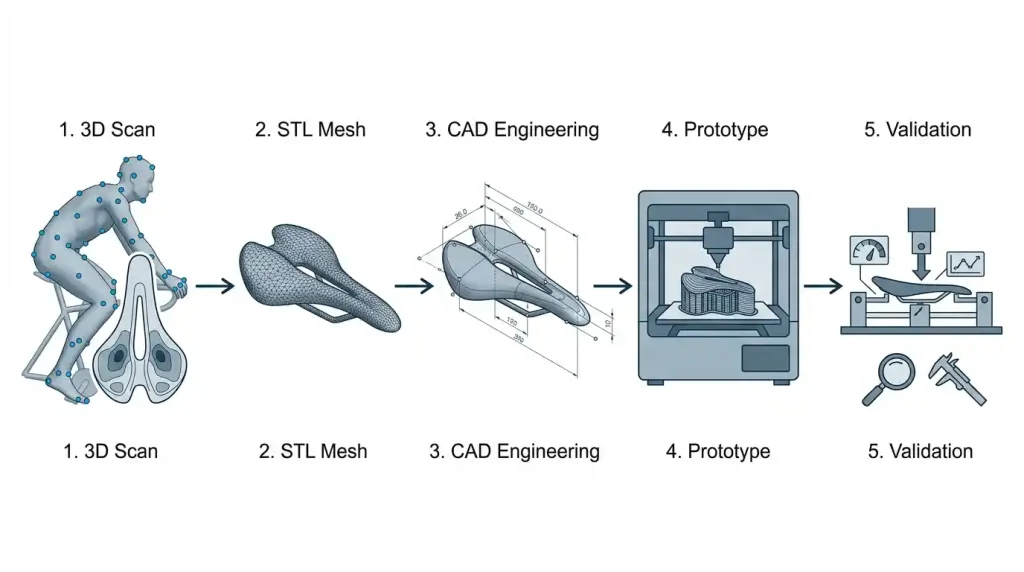
Rider measurement → 3D scan → STL geometry → CAD engineering → Prototype → Validation → Production
The purpose of STL is not to replace engineering development, but to accelerate the transfer of complex three-dimensional information.
1.2 STL Geometry: Advantages and Limitations
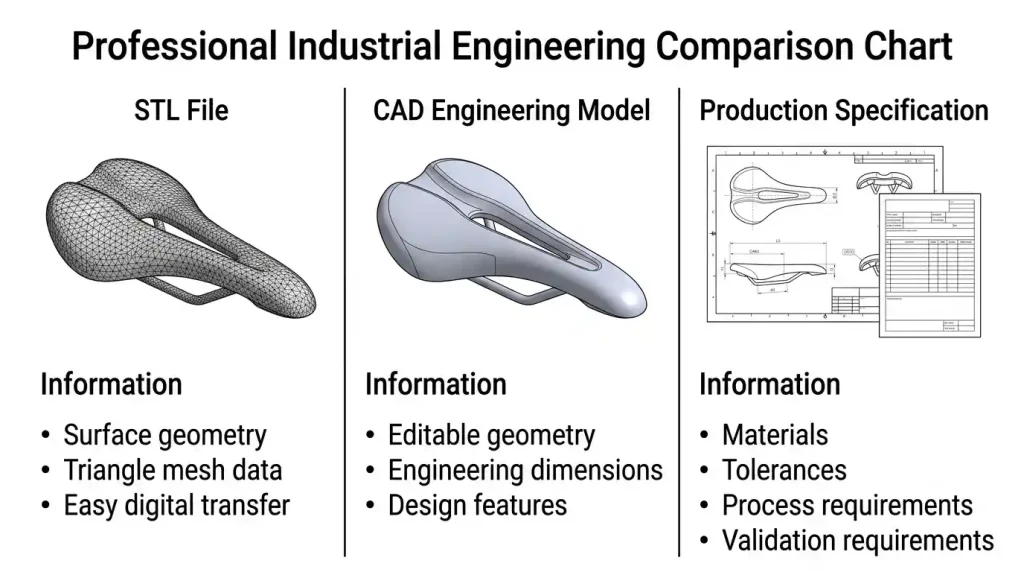
STL (Standard Tessellation Language) represents a three-dimensional surface using triangular mesh geometry.
Its advantages include:
- Easy transfer between digital systems
- Compatibility with additive manufacturing equipment
- Ability to capture complex organic surfaces
- Fast visualization of customized shapes
However, STL has important limitations.
An STL file does not normally contain:
- Material properties
- Fiber orientation
- Manufacturing tolerances
- Injection molding requirements
- Assembly information
- Fatigue performance data
Therefore:
STL geometry is an input for engineering development, not a finished manufacturing specification.
A professional bicycle saddle manufacturer must convert STL data into production-ready engineering decisions.
2. From STL Data to Production-Ready Bicycle Saddles
2.1 Rider Data Acquisition and Digital Modeling
A custom bicycle saddle workflow may begin with several information sources:
- Rider sit-bone measurements
- 3D body scanning
- Existing saddle geometry
- Pressure mapping analysis
- Riding position information
The STL model provides a geometric reference for further engineering work.
However, raw scanning data usually requires optimization before production.
Important processing steps include:
| Digital Processing Step | Engineering Purpose |
|---|---|
| Mesh cleaning | Remove scanning noise and errors |
| Surface smoothing | Improve geometric continuity |
| Feature reconstruction | Define mounting and structural areas |
| Dimensional adjustment | Adapt geometry for manufacturing |
| CAD reconstruction | Create editable engineering models |
The transition from STL to CAD is one of the most important stages because production requires controlled geometry rather than only visual similarity.
2.2 Engineering the Saddle System
A bicycle saddle is not a single component. It is an integrated mechanical system consisting of:
- Shell structure
- Padding layer
- Cover material
- Rail system
Each part requires different engineering considerations.
Saddle Shell
The shell controls the primary structural response.
For composite saddle shells, engineers must consider:
- Fiber orientation
- Laminate structure
- Resin system
- Stress concentration areas
For polymer shells, engineers must consider:
- Wall thickness
- Rib structure
- Injection molding parameters
- Material shrinkage
The final performance depends on design and manufacturing control, not only material selection.
Padding and Comfort Structure
Traditional foam padding and advanced lattice structures have different manufacturing requirements.
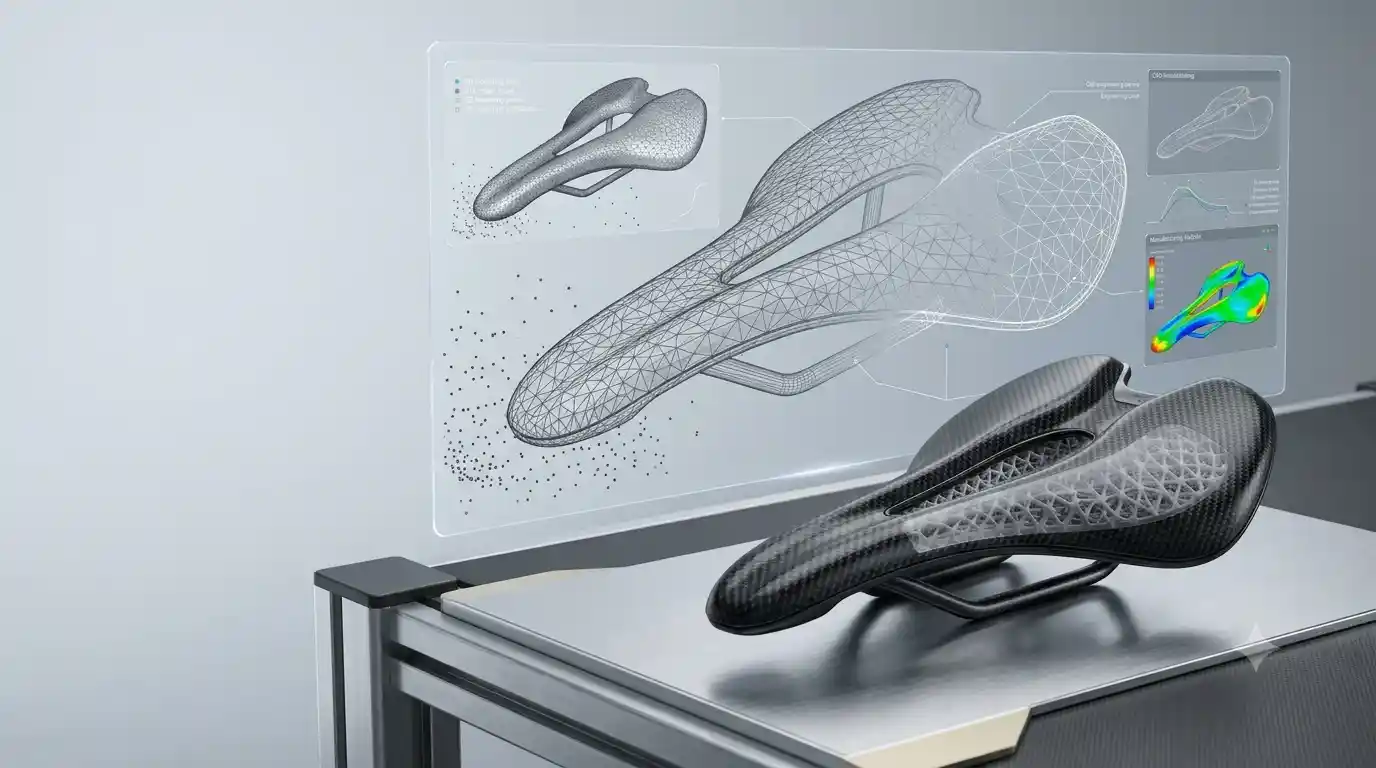
A lattice structure generated from digital geometry may provide new design possibilities, but production engineers must evaluate:
- Material durability
- Environmental resistance
- Manufacturing repeatability
- Long-term deformation behavior
A digital structure must still survive real-world cycling conditions.
Rail System Reliability
The saddle rail transfers rider loads into the bicycle frame.
Because cycling creates repeated loading cycles, rail design should focus on fatigue performance rather than only static strength.
Engineering evaluation may involve fatigue concepts such as:
- Basquin fatigue relationship
- Miner cumulative damage rule
Applicable bicycle component safety requirements should be considered where relevant, including standards within the ISO 4210 series.
3. Illustrative Industrial Scenario: Digital Workflow Adoption
3.1 Typical Manufacturing Problem
Illustrative scenario only:
A bicycle brand wants to develop a premium personalized saddle program.
The company faces several challenges:
- Multiple physical prototype iterations
- High engineering communication costs
- Difficulty transferring rider-specific geometry into production
- Uncertainty about whether customized designs can scale commercially
The company evaluates an STL-based workflow.
3.2 Digital Solution Approach
The workflow becomes:
- Capture rider geometry digitally
- Convert data into engineering CAD models
- Develop prototype saddles
- Validate structural and ergonomic requirements
- Establish production parameters
The digital workflow reduces unnecessary physical iteration, but it does not remove the need for engineering validation.
The critical transition remains:
Digital model → Manufacturable product → Repeatable production
4. TCO Analysis for OEM Bicycle Saddle Buyers
4.1 STL Development Changes Cost Distribution
Digital manufacturing does not automatically reduce all costs.
Instead, it shifts investment toward different areas.
The main cost categories include:
| Cost Category | Typical Content |
|---|---|
| Digital engineering | Scanning, STL processing, CAD development |
| Prototype development | Additive manufacturing or rapid prototype methods |
| Validation | Mechanical and durability testing |
| Tooling | Injection molds or composite tooling |
| Production | Materials, labor, quality control |
| Supply chain | Logistics, inventory, supplier management |
4.2 Total Cost of Ownership Framework
For OEM decision-makers:
TCO = Development Cost + Manufacturing Cost + Quality Cost + Supply Chain Risk Cost
A supplier with the lowest quotation may not always provide the lowest total lifecycle cost.
Important evaluation factors include:
| Production Stage | Primary Business Concern |
|---|---|
| Prototype stage | Speed of iteration |
| Small batch production | Flexibility and customization |
| Mass production | Yield, tooling amortization, consistency |
For premium custom saddle programs, digital workflows may create value by improving development efficiency.
For high-volume standard products, traditional manufacturing approaches may remain more economically suitable.
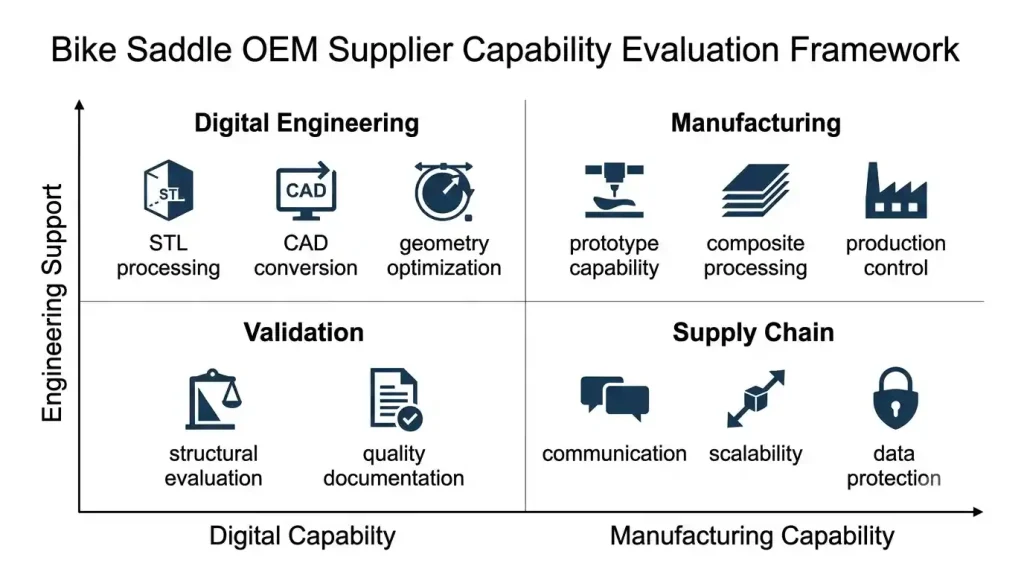
5. How OEM Buyers Should Evaluate a Bike Saddle Manufacturer
A capable bicycle saddle supplier should demonstrate more than production capacity.
5.1 Digital Engineering Capability
Evaluate whether the supplier can:
- Process STL files
- Convert mesh data into engineering models
- Optimize geometry for manufacturing
- Protect customer design data
5.2 Manufacturing Capability
Important questions include:
- Does the supplier have prototype development capability?
- Can production processes scale from samples to volume manufacturing?
- Are quality checkpoints defined?
- Are material and process records maintained?
5.3 Engineering Validation Capability
Before commercial production, buyers should understand:
- What mechanical validation is performed?
- How are structural risks evaluated?
- How are production deviations controlled?
A reliable supplier combines digital capability with manufacturing discipline.
6. Strategic Value of STL-Based Saddle Development
STL technology creates new possibilities for bicycle brands:
- More personalized saddle programs
- Faster product iteration
- Better integration between rider data and engineering
- New opportunities for premium products
However, STL alone does not create competitive advantage.
The advantage comes from combining:
Digital Geometry + Engineering Knowledge + Manufacturing Process Control
Companies that successfully connect these three elements can develop customized products while maintaining commercial reliability.
Actionable Next Steps for Bicycle Brands
Before launching an STL-based custom saddle program:
Step 1 — Evaluate Digital Capability
Review scanning, CAD, and data management requirements.
Step 2 — Validate Prototype Workflow
Confirm that digital models can become functional saddle prototypes.
Step 3 — Select Manufacturing Route
Choose additive, hybrid, or conventional production according to volume requirements.
Step 4 — Establish Quality Controls
Define inspection procedures and validation requirements.
Step 5 — Build Long-Term Supplier Partnership
Select manufacturers capable of supporting engineering development, not only production.
📥 B2B Decision-Maker Resource Suite
Custom Saddle Development Checklist
STL processing, CAD conversion, engineering review, and manufacturing readiness evaluation.
OEM Saddle TCO Framework
Development investment, tooling considerations, production economics, and supply-chain risk analysis.
Engineering Validation Guide
Structural design review, fatigue considerations, and quality documentation requirements.