There is no component more personal — or more costly when specified incorrectly — than a bicycle saddle. Frames, wheels, and groupsets deliver numbers you can defend in a product review. A saddle does not. The same platform that earns strong comfort scores on one complete bike can generate elevated return rates, warranty claims, and retailer friction on another if geometry, foam behavior, or rail specification fails to match the intended rider, position, and use case.
For brand managers, product managers, and sourcing teams, the decision is never simply which saddle looks clean on a CAD render. It is an engineering, commercial, and supply-chain decision that directly affects rider experience, margin, and long-term brand trust. Consumer education correctly begins with sit-bone width and bike fit. The professional version begins in the same place and then moves upstream into tooling ownership, foam compression-set targets, rail torque tolerance, MOQ economics, factory process control, and the quiet ways suppliers protect or re-use molds.
This guide is written for people who issue RFQs, conduct factory audits, and ultimately own the return-rate number. It converts the ergonomics that actually matter into the language of manufacturing capability, risk allocation, and landed cost.
Rider Reality First — Before Unit Price Discussions
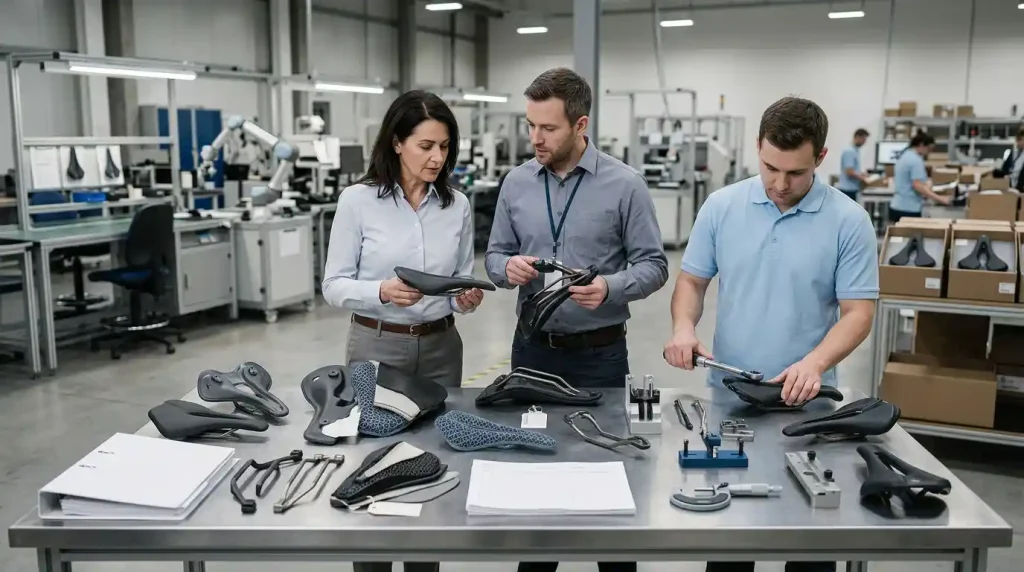
Most saddle discomfort is still not the saddle’s fault. The same principle applies on the B2B side, only the commercial consequences are larger.
Geometry and position dominate. A saddle that is too high, too low, or paired with aggressive reach shifts load onto soft tissue that no channel depth can fully resolve. For complete-bike programs the saddle specification must be developed in parallel with frame geometry and recommended fit ranges, not selected from a catalog after the frameset is tooled. E-bike platforms introduce three additional constraints: more upright postures, higher average system weight, and longer low-speed or stationary dwell times. These favor wider platforms, dual-density or zone-tuned lattice padding, and reinforced rails that resist creak and sag under higher static loads.
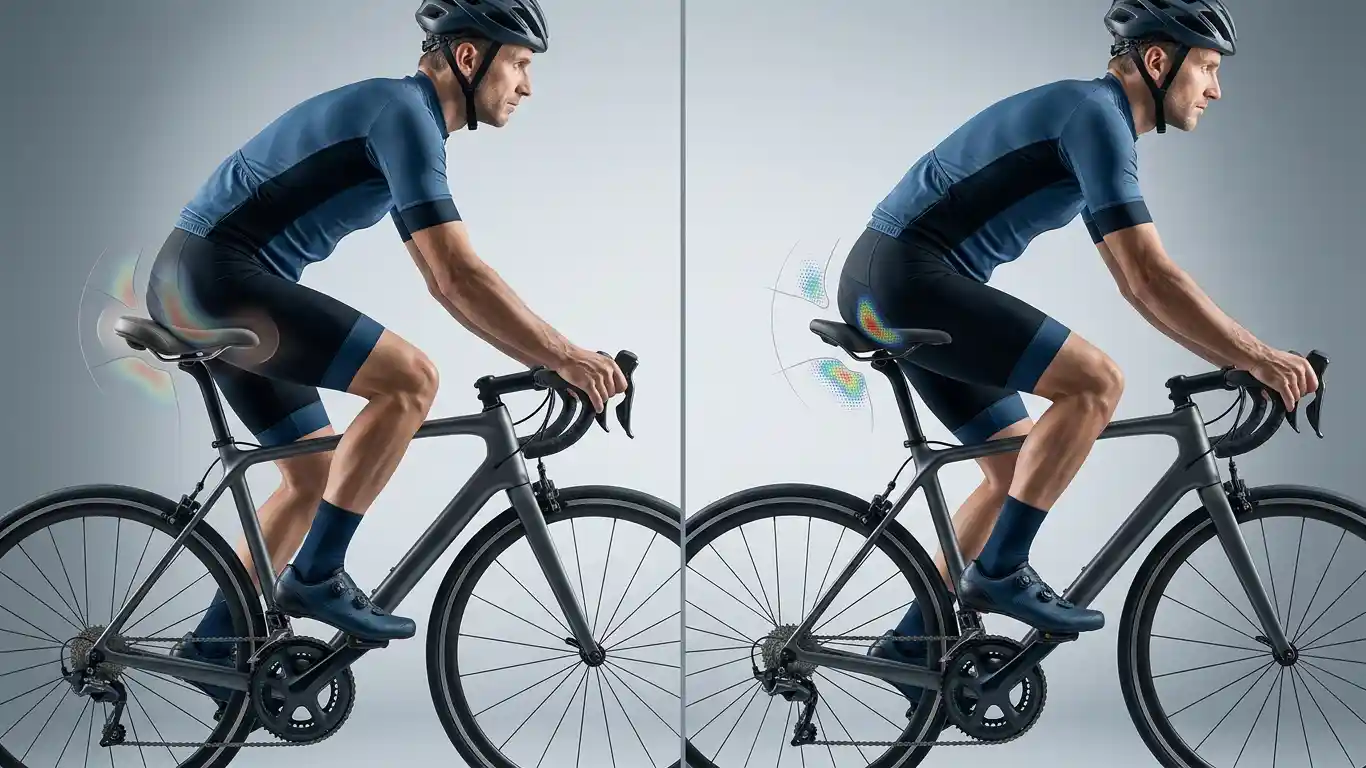
Chamois interaction is measurable. Foam that feels compliant in a short showroom evaluation can collapse under multi-hour loads and recreate the same pressure points as a worn chamois. Specify compression set (permanent deformation after sustained load) and cover abrasion resistance against the apparel ecosystem your riders actually use.
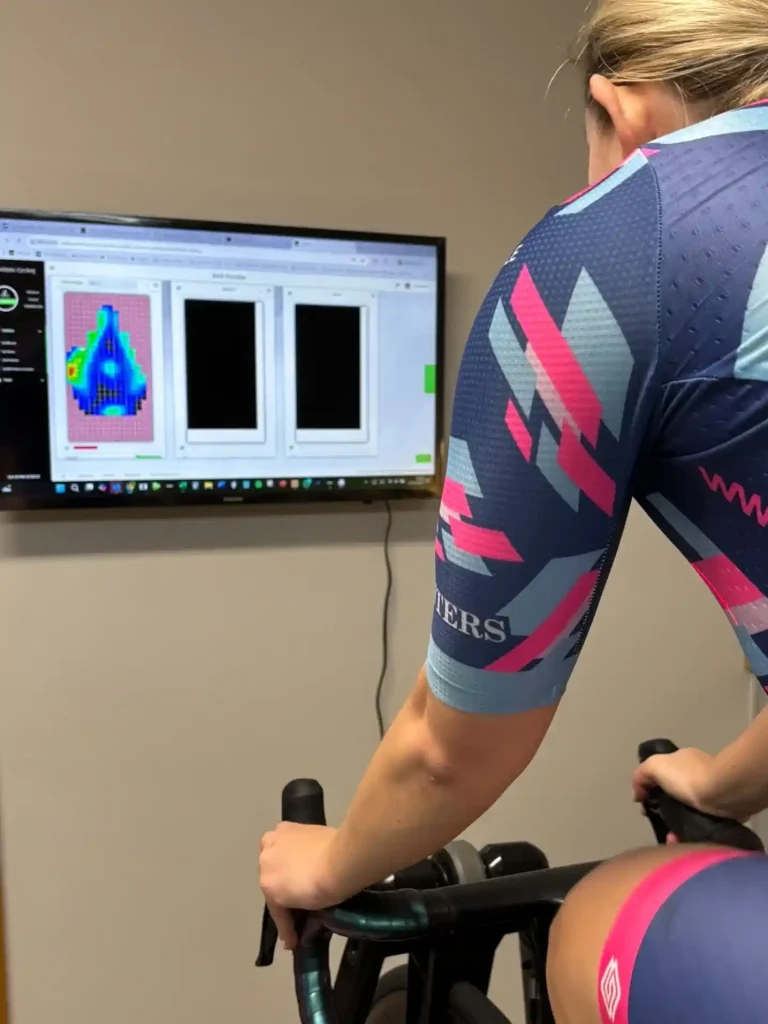
Sit-bone width remains the highest-leverage starting measurement. Systems developed by SQlab and later adopted or adapted by Specialized Body Geometry, Selle Italia idmatch, and professional fit tools consistently show that measured ischial tuberosity distance plus a posture-dependent offset (typically +20–30 mm for road/endurance positions) provides the most reliable width starting point. Two riders with identical sit-bone width can still require different shapes because of pelvic rotation. Static sit-bone devices or dynamic pressure-mapping mats convert this from opinion into data. Brands that run even basic pressure-mapping validation on prototypes routinely observe measurable reductions in early return rates — often sufficient to justify the testing investment within the first production season.
A recurring pattern: a brand launches a “comfort” saddle based on visual similarity to a successful competitor, skips mapping validation, and later discovers that channel-edge transitions create pressure ridges for a meaningful share of the target demographic. The corrective action then requires either a tooling revision or a quiet product refresh — both more expensive than the original validation step.
Shape, Profile, and the Engineering Decisions That Survive Volume Production
Flat versus curved. Flat profiles allow riders to shift fore-aft and remain preferred for performance road, gravel, and racing platforms. Curved or stepped profiles cradle a more fixed position and appear more frequently on comfort, urban, and many e-bike lines.
Central channel or cut-out. Depth, width, and edge radius matter more than the mere presence of a relief feature. Extreme noseless or split-nose designs relocate contact points forward and form a distinct category for triathlon and aero-bar intensive use.
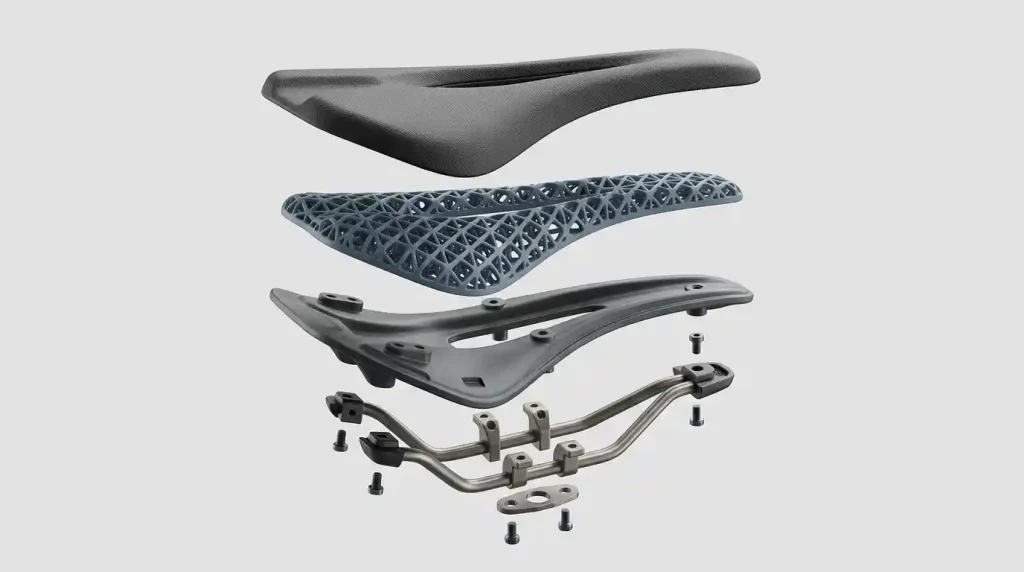
Padding density paradox. Soft foam sells in short evaluations. Firmer, higher-resilience foam or zone-tuned 3D lattice usually performs better on multi-hour rides because it maintains support under the sit bones instead of allowing them to sink and generate shear. Dual-density or multi-layer constructions (high-rebound base plus slower-recovery top layer) are standard on comfort and e-bike platforms. 3D-printed TPU lattice permits density to be varied zone-by-zone and is progressing from premium outliers into broader volume programs. When evaluating lattice samples, request the density map and sustained-load compression data, not only the marketing visualization.
Shell. Volume programs predominantly use injection-molded nylon composite or carbon-reinforced polymer. Full carbon shells appear on ultralight performance models. Shell stiffness influences power transfer, vibration damping, and long-term creep. Crash durability and rail-interface integrity are non-negotiable quality checkpoints.
Rails. CrMo or manganese steel remains the durability and cost foundation. Titanium occupies the weight/durability sweet spot for mid-to-high performance. Carbon rails reduce mass and can add compliance but require compatible clamps and strict torque control; they are unforgiving of over-tightening during assembly or in the field. Specify diameter, any ovalization, and fixation method (adhesive ports, mechanical, or over-molded).
Cover. Synthetic microfiber and technical textiles dominate volume production because they deliver consistency, weather resistance, and minimal break-in. Traditional leather still appears in certain touring or heritage lines but carries weight, conditioning time, and maintenance expectations. Surface friction and abrasion resistance should be written into the specification and verified.
Manufacturing Sequence and Where Cost and Risk Concentrate
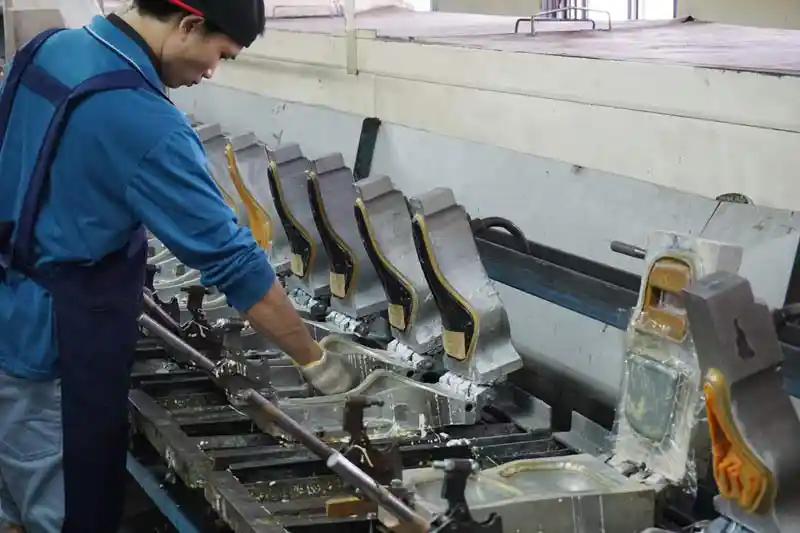
High-volume conventional saddles follow a predictable process:
- Injection molding of the shell in a steel or aluminum mold.
- Foam application — poured or injected polyurethane, or cut closed-cell foam bonded with adhesive. Multi-layer constructions require sequential steps.
- Cover cutting (die or laser) and tensioned application so the material follows the shell without wrinkles or residual stress.
- Rail insertion and fixation.
- Trimming, multi-stage inspection, and packaging.
Cycle time, cavity count, and automation level determine capacity and unit economics. Premium European facilities still rely on skilled hand finishing for selected steps; high-volume Asian clusters (notably Zhejiang, Guangdong, and Shenzhen) emphasize process control and multi-stage quality checkpoints for consistency at scale. 3D-lattice programs move the cushioning step to additive manufacturing before integration with a conventional or carbon shell and rails.
Tooling is the decision gate most buyers under-estimate. A new shell mold, foam mold, and rail fixtures represent non-recurring engineering (NRE). Open or shared platforms reduce this cost and accelerate launch. Exclusive molds protect differentiation but raise minimum order quantity, lock capital, and create exit friction. Always document ownership, maintenance responsibility, modification rights, and disposition of the tools at the end of the commercial relationship. A frequent outcome: a brand funds exclusive tooling, later changes suppliers, and discovers residual process knowledge (and sometimes usable cavities) that shortens a competitor’s development timeline.
OEM vs ODM vs Private Label — Match the Model to Risk and Differentiation Needs
| Model | Design Ownership | Tooling | Typical Time-to-Market | Best For | Primary Risk |
|---|---|---|---|---|---|
| Private Label | Supplier platform | Usually shared | Fastest | Testing demand, catalog fill, low risk entry | Limited differentiation |
| OEM | Buyer specifications | Often dedicated | Medium | Brands with clear technical requirements | Documentation burden, higher NRE |
| ODM | Supplier development | Shared or exclusive | Medium to longer | Brands needing differentiation without full internal engineering | IP clarity, process dependence |
Most commercial programs sit on a continuum: begin with a proven platform, then iterate geometry, density zones, or rail options. Clarify intellectual-property ownership, tooling ownership, and sample-revision cycles in writing before any deposit is transferred.
MOQ, Lead Times, and the Numbers That Move Landed Cost
Observed ranges across volume suppliers:
- Sampling on existing platforms: commonly 10–15 days.
- New tooling development: measured in weeks to several months depending on complexity.
- Mass production after sample approval: typically 30–45 days for orders in the 500–1,000 unit range (subject to material availability and factory loading).
- MOQ: can begin in the low hundreds for standard platforms; exclusive molds push the threshold higher to amortize NRE. Meaningful unit-cost reductions usually appear above 1,000–3,000 units as material purchasing and setup costs are spread.
Unit cost is driven by shell material and complexity, foam type and zoning (or lattice), rail material, cover quality, packaging level, and order volume. Request quotes against identical written specifications. Model full landed cost including tooling amortization, samples, payment terms, Incoterms, duties, and expected defect or return rates.
A common commercial trap: an attractive unit price that assumes shared tooling the supplier later intends to re-use, or foam density optimized for cost rather than the compression-set target the brand requires.
Quality Systems and Acceptance Criteria That Protect the Brand
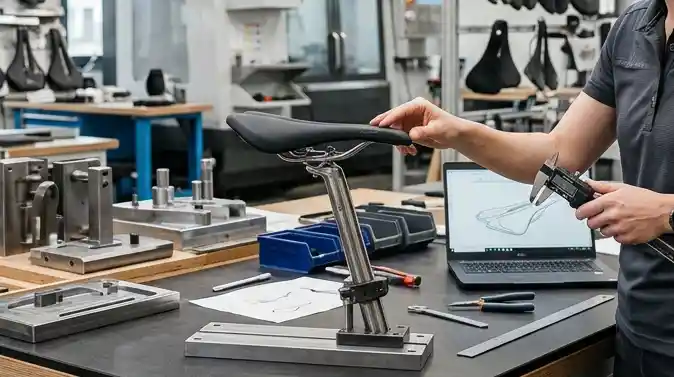
Prioritize suppliers able to demonstrate:
- ISO 9001 (or equivalent) quality management.
- Material traceability from incoming resins and metals through finished goods.
- Multi-stage in-process and final inspection.
- Relevant market compliance documentation (CPSC, CE, REACH/RoHS as applicable).
- Test data for rail strength, shell impact, foam compression set under sustained load, cover abrasion, and weather resistance.
Defect rates consistently under 1 % are realistic for well-controlled lines. Higher rates should trigger process audits. Factory audits (virtual or on-site), physical sample evaluation under pressure mapping or controlled riding, and explicit written quality acceptance criteria (including defect thresholds and rework responsibility) separate reliable partners from opportunistic ones. Packaging must protect against moisture, crushing, and transit damage — a non-trivial share of “defective” product arrives that way.
Practical Sourcing Framework for the Next RFQ
- Define rider use case, target geometry, demographic considerations, and performance priorities (weight, multi-hour comfort, e-bike loads).
- Establish sit-bone measurement and pressure-mapping validation criteria for prototypes.
- Decide customization depth (private label, OEM, or ODM) and the IP/tooling ownership model.
- Shortlist manufacturers with relevant process capability, certifications, export track record, and engineering support bandwidth.
- Issue a written specification and request samples; validate with pressure mapping or controlled field testing.
- Negotiate MOQ, tooling ownership and maintenance, lead times, payment terms, and explicit quality acceptance criteria.
- Lock packaging, labeling, documentation, and compliance requirements for target markets.
- Embed ongoing sampling and continuous-improvement feedback into the commercial agreement.
Frequently Asked Questions
What MOQ should I expect for custom bicycle saddles?
Standard platforms can start in the low hundreds of units. Exclusive molds typically require higher volumes to amortize tooling. Volume breaks above 1,000–3,000 units usually deliver meaningful unit-cost reductions.
How long does saddle tooling development take?
Existing-platform samples commonly require 10–15 days. New exclusive tooling ranges from several weeks to a few months depending on complexity and mold type.
Who owns the molds?
This must be contractually defined. Buyer-funded exclusive tooling should include clear ownership, maintenance, modification, and disposition clauses. Shared or open molds remain with the supplier.
What certifications matter for a saddle supplier?
ISO 9001 for quality management systems, plus market-specific compliance (CPSC for the United States, CE for Europe, REACH/RoHS for materials). Request material test reports for rails, shell polymers, and foam.
How important is pressure mapping in the development process?
It converts subjective comfort claims into objective data. Brands that validate prototypes with sit-bone measurement and dynamic pressure mapping consistently reduce early return rates and strengthen product claims.
OEM vs ODM vs private label — which should I choose?
Private label for speed and lowest risk. OEM when you have detailed specifications and want control. ODM when you need differentiation but lack full internal engineering resources. Most programs combine elements of more than one model.
Closing Perspective
The brands that treat the saddle as a strategic fit component rather than a commodity line item consistently record lower return rates, stronger product reviews, and higher retailer confidence. The engineering and commercial decisions made at the sourcing stage determine whether that outcome is achievable at scale and at acceptable margin.
Start with accurate rider data. Write the specification tightly. Own the tooling conversation. Then select the partner capable of converting anatomical and positional requirements into consistent, manufacturable reality across multiple production seasons.
If your team is evaluating OEM, ODM, or private-label saddle programs — including conventional, e-bike-optimized, or 3D-lattice constructions — a structured technical discussion of geometry targets, foam performance, tooling strategy, and quality acceptance criteria is the most efficient next step.