How to Evaluate a Bicycle Saddle Supplier Before Placing a B2B Order
The best bicycle saddle supplier is not necessarily the one with the lowest price, the largest catalog, or the fastest sample. For B2B buyers, the stronger supplier is the one that can define the product clearly, reproduce the approved specification, control production variation, support applicable testing, and communicate evidence throughout the project.
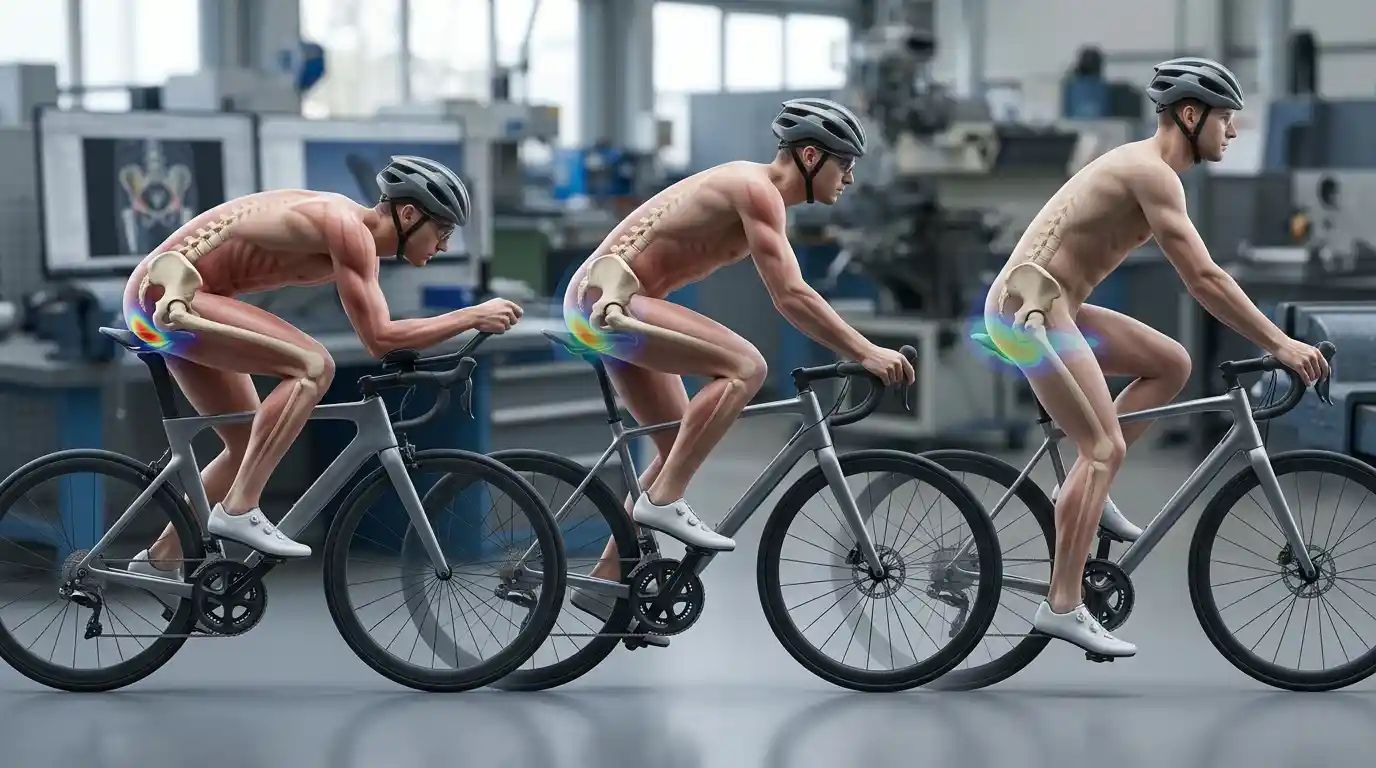
That distinction matters because a saddle is an integrated product. Width, shape, shell construction, padding, rails, cover, and riding position interact with one another. Research has shown that saddle width can affect pressure distribution, while results also depend on rider characteristics and test conditions. One controlled study of female cyclists found that saddle width influenced measured pressure distribution, illustrating why a specification should be matched to the intended application rather than selected from a catalog by appearance alone.
For brands, importers, distributors, and OEM buyers, supplier evaluation should therefore follow a risk-based sequence: product definition → engineering → factory capability → sample approval → testing → quality control → production → commercial terms.
Start With the Product, Not the Quotation
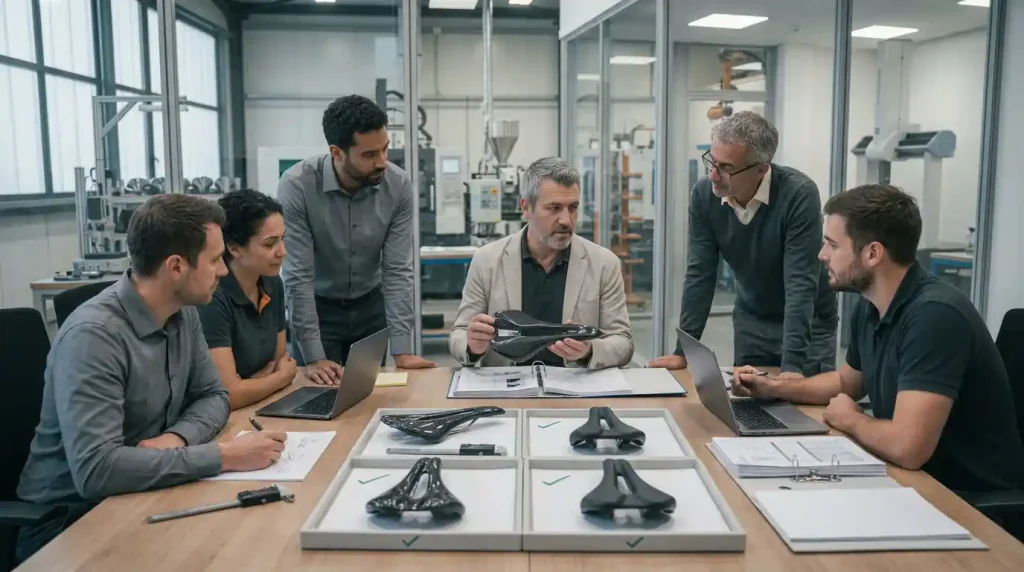
Before comparing factories, define what you are actually buying.
At minimum, document:
- Intended bicycle and riding application
- Saddle width and overall geometry
- Shell construction and material
- Padding material and construction
- Rail configuration
- Cover material and finish
- Branding requirements
- Target weight and acceptable tolerances
- Packaging and labeling requirements
This prevents a common sourcing problem: comparing prices for products that only appear similar.
A supplier may offer an existing saddle, modify an existing platform, or develop a new design. Those are different projects with different development, tooling, sampling, and production implications.
The useful question is not:
“Can you make this saddle?”
It is:
“Can you make this saddle to a controlled specification, repeatedly?”
Evaluate the Saddle as a Complete System
Shell and Geometry
The shell establishes much of the saddle’s structural shape. For OEM and ODM projects, buyers should request a documented specification rather than relying on terms such as “reinforced” or “premium.”
Padding
Padding should be judged by intended application, not thickness alone. Greater softness does not automatically mean greater comfort, because pressure distribution depends on geometry, padding characteristics, rider anatomy, and position.
Rails
Rail material and configuration affect the product’s structural design, weight, cost, and manufacturing requirements. The correct choice is the one that fits the intended product and applicable validation requirements—not the material with the strongest marketing language.
Cover
Cover material, surface texture, stitching or bonding, logo application, and cosmetic tolerance should be included in the production specification. Appearance differences that seem minor on one sample can become significant across a large order if acceptance criteria are not defined.
Check Whether You Are Dealing With a Factory or a Trading Company
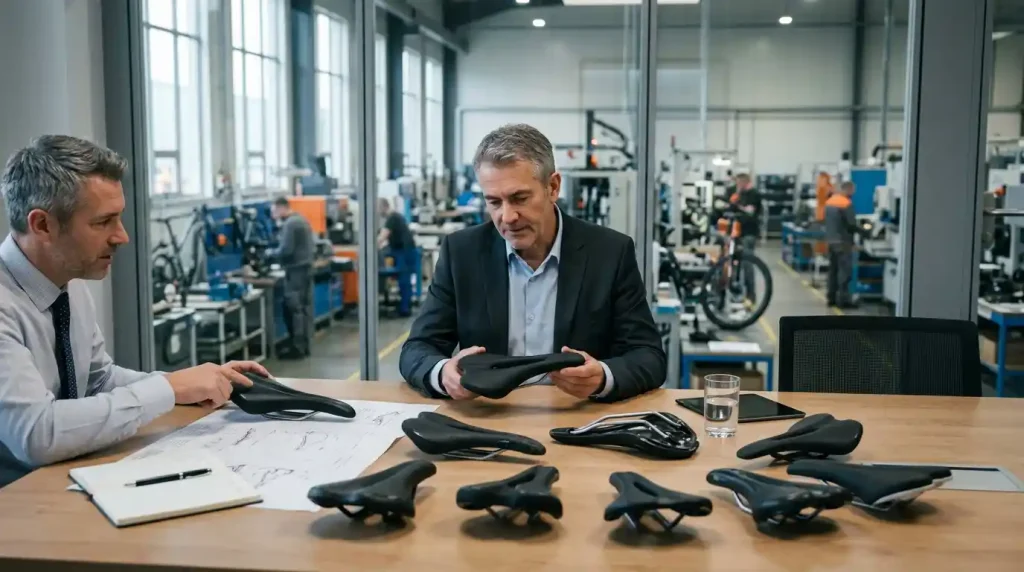
A supplier’s website is not enough to establish manufacturing capability.
Before a major OEM order, ask for evidence covering:
- Legal company identity and manufacturing location
- Which processes are performed in-house
- Which processes are outsourced
- Tooling and product-development capability
- Production equipment relevant to the product
- Quality-control responsibilities
- Production capacity for your expected order volume
- Recent product samples matching the proposed manufacturing process
The important distinction is not that trading companies are automatically unsuitable. A trading company may provide useful sourcing and project-management services. The issue is whether its manufacturing chain is transparent enough for the risk level of your project.
For a custom saddle, you should know who owns the tooling, who controls the specification, and who is responsible when production deviates from the approved sample.
A Sample Is Not Proof of Mass-Production Consistency
A development sample answers one question:
Can the supplier produce an acceptable unit?
Mass-production approval requires another:
Can the supplier reproduce that unit consistently?
A stronger process is:
Product specification → development sample → approved reference sample → production inspection criteria
Ask the supplier:
- Which dimensions are controlled?
- What tolerances are specified?
- Which materials are fixed?
- How are incoming materials inspected?
- How are production defects classified?
- What happens when a deviation is found?
- How is the approved sample retained as a production reference?
This is where supplier quality becomes more important than presentation quality.
Verify Testing by Scope, Not by Claims
ISO 4210-9:2023 specifies test methods for saddles and seat posts in connection with ISO 4210-2. ISO 4210-2:2023 defines safety and performance requirements for specified bicycle categories, including city and trekking, mountain, and racing bicycles within its stated scope.
That does not mean every saddle project automatically has the same testing obligation. Applicable requirements depend on the bicycle category, product configuration, destination market, and commercial requirements.
Before approval, ask:
- Which standard or market requirement applies?
- What test was performed?
- Which product configuration was tested?
- When was the test completed?
- Can the report be matched to the actual production specification?
A supplier saying “ISO tested” is less useful than a supplier that can identify the applicable standard, test scope, product configuration, and supporting documentation.
Quality Control Should Cover the Whole Production Flow
A low price is not automatically a quality problem. Uncontrolled variation is.
Evaluate quality control in three stages:
Incoming control: Are materials and components checked against the approved specification?
Process control: Are critical manufacturing and assembly steps monitored?
Final control: Is the finished saddle inspected before packing and shipment?
Also ask how the supplier handles nonconforming products. Inspection matters, but corrective action matters too.
A useful indicator of production maturity is whether the supplier can maintain the same specifications, material records, inspection criteria, and approved references for repeat orders.
Evaluate MOQ, Lead Time, and Capacity Together
MOQ should never be judged in isolation.
Ask whether the quoted MOQ applies to:
- Existing catalog products
- Private-label branding
- Custom colors or covers
- New tooling
- New shell geometry
- Fully customized ODM products
Lead time should also be separated into stages:
Sample lead time → tooling/development time → bulk production time → reorder lead time
Then ask what happens during peak production periods.
A supplier may be perfectly suitable for a 500-unit trial order but unsuitable for a program requiring reliable replenishment at much higher volumes. Capacity should therefore be evaluated against your expected demand, not the supplier’s maximum advertised capacity.
Use Customization Where It Creates Value
Customization can range from simple branding to genuine product development.
Lower-complexity changes may include logo application, color, packaging, or labeling. More complex changes can involve cover materials, rails, padding architecture, shell geometry, or new tooling.
Each additional variable can increase development and quality-control requirements.
The best OEM question is therefore not:
“What can you customize?”
It is:
“Which customization improves this product enough to justify its additional cost and production risk?”
That keeps customization connected to a real market requirement.
A Practical Bicycle Saddle Supplier Scorecard
Use a common scoring system when comparing several suppliers.
| Evaluation Area | Suggested Weight |
|---|---|
| Product & engineering capability | 20% |
| Quality-control system | 20% |
| Testing & documentation | 15% |
| Manufacturing capability & capacity | 15% |
| OEM/ODM development capability | 10% |
| Sample and communication process | 10% |
| Commercial terms & price | 10% |
These weights are a buyer-created evaluation framework, not an industry standard. The principle is what matters: price should not dominate the decision when technical and quality risks are much more significant.
Score every supplier against the same evidence. Avoid giving high marks for claims that cannot be verified.
Supplier Questions to Ask Before the Final Quote
A serious supplier should be able to answer these questions clearly:
Product: What is the confirmed specification?
Factory: Which processes are performed in-house?
Engineering: What changes require new tooling or development?
Quality: What are the incoming, in-process, and final inspection controls?
Testing: Which requirements apply, and what evidence is available?
Production: What are the MOQ, development stages, lead times, and realistic capacity for this project?
Repeat orders: How will the supplier ensure that future production matches the approved specification?
The quality of these answers is itself useful purchasing evidence.
Conclusion
Choosing a bicycle saddle supplier is ultimately a risk-management decision, not a price-shopping exercise.
A strong supplier should be able to demonstrate five things: a clearly defined product, suitable engineering capability, controlled production, relevant testing evidence, and a repeatable quality process.
The safest sourcing path is to define the saddle first, verify the manufacturing capability second, approve the sample against measurable criteria, confirm applicable testing, and only then make the final commercial comparison.
For OEM and ODM buyers, the critical question is simple:
Can this supplier repeatedly manufacture the exact product we approved at the quality level our market requires?
When the answer is supported by specifications, samples, inspection procedures, testing records, factory evidence, and clear production terms, the purchasing decision becomes much easier to defend—and much less dependent on the supplier’s sales pitch.