
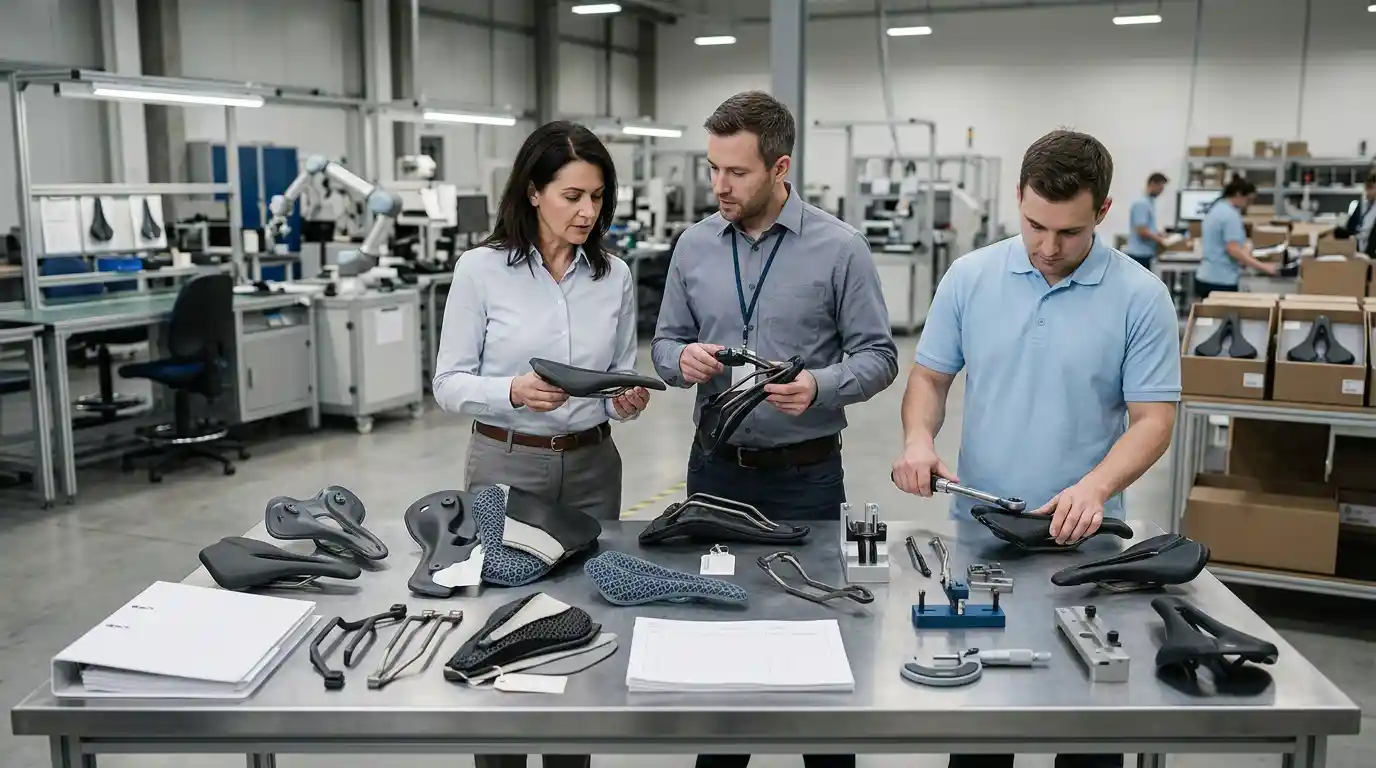
How Can Buyers Verify Bicycle Parts Compatibility Before Ordering?
Identify the exact interface, confirm the approved component combination in current manufacturer documents, and test a sample on the target bicycle before committing to volume. A part that fits in a product photo may differ in axle, mounting pattern, chainline, cable pull or electronic system compatibility. Model names alone are often too broad. For a procurement team, the correct unit of work is a documented assembly, not an isolated catalog SKU.
A recent replacement-crankset discussion shows the buyer’s fear clearly: the owner wanted to avoid purchasing a crank that would not work with the existing SRAM setup, while also weighing a repair against a roughly $500 upgrade. A professional buyer faces the same logic multiplied across service inventory or a production run. An inexpensive unit price is irrelevant if the part creates rework, warranty claims or stranded stock.
Key Takeaways
- Capture the bicycle’s exact year, frame, existing component model and measured interface before quoting a replacement.
- Check the component maker’s current compatibility and service documents; do not infer compatibility from speed count or brand alone.
- Approve a physical sample and a revision-controlled parts list before volume procurement.
What should be recorded before requesting a quote?
Build a baseline record from the bicycle or assembly being serviced. At minimum, record the frame and fork model, model year where known, existing component codes, wheel and axle interfaces, drivetrain speed and mounting details relevant to the part. Photographs of the existing assembly and its markings can prevent a supplier from quoting a visually similar but incompatible version. Where a dimension matters, include the measurement method and tolerance rather than a guess.
The fields vary by category. For a crank, record shell standard, spindle interface, chainline, chainring mount and frame clearance. For a brake, record mount, rotor and control pairing. For a wheel, record axle, hub spacing, freehub and brake interface. These are verification questions, not approved combinations.
| Purchase category | Interface evidence | Assembly evidence | Buyer sign-off |
|---|---|---|---|
| Crank and bottom bracket | Frame shell, spindle and mounting drawings | Maker’s approved combination | Installed sample clears frame and shifts correctly |
| Brake | Mount, rotor and control specifications | Approved lever, caliper and rotor pairing | Functional inspection and relevant safety test |
| Wheel or hub | Axle, spacing, freehub and brake mount | Frame/fork and drivetrain fit | Fit and retention check |
| Saddle and seatpost | Rail profile and clamp requirements | Seatpost maker’s rail approval | Clamp fit and torque documentation |
The point is to make compatibility auditable. If a later batch fails, the buyer should be able to compare what was specified, what was approved and what arrived. The related supplier qualification guide covers authenticity and change control.
Where should buyers verify a claimed combination?
Start with the original component manufacturer’s technical documents. Shimano’s product-information portal publishes current line-up, specifications and compatibility material; its index showed a September 2026 compatibility update when checked for this article. A distributor’s listing may be useful for stock, but it should not override a current manufacturer compatibility chart or service manual. For other brands, request the equivalent official documentation from the manufacturer.
Here is a worked hold/approve path for the bottom-bracket interface, not approval of a complete drivetrain. Shimano’s CUES technical document, bottom-bracket table lists BB-RS501 for a 68/70 mm threaded shell and BB-RS500-PB for an 86.5 mm press-fit shell. Suppose a buyer records a hypothetical frame as 68 mm, threaded, using a measured shell and confirmed thread type. The shell dimension rules out the 86.5 mm press-fit candidate for this frame; it does not yet approve BB-RS501. The buyer must identify the crank model, check the current maker chart and installation instructions for that exact pairing, and inspect chainline and frame clearance on the built bicycle. If the crank is unknown, write shell candidate identified; assembly HOLD. If the chart permits the exact pairing and the installed checks pass, record assembly approved for build ID only with the engineer’s name. A mismatched shell, missing chart entry or failed clearance check is a rejection, not a substitution opportunity.
Record document title, revision or publication date, page and access date. A chart may separate road, MTB, e-bike or cargo applications or condition a pairing on an adapter, firmware or chain. If a seller claims an exception, request written confirmation from the component maker or qualified technical support. An online comment is not engineering approval.
For a superseded part, record original and substitute numbers, changed dimensions or hardware, maker evidence and approver. An approval for one assembly does not automatically cover another.
How should a sample be evaluated before the bulk order?
Order the exact proposed SKU and install it on a representative target bicycle. Document the assembly with photos and a signed fit check. Verify the mating interfaces, clearances, function through the full operating range and whether installation follows the maker’s instructions. A test on the wrong frame size or a different drivetrain may miss the problem that matters in production.
Define the checklist before the sample arrives. A fictional first-gate record, with verified maker data and a hypothetical frame measurement, reads:
| Build / shell evidence | Maker source checked | Candidate decision | Release status |
|---|---|---|---|
| B-01; assumed measured 68 mm threaded, thread type confirmed by buyer | Shimano CUES technical PDF, file CUES_Technical_Documents_LC_SHB_COMP_00.pdf, PDF p. 37, bottom-bracket table; recheck current revision on access | BB-RS500-PB rejected for this shell; BB-RS501 remains a shell candidate | HOLD until exact crank pairing, installed clearance and function are documented |
The hypothetical end-state record is: B-01 | maker chart revision and page attached | exact crank/BB pairing confirmed there | installation photos and full-range function PASS | engineer signs | APPROVED for B-01 only. If any field lacks evidence, status stays HOLD; this example asserts no actual crank pairing. Record access date and recheck the maker chart before ordering. For a saddle, use clamp/rail evidence and saddle safety evidence. “Fits most bikes” is not test evidence.
Where a part affects bicycle safety or the complete bicycle’s compliance, involve the responsible engineering and compliance teams. ISO 4210-8:2023 identifies test methods for pedals and drive systems in the ISO 4210 series. In the United States, the CPSC lists 16 CFR part 1512 for bicycles. Applicability depends on the product and market; this article does not determine a particular bicycle’s compliance obligations.
What belongs in the order and change-control record?
Put the complete approved configuration into the purchase order or attached specification: part number, drawing revision, approved mating parts, included hardware, finish, packaging, test evidence and inspection criteria. List prohibited substitutions. State how a supplier requests a deviation and who can approve it. Require the shipping label and invoice to identify the approved revision so a warehouse can quarantine a mismatch without opening every box.
Compare landed usable cost, including freight, duties where applicable, installation, rejected units and obsolete stock. Specify the named delivery term and place using ICC Incoterms guidance; commercial terms do not establish technical fit.
Keep a substitution matrix with original SKU, approved replacement, required adapter or firmware, evidence and effective date. Review approvals when maker documents change.
Frequently Asked Questions
Is matching drivetrain speed enough to confirm compatibility?
No. Speed count is only one property. Crank, chain, shifter, derailleur and bottom bracket interfaces may have separate restrictions. Check the exact manufacturer component codes and current compatibility documents, then install a sample on the target assembly. Record the document version used for approval so the decision can be rechecked later.
Can a supplier substitute a similar part when stock runs out?
Only through an agreed approval process. Require the proposed substitute’s part number, drawing, relevant compatibility evidence and a sample where fit or safety could change. Identify who approves it and how old and new stock are separated. A supplier’s statement that two components “look the same” does not establish functional equivalence.
Should a brand approve parts from a distributor listing alone?
Use a listing to identify a candidate and its availability, then verify technical claims against the component maker’s current documentation. Listings can omit conditions, adapters or revisions. If the manufacturer does not publish enough detail, request written technical confirmation. Complete the decision with an installed sample on the target bicycle or assembly.
What should be done when the existing part is obsolete?
Separate repair, approved substitution and redesign as three options. Compare their total cost, lead time, warranty effect and technical evidence. An obsolete SKU does not make a visually similar new SKU safe to install. Record the chosen route and tell service teams exactly which bicycles it covers.
If a purchase requires an alternate component, send the exact assembly data and approval criteria through Tyride’s contact page and request written compatibility evidence. For broader purchasing support, review Tyride’s bicycle components sourcing service. Do not approve a quote solely from a catalog photograph.
Editorial note: This is a procurement workflow, not a compatibility chart for any named component. Always use the component maker’s current instructions for a specific build.