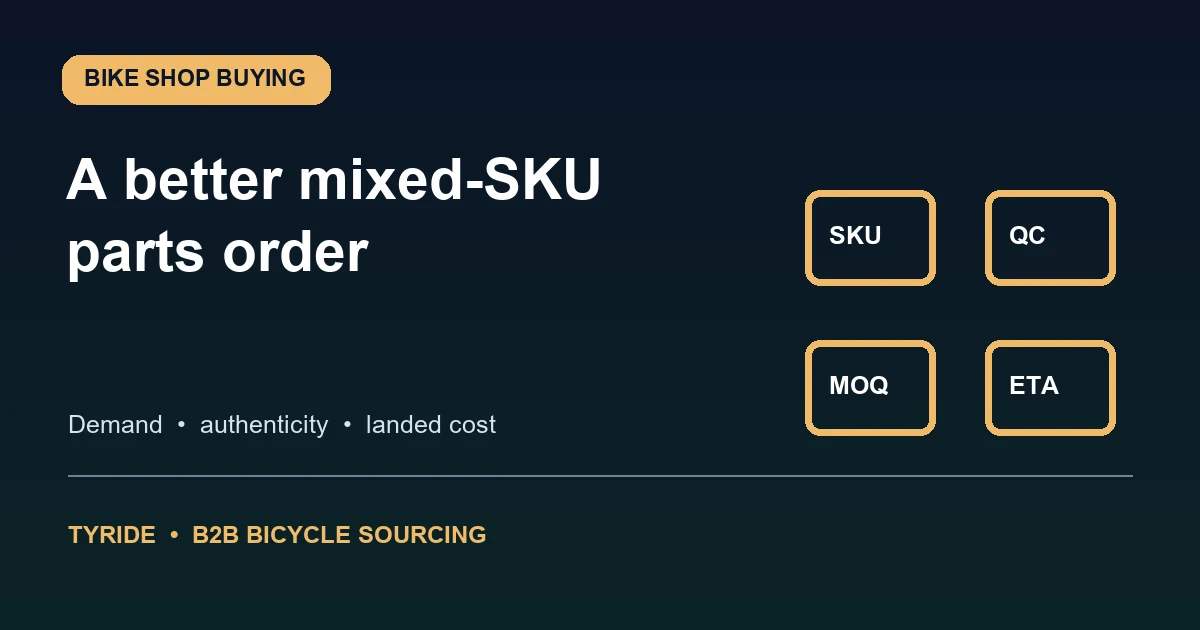
Independent bike shops rarely need a container of one part. They need the right mix of replacement items, predictable replenishment, and a way to avoid tying cash to obsolete stock. A mixed-SKU order is a purchase that groups several stock keeping units into one plan while keeping each item’s specification, source, and quality evidence separate. For shop owners and distributors, that distinction is the core of a workable bulk order.
Key takeaways
- Build the order from service history and confirmed bike models, rather than a supplier’s discount ladder alone.
- Verify the exact branded part and supply chain when authenticity matters.
- Compare the cost of usable stock at your shop, including freight, taxes, inspections, and defects.
- Agree reorder triggers and substitution rules before the first shipment.
Tyride describes component sourcing support for bicycle businesses and wholesale service options. This guide provides a purchasing framework a shop can use with any supplier. It complements our broader low-cost bicycle parts supplier checklist by focusing on a shop’s recurring mixed-SKU order.
Separate a purchasing signal from a public discussion
Our review of publicly searchable Reddit posts dated March 10 to March 30, 2026 found no verifiable thread directly asking to buy bicycle saddles or components in bulk. That absence does not prove there was no buying activity. It means a buyer should not present those posts as evidence of a wholesale trend.
The useful adjacent conversations were about fit, compatibility, price, and the frustration of choosing a component. For example, a March 2026 saddle discussion shows why a shop might carry alternatives or offer trials, but it cannot tell the shop how many of each model to buy. A March 28 saddle purchase post highlights rail compatibility, but it is not a wholesale order.
For demand planning, the shop’s own service tickets, returns, backorders, and customer requests are more direct evidence. Reddit can suggest a question to ask at the counter. It cannot replace your local sell-through record.
Build a SKU list from repeatable demand
Review the last season of service and sales records, then group items by the reason they are needed. Separate fast-moving consumables from model-specific parts and from optional upgrades. For each proposed SKU, record the exact manufacturer part number, the bike or component systems it fits, recent units used, current stock, returns, and supplier lead time. If the shop has little history, begin with a small trial and review actual sell-through before a larger order.
| Stock group | Typical buying question | Sensible first control |
|---|---|---|
| Frequent service items | Which exact sizes and versions recur? | Keep a short approved list with reorder points. |
| Model-specific replacements | Which bikes in the local fleet need this part? | Tie every order line to a compatible model or confirmed request. |
| Comfort upgrades | Which options can customers try? | Carry a limited range; track returns and fit feedback. |
| Slow or expensive items | Is a customer order more appropriate? | Avoid speculative depth until demand is proven. |
Do not let a price break change the product identity. A cassette, chain, pad, saddle, or clamp that looks similar may serve a different drivetrain, brake, or seatpost configuration. Put the exact approved specification beside the target quantity in the purchase sheet. For saddle lines, our OEM saddle specification guide explains the additional fit questions.
Verify source and compatibility before consolidating suppliers
When a product is sold as a branded original, record the invoicing entity, manufacturer part number, package format, and route through the supply chain. Shimano’s anti-counterfeit program explains its authentication labels and warns about products whose origin is uncertain. Its guidance is a reason to verify a branded item, not proof that any specific marketplace listing is fake.
Ask for documentation that matches the actual line item. A supplier’s general certificate or a test report for another model cannot establish the performance of the ordered part. Safety-relevant components deserve product-specific review and, where necessary, the manufacturer’s installation instructions. For bicycles within its scope, ISO 4210-2:2023 sets safety and performance requirements for the covered categories and sub-assemblies. Determine which standard and market requirements apply to the actual bike and part.
Consolidating vendors can reduce order administration, but it also creates a single point of failure. For critical lines, document an approved alternate source or a clear backorder procedure. If a supplier proposes a substitution, require a new part number, compatibility review, and approval before shipment. A silent substitution may leave the shop with stock it cannot install or return.
Compare delivered usable cost, not a discount percentage
A quotation should identify each SKU, quantity, unit of measure, pack size, lead time, warranty route, and delivery term. Delivered usable cost is product cost plus freight, import charges where applicable, inspection, expected rejects, and the cost of handling unsuitable stock. This is a decision framework, not a universal cost formula; the relevant items vary by market and agreement.
For international orders, name the agreed delivery point and the Incoterms rule with its version. The International Chamber of Commerce explains that Incoterms allocate responsibilities and risk between buyer and seller. Its 2020 checklist distinguishes FCA for container or multimodal moves from FOB for certain cargo loaded directly on a vessel. Ask your freight partner to check the appropriate term for the actual movement. “FOB price” without a named port and a clear shipment plan is not a complete comparison.
Request at least two quote scenarios: a small replenishment order and the larger volume that unlocks a price tier. The second quote wins only if the extra units are likely to sell before specification changes or stock carrying costs erase the discount. The shop should calculate this with its own demand and cash constraints, rather than a generic industry percentage.
Use a trial order as a process test
The first mixed-SKU order tests more than product quality. It tests whether the supplier can keep each line identifiable and deliver the promised mix. Before shipment, request a line-by-line packing list showing SKU, quantity, batch or lot where available, and carton assignment. On receipt, compare the goods with the approved samples and purchase order. Record missing items, wrong variants, damage, and the time required to resolve each issue. If the buyer uses acceptance sampling, the ISO 2859-1:2026 standard describes lot-by-lot sampling schemes; the chosen plan still needs to match the product risk and contract.
Use that record in the second purchasing decision. A supplier that responds quickly to a small discrepancy may be more useful than one with a slightly lower unit quote but unclear replacement procedures. Agree in advance who pays for a confirmed defect, how evidence is submitted, and whether credit or replacement is available. Tyride’s service overview lists sampling and order coordination options; confirm the precise terms in the quotation and contract.
Set a reorder rule for each line
The first order is only the start of inventory control. For each SKU, set a review date, a lead time, and a reorder point based on usage during that lead time plus a buffer suited to the item’s importance and demand variability. A reorder point is the stock level that triggers replenishment. Oracle’s inventory guide defines it as forecast demand during replenishment lead time plus safety stock. A shop should revisit the rule when a bike standard changes, a product is superseded, or returns rise. Mark discontinued and superseded part numbers clearly so the next purchase does not repeat an old mistake.
Keep special-order items separate from normal stock. If a customer needs an unusual model-specific part, promise a lead time based on supplier confirmation, not on the date of the next planned bulk order. If the supplier offers a substitute, check fit and get customer approval before committing. These small controls protect the shop’s service schedule as much as its margin.
A mixed-SKU RFQ a supplier can answer
Send one spreadsheet or purchase list with these fields for every line: product name, manufacturer and part number, compatible bike or system, drawing or critical dimensions, desired quantity, acceptable pack size, approved alternatives, target destination, and required documentation. At order level, add the requested delivery date, Incoterms rule and named place, labeling needs, inspection method, warranty process, and payment terms.
For saddle or complementary component lines, contact Tyride with your SKU list and target quantities. Request a sample and line-specific evidence where fit or safety depends on exact construction. A clear RFQ lets the supplier tell you which items it can support and which need a different source.
Editorial note: the March 2026 Reddit examples above are individual purchasing discussions. They are included to illustrate compatibility and customer questions, not as evidence of bulk demand or supplier performance.