How B2B Buyers Should Specify and Source Bicycle Saddles for Brands and OEMs
For bicycle brands, OEM buyers and product managers, the challenge is not finding a saddle that feels comfortable during a five-minute showroom test. The real challenge is specifying a saddle system that delivers consistent comfort, durability and performance across thousands of riders while meeting cost, weight and production targets.
Many sourcing projects fail because the purchasing decision is driven by appearance, foam thickness or FOB price rather than rider biomechanics and engineering requirements. The result is often increased warranty claims, rider complaints, redesign costs and delayed product launches.
In our experience working with bicycle saddle sourcing projects, the factors that most strongly influence rider satisfaction are:
- Saddle width relative to rider anatomy
- Shell shape and flex characteristics
- Rail material and structural design
- Pressure-relief features
- Padding density and resilience
- Cover durability and weather resistance
Understanding how these variables interact allows buyers to create more accurate specifications, compare suppliers more effectively and reduce long-term product risk.
The Biggest Mistake: Choosing Padding Before Shape
Many first-time buyers assume a softer saddle will be more comfortable.
In practice, saddle shape and width usually have a greater impact on comfort than adding extra foam.
A rider’s weight is primarily supported by the ischial tuberosities, commonly known as the sit bones. When the saddle is too narrow, support shifts toward soft tissue. When it is too wide, pedaling efficiency and freedom of movement can suffer.
Professional fitting systems typically start by measuring sit-bone width and then selecting a saddle that is wider than the measured distance. While many manufacturers use an additional 20–30 mm as a starting guideline, the final width depends on riding posture, pelvic rotation, flexibility and intended use.
For OEM programs, offering multiple widths within the same platform is often more effective than attempting to serve all riders with a single size.
Industry Insight
One of the most common sourcing mistakes is requesting thicker foam to solve comfort complaints.
During longer rides, excessively soft foam can allow the sit bones to sink into the saddle. This may increase pressure on surrounding soft tissue and reduce support consistency. A properly shaped shell combined with appropriately tuned foam density generally produces better long-term comfort than simply increasing padding thickness.
Rider Position Determines Saddle Design
The rider’s posture is often the most important input when specifying a saddle.
Aggressive Road Position
Road cyclists typically rotate their pelvis forward and spend significant time in aerodynamic positions.
Common specification characteristics include:
- Narrower profile
- Short nose or performance nose design
- Minimal padding
- Pressure-relief channel or cut-out
- Lightweight rail materials
Gravel and Endurance Riding
Gravel riders frequently change position throughout a ride and encounter continuous vibration.
Common requirements include:
- Moderate width
- Controlled shell flex
- Enhanced vibration damping
- Durable cover materials
- Reinforced rail structures
Mountain Bike Applications
Mountain bikers require freedom of movement during technical riding.
Typical specifications include:
- Compact rear profile
- Abrasion-resistant side panels
- Moderate support padding
- Durable shell construction
- Strong rail-to-shell interfaces
City and Recreational Bikes
Comfort and support are generally prioritized over weight.
Common features include:
- Wider platforms
- Upright riding geometry support
- Dual-density foam
- Durable synthetic covers
- Steel or chromoly rails
E-Bike Platforms
Electric assistance changes riding duration and average system weight but does not automatically determine saddle width.
An e-bike commuter, e-MTB rider and cargo-bike user may require entirely different saddle designs despite all riding electric bicycles.
The intended posture should always drive the specification.
Understanding the Saddle as a Complete System
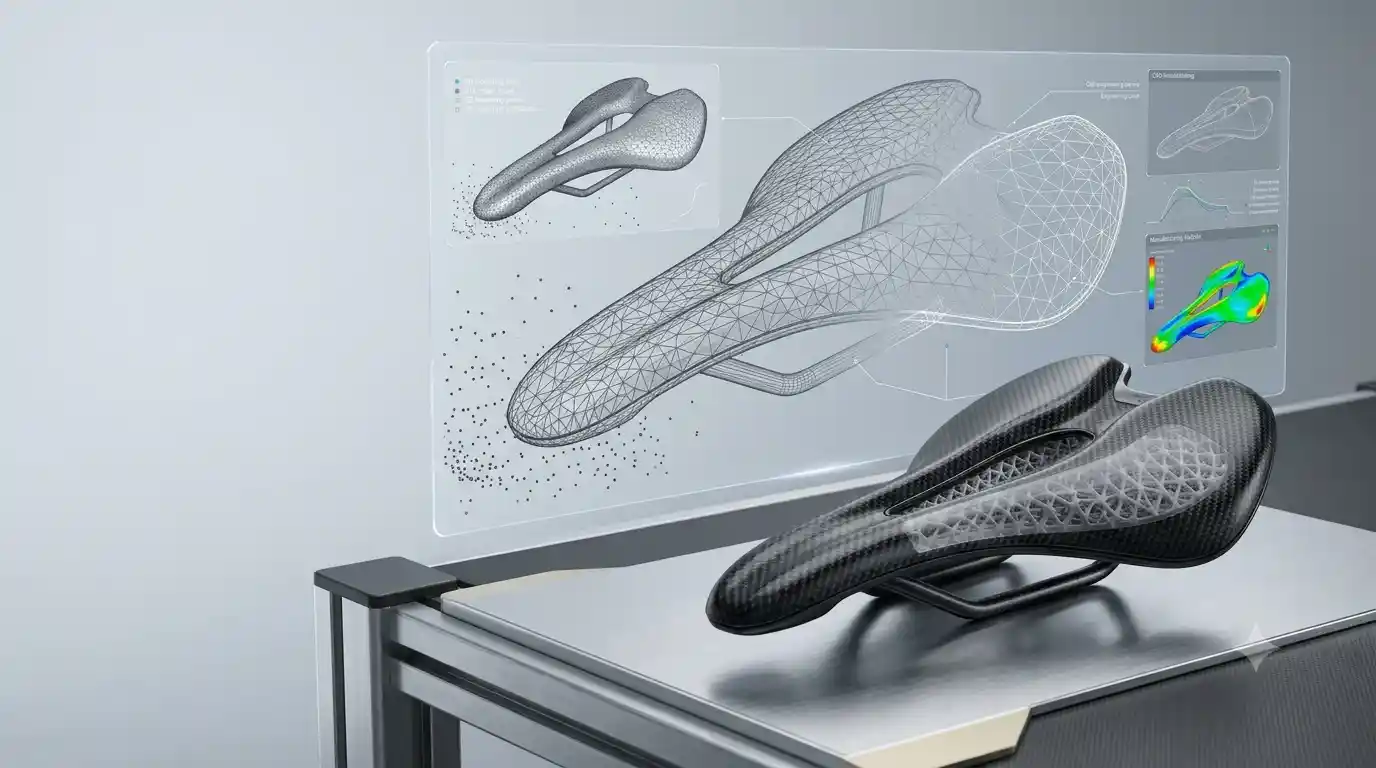
A bicycle saddle is not a single component. It is a system consisting of the shell, rails, padding and cover.
Changing one element often affects the performance of the others.
Shell Construction
The shell determines overall geometry and much of the saddle’s ride feel.
Common materials include:
Nylon Shells
Advantages:
- Cost-effective
- Durable
- Consistent production quality
Commonly used for:
- Commuter bikes
- Hybrid bicycles
- Mid-volume OEM programs
Carbon-Reinforced Shells
Advantages:
- Improved stiffness-to-weight ratio
- Lower weight
- Precise performance characteristics
Commonly used for:
- Performance road bikes
- High-end gravel platforms
- Premium OEM projects
Rail Material Trade-Offs
Rail selection affects weight, durability, vibration characteristics and cost.
Chromoly Steel Rails
Advantages:
- High durability
- Low cost
- Proven reliability
Limitations:
- Higher weight
Suitable for:
- City bikes
- Entry-level bicycles
- High-volume production
Titanium Rails
Advantages:
- Reduced weight
- Good fatigue resistance
- Improved vibration damping characteristics
Limitations:
- Higher material cost
Suitable for:
- Mid-range and premium models
Carbon Rails
Advantages:
- Lowest weight
- Tunable stiffness
Limitations:
- Highest cost
- Greater sensitivity to clamp compatibility and installation torque
Suitable for:
- Premium road and XC applications
For many OEM programs, titanium rails often provide the best balance between performance and cost.
Pressure Relief: Channels vs Cut-Outs
Pressure-relief features are frequently requested in OEM development projects.
However, there is no universal solution.
A full cut-out may significantly reduce pressure for one rider while creating edge pressure for another.
The effectiveness depends on:
- Saddle width
- Shell curvature
- Rider posture
- Pelvic anatomy
- Padding design
For this reason, prototype testing is more reliable than assuming one pressure-relief design works for every application.
OEM Case Example
A commuter-bike brand requested a heavily padded saddle after receiving feedback that existing models felt too firm.
Initial prototypes used thicker foam while retaining the original shell geometry.
Rider testing revealed that comfort improved during short rides but declined during longer sessions due to reduced support stability.
A second prototype retained moderate foam thickness but introduced:
- Improved sit-bone support zones
- Slightly wider rear platform
- Higher-density foam beneath load-bearing areas
The revised design received significantly stronger rider feedback despite using less overall padding.
The lesson was clear:
Comfort was primarily created by support geometry, not foam volume.
Testing Requirements Buyers Should Request
Comfort sells bicycles, but durability protects brands.
Every RFQ should define measurable testing requirements.
The current ISO 4210-9 standard specifies saddle and seat-post test methods, including security testing, static strength testing and fatigue testing for saddle assemblies. citeturn0search0turn0search5
Examples include:
- Saddle security testing
- Static strength testing
- Rail strength evaluation
- Saddle and seat-post fatigue testing
- Seat-post interface testing
The standard also includes repeated load fatigue testing of saddle assemblies and structural loading requirements for saddle systems. citeturn0search3turn0search13
Beyond laboratory testing, brands should also conduct:
- Rider validation
- Long-distance comfort testing
- Environmental exposure testing
- Cover abrasion testing
- Production sample inspections
What a Professional Bicycle Saddle RFQ Should Include
Many suppliers receive RFQs that simply state:
“Need comfortable saddle for e-bike.”
This creates ambiguity and slows development.
A professional RFQ should specify:
Product Requirements
- Bike category
- Rider position
- Target rider weight
- Intended riding duration
- Width range
- Length range
Construction Requirements
- Shell material
- Rail material
- Rail dimensions
- Padding type
- Cover material
Performance Requirements
- Target weight
- Durability objectives
- Compliance requirements
- Testing criteria
Commercial Requirements
- MOQ
- Annual volume forecast
- Packaging specifications
- Branding requirements
- Tooling ownership
- Intellectual property terms
Clear RFQs shorten development cycles and reduce misunderstanding between buyers and suppliers.
Supplier Qualification Checklist
Before approving a supplier, buyers should verify:
- Material traceability procedures
- Incoming material inspection standards
- Foam density control methods
- Rail alignment inspection process
- Tooling ownership policies
- Product testing capabilities
- Corrective action procedures
- Sample iteration capabilities
- Documentation systems
Red flags include suppliers that cannot explain testing procedures, lack traceability records or focus exclusively on offering the lowest FOB price.
A Practical Decision Framework
When evaluating a bicycle saddle project, use the following sequence:
- Define rider posture and bike category.
- Determine width range using rider data.
- Select shell geometry before discussing foam thickness.
- Choose rail materials based on performance and cost targets.
- Define pressure-relief strategy.
- Specify testing requirements.
- Validate prototypes with riders.
- Confirm quality-control procedures.
- Clarify tooling and IP ownership.
- Compare suppliers based on engineering capability, not price alone.
Final Thoughts
The most successful bicycle saddle programs begin with rider requirements rather than supplier catalogs.
Brands that clearly define geometry, materials, testing requirements and acceptance criteria typically achieve faster development cycles, fewer field issues and more predictable product performance.
A supplier quotation becomes meaningful only after the technical specification is already defined. Until then, the lowest price often hides the highest risk.
For OEM and ODM buyers, the objective should not be sourcing the cheapest saddle. It should be sourcing the right saddle platform that consistently delivers rider comfort, durability and brand credibility at scale.