
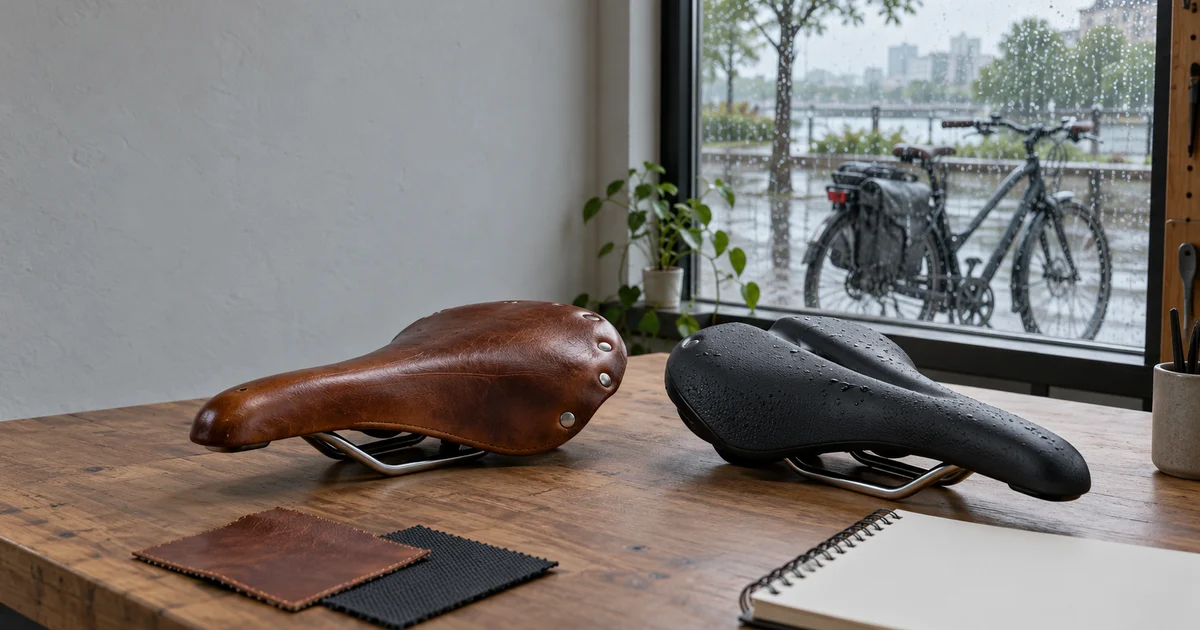
Illustrative image created for this article. The saddles are unbranded concepts, not tested products.
For an outdoor commuter or shared-bike fleet, a saddle decision affects more than the rider’s first impression. It affects cleaning, weather exposure, staff time, replacement stock, and how consistently a mixed group of riders can use the bikes. Leather and synthetic saddles can both work, but the right choice depends on the operating plan and the exact product construction.
Key takeaways
- Do not treat “leather” or “synthetic” as a complete performance specification.
- Ask what care the exact saddle model requires, then price that labor into the fleet plan.
- Validate weather exposure, cover condition, rail attachment, cleaning, and rider fit on representative samples.
- Buy replacement units against a controlled specification so the fleet can be maintained after launch.
A Reddit question exposes a real operating decision
In a July 2026 r/bikecommuting thread, a rider who had replaced a fraying OEM saddle with a Brooks leather model wondered how it would fare through a New England winter. Replies ranged from using a rain cover to choosing an all-weather Cambium model. Those are individual experiences, not a controlled comparison or evidence of fleet purchasing demand. The thread is useful because it names the operational question a buyer must resolve: who will protect, inspect, and maintain each saddle when bicycles are exposed to the weather?
The replies also show why a fleet maintenance instruction should not be copied from a forum. One commenter suggested neatsfoot oil, while Brooks’ own guidance says to use its specified Proofide treatment on applicable leather saddles. A buyer should use the exact model’s current care instructions when writing a staff procedure.
The product maker’s own guidance is more specific. Brooks England’s FAQ advises leather-saddle owners to avoid prolonged heavy rain, inspect saddle tension and leather condition, and use its stated care method. The same FAQ describes Cambium saddles as using a vulcanized-rubber top that does not need leather-style tension adjustment and is intended for inclement weather. These statements apply to Brooks products; they should not be generalized to every leather or synthetic saddle.
Finished-saddle performance is the behavior of the assembled cover, shell, padding, rails, and fasteners under the intended use. Maintenance burden is the staff time and material needed to keep a saddle usable. Reference sample is the approved physical unit used to compare later deliveries. These terms make a fleet decision more precise than a material label alone.
Compare complete saddles, not material labels
“Synthetic” may describe a nylon cover, coated fabric, molded polymer, rubber top, or several layers over a shell and foam. Water may affect seams, adhesive, rivets, rails, or padding even if the outer material sheds rain. Leather likewise varies by construction and care regime. A buyer should request a bill of materials and a finished-saddle sample before treating a catalog label as a performance result.
| Decision factor | Leather saddle question | Synthetic saddle question |
|---|---|---|
| Weather | What protection and drying steps does this model require? | Is the finished saddle, including seams and hardware, rated for the intended exposure? |
| Maintenance | Who checks tension and conditions the leather, and how often? | Which fasteners, covers, or surfaces need inspection or replacement? |
| Rider fit | How does break-in or shape change affect a shared rider population? | Does the fixed profile suit the fleet’s intended postures and rider range? |
| Cleaning | Which products and methods does the maker permit? | Can the full assembly tolerate the fleet’s cleaning routine? |
| Service | Are model-specific repair parts and identical replacements available? | Can the same construction be reordered without an unapproved material change? |
This is a question set, not a universal ranking. For example, Brooks markets its Cambium range for varied conditions and says the rubber top needs no break-in or tension adjustment. That may reduce one maintenance task compared with one of its leather models. A different synthetic saddle may have a stitched cover or exposed foam and require a different inspection plan.
Build a pilot that reflects fleet use
A showroom touch test cannot reproduce months of parking, cleaning, and repeated adjustment. Select candidate saddles against the same bicycle type and operating conditions. Record the bicycle model, riding posture, seatpost clamp, rail dimensions, installation method, and the rider range the fleet serves. Then test a small number of each approved candidate before choosing a full order quantity.
The pilot should answer five operational questions:
- Fit: Can staff set the saddle securely and consistently for the intended riders?
- Exposure: What changes after the actual rain, sun, storage, and cleaning routine?
- Structure: Do the shell, rails, and attachments remain sound under the applicable validation plan?
- Workload: How many inspection or care steps must staff perform per bicycle?
- Recovery: Can a damaged unit be replaced with the same controlled model and specification?
Set pass and fail criteria before the pilot begins. For example, specify which visible cover changes are cosmetic and which require replacement. Record maintenance time instead of guessing it. The result is a buyer-owned comparison for the intended fleet, not an unsubstantiated claim that one material always lasts longer.
Where the bicycle category calls for it, ISO 4210-9:2023 specifies saddle and seatpost test methods for ISO 4210-2. It is a method reference, not a blanket certification of any saddle shown online. Ask a supplier for a report identifying the tested model, configuration, method, result, and date. Tie that report to the approved sample and production drawing.
For the technical RFQ itself, Tyride already offers a B2B bicycle saddle specification guide. Use that to define geometry, construction, testing, and commercial terms. The pilot described here adds the day-to-day fleet operating evidence that a drawing cannot supply.
Include care and replacement cost in the quotation
Two saddles with similar unit prices can create different work for fleet staff. Compare the cost of purchase, installation, care products or covers, periodic inspection, downtime, and replacement. Do not insert generic lifetime or failure-rate numbers. Use pilot records and supplier terms to estimate the actual program cost.
The quotation should state the MOQ for the exact saddle construction, not just a product family. Ask whether the cover, shell, rails, padding, and fasteners will remain the same across repeat orders. Require notification and approval when a critical material or process changes. Keep a reference sample so the fleet can compare later deliveries with what was tested.
If a removable rain cover is part of the plan, specify it separately. Tyride’s saddle-cover sourcing guide addresses fit, retention, water-resistance claims, and finished-cover testing. A cover can help manage exposure, but its performance and staff compliance need their own validation.
Choose by use case, then request samples
Leather may suit a fleet that values its ride character and can follow the maker’s care instructions. A specific all-weather construction may be easier for a fleet with exposed parking and limited maintenance time. Neither conclusion follows from material names alone. The buyer should choose the saddle that passes the fleet’s fit, exposure, maintenance, and service tests at an acceptable total program cost.
For an OEM or distributor inquiry, send the bicycle use case, climate and parking conditions, rider posture, cleaning method, expected order quantity, and replacement plan through Tyride’s contact page. Ask for samples and model-specific documentation before committing to a volume order. About Tyride explains the company’s stated saddle and component-sourcing scope.
Editorial note: The Reddit discussion is used to identify a buyer question. Brooks product guidance supports statements about Brooks products only. Product approval must be based on the exact candidate saddle and the requirements of the intended bicycle fleet.