
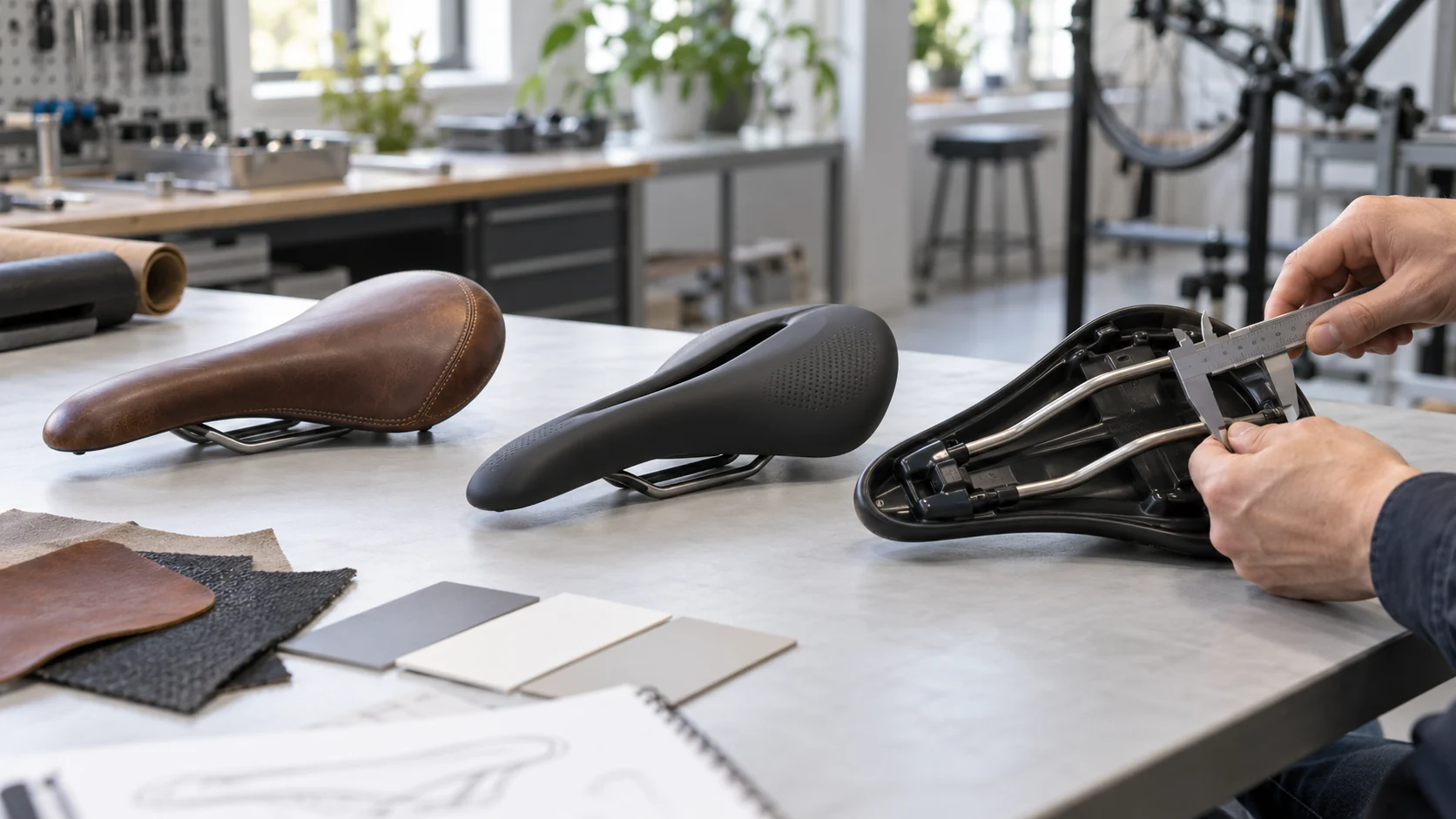
A brand can put its name on a bicycle saddle without owning the factory or every element of the design. That commercial arrangement is common enough to deserve careful questions, but a similar shape or unfamiliar instruction sheet does not identify who manufactured a product. For bicycle brands and wholesalers, the useful task is to establish the manufacturing role, approved specification and responsibility for failures before a private-label saddle goes into production.
Illustrative image generated for this article. It is not a photograph of any company or product discussed below.
Key takeaways
- A July 2026 touring-saddle thread included a comment guessing that one saddle came from a Chinese supplier and was rebranded. The comment is a hypothesis, not proof of origin.
- The same thread raised concrete product questions about rail failures, price and comfort. A buyer can turn those questions into sample, test and warranty requirements.
- A signed reference sample, exact model and revision, and documented production controls matter more than a confident supplier story.
Three terms help a buyer set the scope:
- Private-label saddle is a saddle sold under the buyer’s brand, whether it starts from an existing platform or a new design.
- Reference sample is the signed physical sample used to judge later production units.
- Change control is the written rule for approving changes to materials, parts or production source.
What can a Reddit discussion tell a sourcing team?
The thread titled “New Saddle – Wanted This For Years!” began as a rider’s post about a new touring saddle. In the comments, riders disagreed about comfort and value; several described broken rails or concerns about alignment. One commenter speculated that another branded leather saddle was sourced from China and given a new label, based partly on its instructions. The thread offers user questions worth testing, but no documentary evidence of that brand’s factory, bill of materials or sales agreement.
Do not repeat a forum claim as an established supplier relationship. Instead, ask what a buyer would need to verify. The answer is a controlled trail from legal seller and factory through drawing, sample, test report and purchase order. Tyride’s OEM saddle specification guide explains how to define the product before inviting quotes.
Original analysis: The thread mixes product feedback with an origin claim. Those are different evidence types. Rail complaints can shape a test plan; a guess about a factory cannot establish who made the saddle. This conclusion comes from the specific comments in that thread, not an audit of the brands mentioned.
Identify the actual production arrangement
“Private label” can describe different levels of buyer control. In a stock-platform program, the buyer may choose an existing saddle and customize color, logo or packaging. In a buyer-controlled OEM project, the buyer may own the drawing and tooling. An ODM supplier may develop the design while the brand specifies the target application and approves the result. The label alone does not reveal who owns the tooling, who can change materials or who handles warranty claims.
Ask each potential supplier to identify:
For example, two offers might use a saddle with the same visible shape. One may specify the rail material and production site. The other may leave both blank. The buyer can compare the first offer against a controlled sample. The second needs more evidence before it can be judged on equal terms.
| Question | Document or answer to request |
|---|---|
| Who invoices the buyer? | Legal company name and contract entity |
| Where is the saddle made and assembled? | Named production site and relevant subcontracted steps |
| Who controls the design? | Drawing owner, tooling owner and permitted changes |
| What is being customized? | Written list of geometry, rails, cover, foam, color, branding and packaging changes |
| Who handles defects? | Warranty contact, remedy and traceability process |
These questions are not an accusation that a trader or contract factory is unsuitable. They let the buyer assign responsibility and compare offers on equal terms. Tyride describes its saddle manufacturing and component-sourcing roles for buyers starting that conversation.
Translate rider complaints into testable requirements
The touring thread’s comments point to three distinct evaluations. Rail integrity needs a structural and assembly check. Comfort needs testing with the intended riders and riding position. Care and warranty need clear instructions appropriate to the material. None can be settled by an attractive product photo.
For rail and saddle strength, ask for a report that identifies the exact model and revision, test method, laboratory or responsible test facility, result and any applicable rider or usage limits. ISO 4210-9:2023 specifies saddle and seat-post test methods for ISO 4210-2. A generic statement that a factory “follows ISO 4210” is less useful than product-level evidence tied to the sample being purchased. The buyer must also determine which requirements apply in the target market and bike category.
For U.S. complete bicycles, the Consumer Product Safety Commission’s business guidance identifies 16 CFR Part 1512 as the bicycle rule and discusses seat-related requirements. A brand should map applicable rules to its finished bike and market. An ISO test report and U.S. regulatory review answer different questions.
For comfort, test the approved saddle in the intended posture and on the intended bicycle type. Record width, length, shell profile, padding, cover and rail configuration for each sample. A five-minute showroom impression cannot represent every rider; the relevant question is whether the design performs acceptably for the target group and whether the production version matches the approved prototype.
For care claims, use instructions from the actual maker. For example, Brooks England’s product-care guidance explains maintenance of its own leather saddles, including tension and conditioning. Those instructions should not be copied onto a different manufacturer’s product without that manufacturer’s approval. A private-label program needs its own validated care and warranty text.
Control the sample-to-production handoff
One approved sample is a starting point, not proof that later cartons will be identical. Before volume production, agree the permitted range for critical dimensions and materials, the appearance standard for cover seams and branding, and the inspections at incoming, in-process and finished-goods stages. Photograph and sign the reference sample. Record the revision on the drawing and purchase order.
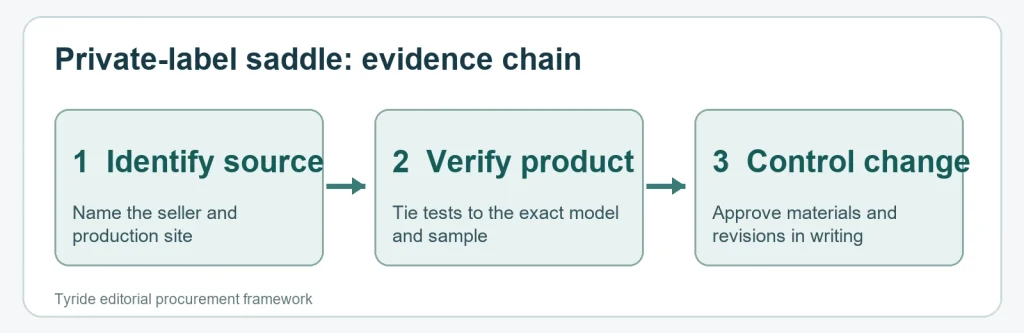
Then make change control explicit. If the supplier changes rail stock, foam density, shell resin, cover material or subcontractor, the buyer should know which changes require written approval and retesting. This is especially important when a buyer compares an initial attractive quotation with later replenishment orders. Tyride’s saddle-cover sourcing guide gives a focused example of material and finish questions.
This decision has a clear evidence trail. The buyer keeps the signed sample, the test report for that exact model, and the agreed change rule. In the July 2026 rider discussion, rail durability was debated. A controlled record would let a brand investigate a later rail complaint against the product it actually bought.
What should be in the saddle RFQ?
Send a short, controlled brief: intended bike and rider, riding posture, target dimensions, rail profile and seatpost-clamp requirement, shell and padding targets, cover material, expected environment, branding, packaging, test requirements, target market, first order and annual volume, and tooling ownership. Ask the supplier to quote exceptions separately rather than quietly substitute a cheaper construction.
If a supplier cannot identify the production role or connect a test report to the exact offered model, pause the order. If the gaps can be closed, request revised documents and samples. If they cannot, a low price does not answer the brand’s durability or warranty risk.
For an OEM or private-label review, send Tyride the target saddle specification and sample requirements. Ask for a documented response that your team can evaluate against the same criteria used for other suppliers.
Frequently asked questions
Does a similar-looking saddle prove two brands use the same factory?
No. Similar appearance may reflect shared design conventions, copied styling or a common platform, but it does not establish origin. Verify the legal entity, production site and product documents before making an attribution.
Is an ISO 4210 claim enough to approve a saddle?
No. Ask which part of the standard was used, which model and revision were tested, what the results were and whether the intended bicycle application is covered. ISO 4210-9:2023 describes saddle and seat-post test methods; it is not a blanket approval of every product from a factory.
Should a buyer use Reddit durability reports?
Yes, as prompts for questions and testing. A forum report may identify a possible failure mode, but it usually lacks the sample size, exact model revision and usage history needed to estimate a failure rate.
Research methodology: Our narrow 20-day Reddit review found three verifiable related posts and no confirmed bulk saddle inquiry. This article uses one saddle thread as rider feedback, then checks standards and U.S. business guidance. The private-label claim remains unverified. Tyride has not audited the products or companies in that thread. Content reviewed 25 October 2026. About us.