
Bicycle brands, importers and dealers often need to place orders before the next selling season, but ordering early can lock up cash in models customers may not buy. Ordering late can leave popular sizes or parts unavailable when demand arrives. A safer bulk-order plan connects the sales forecast to item-level quantities, supplier lead times and explicit rules for changing the order.
Key Takeaways
- Start with sell-through and on-hand inventory by SKU, size and color, not a single total-unit target.
- Separate proven core products from seasonal tests and customer-specific special orders.
- Compare staged quantities and MOQ against the cost of carrying unsold stock.
- Put substitution, delivery, quality and replenishment terms in writing before production starts.
Sell-through is the quantity sold to customers during a set period, compared with stock available for sale.
Landed cost is the purchase price plus delivery, import charges and other costs needed to receive usable stock.
MOQ means minimum order quantity, the smallest quantity a supplier will accept for a product or configuration.
What September 2025 industry discussions reveal about order planning
The trade press reported a similar tension that month. In a September 23 Taichung Bike Week industry report, Bicycle Retailer and Industry News described pockets of high inventory, discounting concerns and supply-chain disruption. The article also reported that many brands had already ordered for the 2027 model year by mid-September. That is a report of industry conversations, not a complete survey. It shows why preseason commitments should be tested against current stock and realistic sell-through.
An Associated Press report on bicycle retailers offers historical context: after pandemic-era supply shortages, excess inventory arrived as demand cooled, and some shops leaned more on repairs and accessories. It does not describe September 2025 conditions, but it illustrates how a fast change in demand can leave buyers with stock ordered for an earlier market.
Two September conversations offer useful, limited examples of the decisions behind bicycle ordering. On September 5, MERIDA & CENTURION Germany posted from the BIKE&CO Order Festival in Kassel, describing dealer meetings and previews of products for the coming season. The post shows a trade setting where retailers and suppliers discuss upcoming products directly; it does not report purchase volumes or prove that dealers placed orders at the event.
On September 30, a LinkedIn post about bicycle and component sourcing asked readers how they balance cost, design and supply-chain resilience under raw-material and logistics pressure. Again, this is one industry post, not market-wide data. Together, the examples suggest a useful planning discipline: discuss next-season products early, but turn the conversation into a line-by-line plan with costs, lead times and decision gates.
Retail price changes also matter to the forecast. In a September 5 Reddit thread, r/specialized members discussed price increases on selected bikes. The discussion included conflicting assumptions about store and online prices, and riders asked which models were affected. This is not a verified price index. It is a reminder to date-stamp supplier quotes and confirm the exact channel, model and validity period before using a price in a purchase plan.
Build the order forecast from evidence you control
Use market reports as context, not as a substitute for your own sales. A March 2025 Forbes report on U.K. bicycle sales said the Bicycle Association recorded 1.45 million cycle sales in 2024, down 2% from 2023. The Association’s data service covered about 70% of retailer volume, according to the report. Those figures describe the U.K. market and cannot predict sales for a different country, category or business. They reinforce the need to forecast from the buyer’s own SKU-level sales and stock.
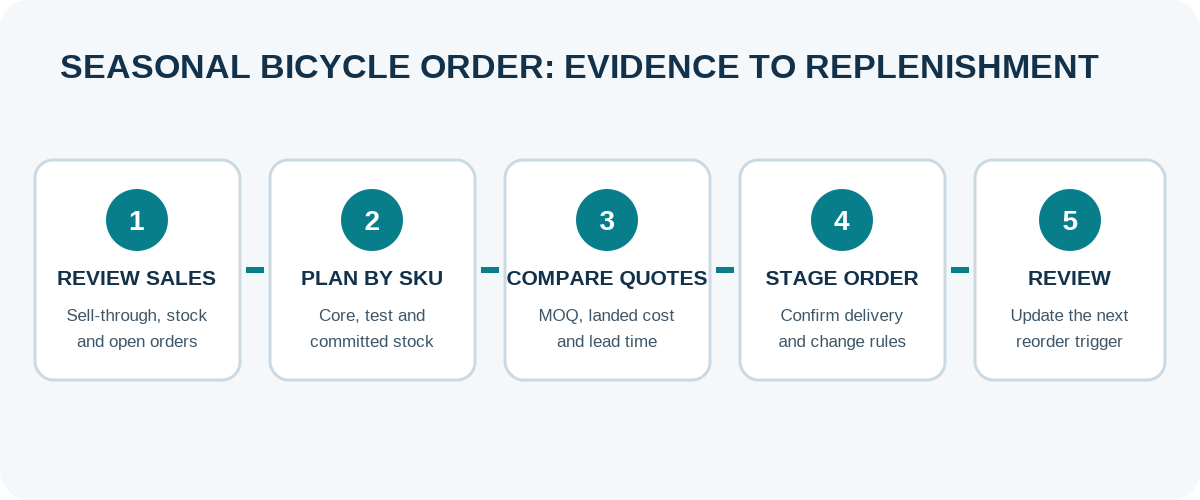
Seasonal bulk ordering means placing bicycle or component purchase orders ahead of a defined selling period. A purchase forecast should begin with data the buyer can verify: prior sales, current stock, open purchase orders, known seasonal patterns and confirmed customer commitments. Keep projections separate from firm demand. If the business has only one season of data or recently changed its product range, label the forecast as provisional rather than applying a precise growth percentage without support.
Prepare a table at the SKU level before asking suppliers for a bulk quote:
| Product group | What to record | Suggested buying treatment |
|---|---|---|
| Core models or components | Recent sell-through, stock on hand, open orders and replenishment time | Plan routine replenishment from observed demand |
| Seasonal or new products | Launch date, expected audience, sample status and evidence behind the forecast | Start with a controlled allocation or staged commitment |
| Size and color variants | Sales and returns by variant, plus supplier pack constraints | Order the proven mix; avoid equal quantities by default |
| Special-order items | Customer commitment, exact specification and deposit status | Buy against confirmed need where possible |
| Service parts | Installed base, repair demand and compatibility | Prioritize parts that keep sold products usable |
Tyride’s guide to planning a first wholesale bicycle parts order provides a useful small-shop example: it separates core stock, limited trials and special orders, and labels its budget as illustrative rather than a market quotation. The same categories can scale to a seasonal plan, even though a larger buyer will need its own sales and inventory data.
Separate core demand from forecast risk
A common planning mistake is to apply one growth assumption to every model and variant. A popular frame size, a new color and an untested accessory do not carry the same risk. Group items by evidence strength so a promising launch does not push unproven stock into the same order quantity as a proven seller.
Use three practical categories:
- Core: products with repeat sell-through or confirmed customer demand. Set replenishment levels using sales history and supplier lead time.
- Test: products with a plausible market but limited sales evidence. Use sample review, smaller quantity or a staged release where available.
- Committed: products ordered for a named customer or project. Confirm specification, payment terms and cancellation rules before the order is placed.
Record why each item sits in its category and when the classification will be reviewed. If the product is new, the first shipment should produce learning: which variants sell, what service parts are needed, and whether the supplier’s quality and delivery match the approved sample.
Compare MOQ with inventory exposure
A minimum order quantity can lower the unit price, but it can also increase the buyer’s cash exposure. Compare the MOQ against the amount the business expects to sell or use before the next replenishment decision. If the supplier requires more units than the forecast supports, ask whether the quantity can be split by color or delivery date, whether an existing configuration has a lower minimum, or whether another sourcing route is more appropriate.
For each quotation, compare at least three quantities that matter to your actual plan. Ask the supplier to show unit price, setup cost, packaging, sample charges, lead time and shipment terms separately. Then calculate the delivered cost for the exact mix, not just a headline price at the largest tier. For EU-bound purchases, the European Commission’s Access2Markets tariff guidance explains that the product code and origin affect the customs tariff. U.S. importers can consult the International Trade Administration’s HS code guide for classification resources. Use current official tools or a customs professional for the destination and product in your order; do not reuse an old tariff assumption.
| Quote item | Why it belongs in the comparison |
|---|---|
| Exact model, material, color and packaging | Confirms that supplier quotes describe the same product |
| MOQ by item and variant | Reveals whether the order creates excess stock |
| Sample and setup costs | Separates one-time charges from recurring unit cost |
| Delivery term and destination | Defines which freight and import costs are included |
| Lead-time basis and quote expiry | Keeps the arrival plan and price assumptions current |
| Substitution and cancellation rules | Shows who controls changes after approval |
| Inspection and remedy terms | Defines what happens when goods do not match requirements |
For customized saddle programs, Tyride’s bulk saddle purchasing guide explains why MOQ depends on the exact configuration and why buyers should compare accepted stock cost, not only a unit-price headline. The principle applies across bicycle components: calculate the cost of the configuration you will actually receive and sell.
Use staged purchasing when uncertainty is real
Staged purchasing can reduce exposure when demand is uncertain, but it only works if the supplier can support the schedule and the buyer understands the cost. Ask whether the order can be split into production or delivery lots, what quantities trigger each lot, how long the supplier can hold finished goods, and whether later releases carry a different price or freight charge.
Do not assume that a verbal promise means inventory is reserved. Put the schedule, quality baseline, release instructions, payment milestones and cancellation rights into the purchase documents. If the supplier cannot stage production, consider whether the MOQ remains justified by the forecast and cash plan.
Also define a change-control rule. If materials, colors, components, packaging or production sites change, require written approval before the substitution enters the order. Tyride’s supplier-check guide for bicycle parts recommends comparing a controlled specification, sample evidence, production controls and delivered cost. Those checks make quotes more comparable and help buyers assess whether a supplier can repeat the approved product.
Set reorder triggers before stock arrives
A reorder trigger turns the forecast into a repeatable operating rule. For each core item, record the average usage or sell-through period, supplier lead time, current stock and the time needed to approve a replenishment order. The trigger should account for the time between placing an order and receiving usable stock, not only the number of units remaining on the shelf.
For new products, avoid pretending the trigger is precise before there is sales history. Review the first shipment at a fixed point after launch and adjust the next order using actual sell-through, returns and customer requests. Keep slow-moving variants visible so they do not disappear inside a healthy total-inventory number.
A simple monthly review can ask:
- Which SKUs sold faster or slower than forecast?
- Which sizes or colors are accumulating?
- Did the supplier meet the confirmed lead time and quality terms?
- Were substitutions, freight or import costs different from the quote?
- Should the next order be replenished, reduced, delayed or discontinued?
Make the supplier quote fit your plan
A strong request for quotation gives every supplier the same product definition and buying scenarios. Include the destination market, delivery location, quantity by SKU and variant, packaging, requested shipment window and approval requirements. Ask suppliers to state exceptions explicitly rather than silently quoting a different configuration.
For a sourcing project, Tyride’s component sourcing service lists an inquiry-to-delivery process and publishes different MOQ conditions for stocked and customized components. Treat those as the company’s stated terms, then confirm the exact product, quantity, sample arrangement and current quotation with the supplier. For technical specifications, sample needs and order details, send the requirements through the Tyride contact page.
Frequently asked questions
How far ahead should a bicycle dealer place a seasonal order?
Work backward from the date products must be available for sale, using the supplier’s confirmed production and transport schedule. Add time for sample approval, specification changes, inspection and customs or local delivery where relevant. Calendar assumptions should be confirmed for each supplier and destination.
How can a small buyer manage a high MOQ?
Ask whether the minimum applies per model, color, size or total order. Request alternatives such as a stocked configuration, split delivery or a smaller sample order, then compare the total cash and delivered cost. Do not accept excess variants simply to reach a price tier unless the demand plan supports them.
Should a buyer place a preorder for every new model?
No. Preorders make sense when the buyer has enough evidence to justify the commitment and the commercial terms are clear. For untested products, separate the test quantity from core replenishment and define how results will affect the next order.
What should be checked before approving a production run?
Confirm the exact specification, approved sample, material and packaging requirements, inspection plan, delivery schedule, substitution rule, payment milestones and remedies for nonconforming goods. Keep the approval record with the purchase order.
A seasonal order should stay adjustable where possible
Seasonal bicycle purchasing requires early coordination, but early planning does not require blind commitment. Use sales and stock evidence to define core quantities, keep uncertain variants separate, compare MOQ with cash exposure, and confirm supplier terms before approving production. This gives buyers room to respond when demand, component availability or prices change.
A clear SKU plan also makes supplier conversations more productive. Send the same specification and quantity scenarios to each candidate, record every exception, and base the final order on the product and delivery terms you have actually approved.
Editorial note: LinkedIn and Reddit examples cited here are individual posts from September 2025, not market surveys. The LinkedIn posts describe trade activity and sourcing questions, while Reddit comments capture consumer discussion. Neither source establishes industry-wide sales, inventory, pricing or procurement trends. Planning steps are buyer guidance, not sales forecasts.