
Fleet procurement means choosing, buying and supporting bikes for a group of riders. Buying e-bikes in volume can lower the unit price and simplify fleet operations, but a low quotation does not guarantee a low-cost fleet. Before placing a bulk order, buyers should confirm that the bikes can be serviced locally, that replacement parts will remain available, and that the supplier can support the exact specification through the full purchasing cycle. For fleet operators, the right comparison is the cost of usable, maintainable bikes over the planned service period, not the invoice price alone.
Key Takeaways
- Treat service access and spare-part continuity as procurement requirements, not post-purchase details.
- Standardize models and components where the use case allows, then verify samples and documentation before committing volume.
- Compare delivered and supported cost across suppliers, including expected maintenance, downtime, replacement parts and warranty response.
- Use staged orders when demand or service readiness is uncertain, and define the criteria for expanding the fleet.
Fleet serviceability means that a bike can be inspected, repaired and returned to use with available skills, tools and parts.
Landed cost means the purchase price plus delivery, import charges and other costs needed to receive usable stock.
MOQ means minimum order quantity, the smallest quantity a supplier will accept for a product or configuration.
Why serviceability belongs in the e-bike RFQ
Service can also help a shop weather changes in bike sales. In a May 2024 Associated Press report on U.S. bike shops, owners described shifting attention toward repairs and accessories as bike inventory returned after pandemic shortages. The report is historical context, not evidence about current fleet demand. It does show why fleet buyers should ask who will maintain the bikes after delivery.
An e-bike fleet is only useful while its bikes remain available for riders. A model that is inexpensive to purchase can become costly if mechanics cannot diagnose it, replacement parts are proprietary, or the supplier cannot explain how warranty claims will be handled. Fleet buyers should evaluate serviceability before selecting a model, because the decision affects uptime, spare inventory and the training required for staff or service partners.
A September 2025 discussion in r/ebikes about low-cost e-bikes and repair access illustrates the concern. Riders described local shops that would handle mechanical repairs but avoid electrical work on unfamiliar direct-to-consumer models; comments also raised parts availability and proprietary components. This is anecdotal user discussion, not a representative survey, but it surfaces a concrete procurement question: who can repair the bike in the place where the fleet will operate?
Ask shortlisted suppliers for a service plan that answers these questions:
- Which local or regional service providers are trained to work on the model?
- Which components are proprietary, and which can be replaced with standard parts?
- What diagnostic tools, software access or training does repair require?
- How are batteries and electrical faults handled under warranty?
- Which spare parts are stocked locally, and what is the replenishment process?
- What is the expected response time for technical questions and warranty claims?
Get responses in writing and compare them alongside the commercial quote. A promise of “global support” is not a service plan until it identifies the coverage, contact path and response terms.
For U.S. fleets, check product and battery safety requirements for the intended use. The U.S. Consumer Product Safety Commission’s micromobility guidance advises using devices and batteries designed and certified to applicable voluntary safety standards. Requirements differ by market and product, so buyers should confirm which standards apply to their selected model.
The CPSC’s 2024 staff statement on e-bike battery testing describes exploratory testing of five battery packs, including original-equipment, replacement and generic packs. It is a limited test, not a fleet reliability rate. It does support asking suppliers to identify the approved battery and charger configuration and provide the test or certification evidence relevant to the destination market.
Build a total-cost comparison before negotiating unit price
A useful e-bike fleet comparison separates purchase cost from operating cost. This helps buyers see whether a price difference is meaningful after freight, assembly, service and replacement parts are included.
The bike trade has also had to manage changing inventory levels. In an August 2025 Forbes interview with Merida’s chairman, the company discussed post-pandemic overstocking and its view that destocking had run its course. That is one manufacturer’s perspective, not a forecast for every market. For a fleet buyer, it is a reason to ask how a supplier handles product changes, replacement parts and follow-on orders as demand shifts.
| Cost area | What to include in the comparison | Evidence to request |
|---|---|---|
| Acquisition | Bike configuration, accessories, packaging and setup | Itemized quotation by model and quantity |
| Delivery | Freight, customs, duties, insurance and destination handling | Named delivery term and charge inclusions |
| Maintenance | Labor, routine service parts and staff training | Maintenance schedule and service documentation |
| Downtime | Replacement-bike needs and repair turnaround | Parts availability and service escalation route |
| Warranty | Covered components, exclusions and claim process | Written warranty terms and claim examples |
| End of service | Battery, electronics and frame disposal or replacement plan | Product lifecycle and local handling guidance |
Do not assign a made-up failure rate or service cost to make the table look precise. Use the buyer’s own maintenance history, supplier documentation and pilot results. If the fleet is new, mark uncertain costs as assumptions and update them after the pilot.
This approach is also useful for components that wear across the fleet. Tyride’s guide to checking low-cost bicycle parts suppliers recommends comparing the exact specification, sample evidence, production controls and delivered cost. Apply the same discipline to fleet spares: match the part number and revision, confirm fit, and agree on how substitutions are approved.
Standardize the fleet where it reduces operational friction
Standardization can simplify rider training, workshop procedures and spare-part stocking. It is most valuable when the bikes serve similar routes and workloads. It is less useful when one model cannot meet distinct needs such as cargo capacity, rider fit, terrain or range.
Start by grouping the fleet into use cases. For each group, define the required load, typical route, daily distance, parking and charging setup, weather exposure, and expected maintenance capability. Then choose the smallest number of configurations that can meet those needs without forcing riders into an unsuitable bike.
Before volume purchasing, compare the critical interfaces across proposed models. These may include tire sizes, brake pads, drivetrain parts, bearings and contact points. Where components are compatible, standardization may reduce the number of spares a maintenance team needs to hold. Where they are not compatible, document the difference instead of assuming visual similarity means interchangeability.
For example, Tyride’s headset bearing identification guide shows why dimensions and interface details matter when sourcing replacements. A fleet parts list should capture the same level of specificity for each serviceable component.
Run a pilot that tests the operating model
A sample or pilot should test more than ride feel. It should verify the purchase specification and reveal whether the fleet can be supported at the intended locations. The right pilot is large enough to expose practical issues, but small enough that unresolved questions do not become fleet-wide commitments.
Use a written acceptance checklist covering:
- the delivered model, size and component specification against the approved quotation;
- assembly instructions and the availability of required tools;
- rider fit and handling under representative loads and routes;
- charging and battery-handling procedures at each operating site;
- service access for both mechanical and electrical faults;
- spare-part ordering, lead times and substitution controls;
- the warranty claim process and named escalation contact.
Record failures, delays and unresolved questions during the pilot. Agree in advance what outcome allows the buyer to proceed, revise the specification or stop the purchase. Do not let a successful sample automatically approve every production unit; retain incoming inspection and lot identification for the bulk shipment.
Ask suppliers for a volume plan, not only a volume discount
Volume pricing is only one part of a workable commercial offer. Ask suppliers to quote the exact configuration at several quantities that match your procurement scenarios. For each tier, request the production lead time, shipment plan, payment milestones, warranty coverage and what happens if a component becomes unavailable.
A complete request for quotation should include:
- model, frame size mix and full component specification;
- first-order quantity and expected follow-on quantity, clearly labeled as forecast;
- destination and required arrival window;
- sample or pilot requirements and approval owner;
- itemized pricing, freight terms and quote expiry;
- warranty, spare-parts list and service response process;
- approved substitution rules and change notification;
- inspection and acceptance requirements before shipment.
Tyride’s component sourcing service describes its published process as inquiry, quotation, contract, production and delivery, and states that samples are recommended before a bulk commitment. Those are Tyride’s stated service details; buyers should confirm current MOQ, sample terms, product scope and delivery arrangements for their own order. For questions about a specific product list, use the Tyride contact page to submit the specifications and destination for a quote.
Make the purchase decision in stages
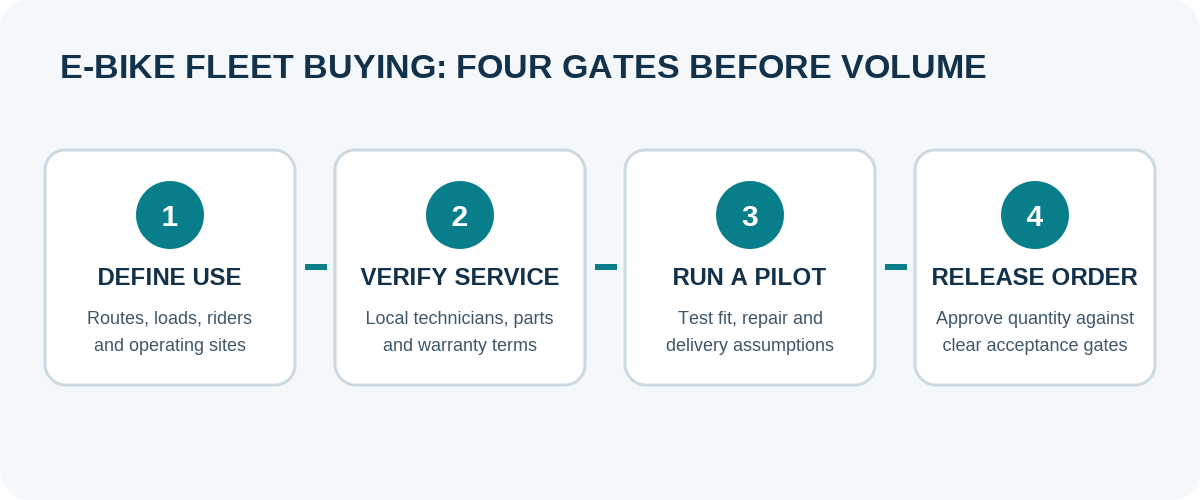
A practical fleet purchase moves through clear gates: define the use case, shortlist suppliers, verify service support, approve samples, run a pilot, then release the agreed order quantity. At every gate, record what has been verified and what remains an assumption.
The September 2025 conversation on LinkedIn about bicycle sourcing costs and supply-chain resilience asked industry readers how they balance cost, design and supply reliability in component sourcing. It is a discussion prompt rather than evidence of a market-wide trend, but it captures the trade-off fleet buyers face: a resilient supply plan can matter more than the lowest first-order price.
Frequently asked questions
What should a company check before buying e-bikes in bulk?
Confirm that the selected model fits the route and rider requirements, that local technicians can service it, and that key replacement parts are available. Review warranty coverage, parts lead times, the sample approval process, landed cost and the supplier’s rules for substitutions before signing a volume order.
Should a fleet buy one e-bike model for every rider?
Only if one model fits the fleet’s different routes, riders and loads. Standardizing compatible parts can simplify maintenance, but a single configuration should not be forced onto use cases with meaningfully different requirements.
How can a buyer reduce risk on a first fleet order?
Use an approved sample and a limited pilot, document service and parts requirements, and tie the larger order to clear acceptance criteria. Keep any unverified operating-cost assumptions visible until the pilot provides local evidence.
Does the lowest bulk price usually mean the lowest fleet cost?
No. Compare the full delivered and supported cost, including maintenance, downtime, spare parts, training and warranty handling. A cheaper bike may still be the right choice, but the quotation alone cannot establish that.
Plan the fleet around support, not just delivery
Bulk e-bike procurement works best when the buyer treats service support, spare parts and lifecycle cost as part of the product specification. A clear RFQ, supplier comparison and pilot help organizations uncover problems before they affect the full fleet. Once the service model is proven, the buyer can negotiate volume with a better understanding of what must remain consistent across future orders.
For component sourcing alongside a fleet project, prepare the exact parts list, quantities and destination before requesting a quotation. Tyride supports bicycle component sourcing and can discuss the requirements for a specific order; confirm product scope and commercial terms directly before making a purchasing decision.
Editorial note: Reddit and LinkedIn posts cited here are dated September 2025 and illustrate individual discussions. They are not representative surveys or proof of market-wide conditions. Procurement checks are practical guidance; buyers should validate product compatibility, applicable requirements and commercial terms for their own region and use case.