
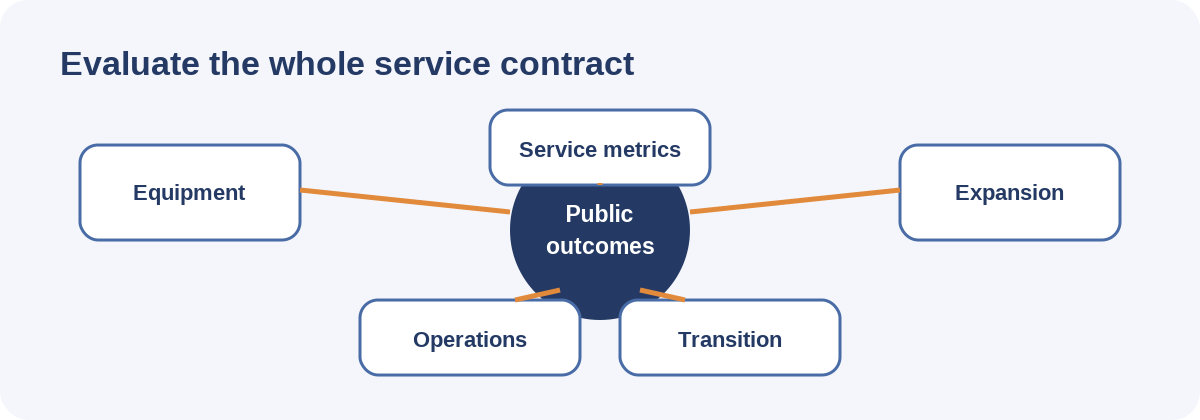
Bike-share procurement is the process of selecting the bicycles, stations, operator and support plan for a shared-bike service. It is a service and operating contract as much as an equipment purchase. Lifecycle cost includes buying, running, maintaining and replacing the system over time. A buyer should evaluate the fleet, stations, charging, maintenance, technology, transition, performance measures and expansion options together. Comparing only the price of bicycles can hide the largest lifecycle and service risks.
Public case studies show two useful approaches. Los Angeles Metro tied a long-term bike-share contract to equipment, operations and service improvements. Mexico City’s Ecobici procurement combined supplier engagement, community input and competitive bidding. Both cases show why a well-defined outcome can matter more than a low unit price alone.
Key Takeaways
- Define outcomes for availability, maintenance, user access and expansion before issuing a tender.
- Compare lifecycle cost across equipment and operations, including transition and charging.
- Use pre-market engagement and community input to improve the specification.
Define the service outcomes before specifying the fleet
A bike-share fleet specification should describe what the system must deliver: where bikes and stations will operate, how availability will be measured, how repairs will be handled, how riders will access the service and what expansion would require. Then specify the equipment and technology needed to meet those outcomes.
The Los Angeles County Metropolitan Transportation Authority’s January 2024 board report provides a detailed example. Metro recommended a five-year-and-five-month base contract plus two three-year options for mobilization, operations, maintenance and expansion, with a total potential value of about $132.6 million. The report also described a five-month transition period, new stations and bikes, charging upgrades, maintenance requirements, and service metrics that could affect payment. These provisions illustrate the scope of the commitment; they are not a price benchmark for another city. Read Metro’s contract report.
For buyers, the lesson is to make the service model explicit. State who owns equipment, who maintains it, what data the operator must report, how a transition will be managed and how options or expansions can be activated. If the service depends on batteries being charged, include the charging method and responsibilities in the procurement documents.
Compare lifecycle costs and operating dependencies
A credible evaluation should include procurement, installation, staffing, maintenance, parts, charging, software, payment access, user support, theft or loss response, and end-of-contract transition. Ask bidders to show how the service will meet performance requirements and what evidence will be reported over time.
Metro’s report said the new configuration would increase pedal-assist e-bikes from 370 to 1,350, with the e-bikes accounting for 75% of the system when fully deployed. It also cited historical usage in which Metro e-bikes were used seven times more than classic bikes. The report described a battery range above 45 miles for the new e-bikes and 100 stations designed for in-dock charging, subject to approvals. These were projected or specified contract features, not proof that every new system will have the same outcome. The procurement point is to connect the chosen fleet mix to local usage evidence, charging capacity and service plans.
Use separate line items for capital equipment and recurring operations where possible. Compare the cost of keeping a bike available, not just the initial purchase price. Define what happens if a proposed charging feature cannot be installed or if the promised delivery schedule slips. Metro’s report explicitly noted that without in-dock charging, the program would need battery swaps, creating additional cost and vehicle miles for service operations.
Use market engagement and competition to improve the specification
A tender should give capable suppliers a fair chance to explain what is feasible before the final specification locks in. Mexico City’s Ecobici modernization, described by the Open Contracting Partnership, used worldwide vendor engagement, resident consultation, transparent project updates and a reverse auction involving two consortia and 26 rounds of price improvements. Between 2019 and 2023, the reported system grew from 6,500 to 9,300 bikes, while operating costs were reported as 54% lower than the previous service. These are results reported in the case study and tied to that procurement context. Read the Ecobici procurement case.
The process offers practical ideas for other buyers: share the draft requirements with the market, explain which outcomes are fixed and where suppliers can propose alternatives, and ask riders or community groups to identify access and design needs. The final tender can then compare bids against clear service goals rather than assumptions that only one equipment model can satisfy.
A smaller European example shows how a trial can inform a later order. Croatia Post tested e-bikes for six months before procuring 180 for postal deliveries. The case does not establish that the same fleet size suits another operator; it illustrates how a defined test period can precede a larger procurement decision. Read the European Commission case study.
Plan the transition as a procurement workstream
A successful award can still fail operationally if the transition plan is incomplete. Identify what happens to existing bikes and stations, how membership or payment data will move, when staff training begins, and how users will be told about changes. Build a mobilization calendar with named owners and acceptance gates for equipment, software, stations and customer support.
Metro’s report described a transition period of up to five months during which both the existing and new contracts would be active, giving the new operator time to mobilize while service continued. It also included handling of existing equipment and transfer of member information. That illustrates the value of transition clauses as continuity measures, not merely administrative detail.
For equipment and replacement components, state compatibility and revision controls. A program should know which approved components fit each generation of bike and how future substitutions will be evaluated. Tyride’s bicycle components sourcing service and about page describe its role in saddle manufacturing and coordinated parts sourcing. The saddle OEM specification guide is relevant when saddle geometry or materials are part of the fleet specification.
Let rider feedback inform, but not replace, operational evidence
Rider comments can expose friction that formal procurement documents miss. In a January 2024 Reddit thread, a user of a city winter bike-share pilot said the shared winterized bike could spare them from buying a separate winter bicycle. Another commenter identified Montreal as the location. This is a single user’s experience, not a demand estimate or a system performance measure. It is still a useful prompt to examine seasonal equipment, local maintenance capacity and whether service continues when private-bike use changes. Read the Reddit discussion.
One January 2024 LinkedIn update described a delivery operator’s plan to grow from 20 active riders to 100 by the end of January, then add another 100 through a second production round by the end of March. This was a company-stated delivery-fleet plan, not a bike-share result or a verified outcome. It is useful only as a prompt to test whether procurement phases match an operator’s rollout and support capacity. See the LinkedIn update.
Pair rider feedback with system data: trips per bike, failed unlocks, out-of-service time, repairs by type, station availability, battery status, complaints and participation across neighborhoods. State how the data will be reported, audited and used to make decisions about the next procurement phase.
Bike-share procurement review checklist
Before publishing an RFP or approving a contract, confirm that it covers:
| Procurement area | Questions to resolve |
|---|---|
| Service outcomes | How will availability, access, safety and user experience be measured? |
| Equipment | What fleet mix, stations, charging and technology meet the use case? |
| Lifecycle cost | Are operations, maintenance, parts, transition and options included? |
| Performance | What data is reported, how often, and what remedies apply? |
| Transition | How will users, staff, equipment and data move to the new service? |
| Expansion | Can new areas or partners be added under defined scope and pricing? |
A strong procurement leaves room for supplier insight while making performance and accountability measurable. Buyers planning a commercial operator fleet can also use the e-bike purchasing checklist and the pilot-to-scale guide. If your program requires standardized saddles or coordinated bicycle components, explore Tyride’s product range and OEM/ODM support, then send the target specification through the contact page.
Research method: This article compares the primary Los Angeles Metro board report with the Open Contracting Partnership case summary, then uses one Reddit winter-rider account only as a qualitative prompt. The LinkedIn page does not expose its exact publication date; the post’s end-January and midyear 2024 schedule provides the time-window clue. Contract amounts and program outcomes belong to the named cases; they are not general price or performance benchmarks.
Editorial note: Tyride’s editorial team checked claims against the linked documents. The Reddit and LinkedIn posts are identified as individual accounts, not system-wide measures.