
Bike dealers can reduce the risk of another inventory pile-up by tying each new purchase order to current sell-through, aged stock, confirmed incoming units, and a documented reorder trigger. A low unit price or early-season discount is not enough reason to buy more if last season’s stock has not moved.
This guide is for bicycle retailers, distributors, and brand teams reviewing finished-bike inventory and replenishment. It turns a shop-floor discussion into a repeatable decision process. A January 2025 Reddit thread about leftover mountain bikes and a 2025 LinkedIn post about INTENSE’s Frame First program illustrate two different responses to inventory pressure. Both are individual company or practitioner examples, not proof that one model works for every dealer.
Key Takeaways
- Review sell-through by exact model, size, and age before submitting a seasonal order.
- Count open purchase orders and reserved demand in inventory position so delayed units are not ordered twice.
- Set a written reorder trigger and a maximum stock commitment for each product group.
- Treat display, build-to-order, and frame-first programs as alternatives to evaluate, not guaranteed savings.
What should a bike dealer measure before reordering?
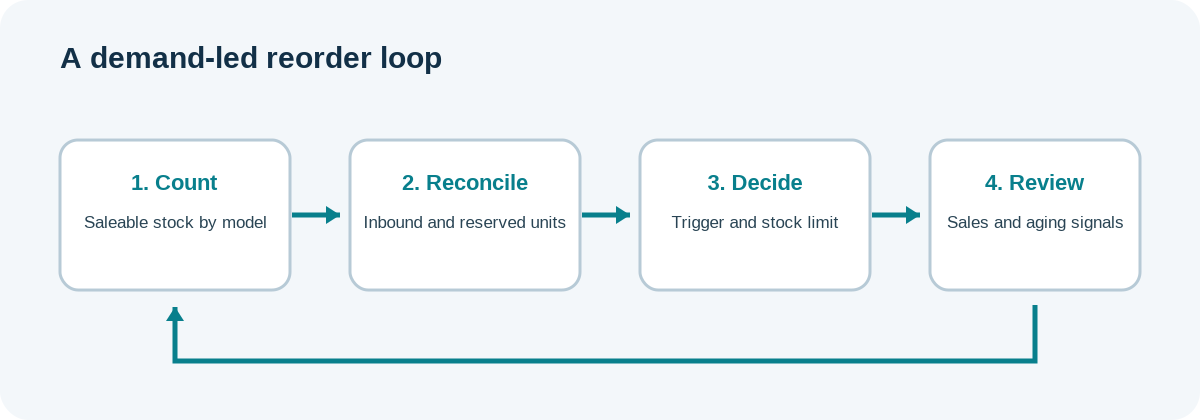
Measure saleable stock, stock age, sales velocity, confirmed inbound units, and committed customer demand by exact model and size. A total bike count hides the difference between a popular configuration and a slow-moving size that has been on the floor for months.
The January 28, 2025 Reddit r/BikeMechanics discussion, “Selling off inventory” began with a shop owner asking how to move leftover full-suspension bikes while respecting brand resale restrictions. A reply described stores discounting old stock or breaking down bikes, while another recommended talking to the brand representative. The thread showed the practical connection between aged stock and later purchasing: one commenter said the shop would buy fewer bikes until dead stock moved. This is a small, anecdotal discussion, but it identifies a real decision point for a dealer: old inventory consumes space and cash that could support the next order.
Track these fields weekly or monthly, depending on the season and transaction volume:
| Field | Why it matters | Buyer action |
|---|---|---|
| Units available by SKU, model, and size | Finds gaps hidden by category totals | Separate fast and slow variants |
| Weeks since receipt and model year | Identifies aging exposure | Review markdown, demo, or transfer options |
| Sales in the review period | Establishes local sell-through | Compare with the same season where records allow |
| Confirmed inbound units | Prevents duplicate ordering | Include only supplier-confirmed quantities and dates |
| Reserved or customer-committed units | Separates sellable stock from promised stock | Keep reservations tied to named orders |
| Margin after discount and selling cost | Shows the cost of waiting or clearing | Compare realistic contribution, not MSRP alone |
How do you calculate a practical reorder point?
For a continuously reviewed SKU, a simple starting rule is: reorder point = expected demand during replenishment lead time + safety stock. For seasonal bicycles, adapt the rule to the selling window and the supplier’s actual order calendar. Do not assume an average from the whole year represents the next eight weeks.
For example, if a specific commuter model sells four units per week, replenishment takes three weeks, and the dealer chooses a buffer of three units, the initial trigger is 15 saleable units. The numbers are illustrative. Replace them with the dealer’s sales and confirmed lead-time data. If 20 units are already on a confirmed inbound order, the buyer should include them in inventory position rather than create another order from an on-hand-only report.
Use a basic control sequence:
- Freeze the stock snapshot date and reconcile physical stock with the system.
- Remove damaged, quarantined, demo-only, and customer-reserved units from saleable inventory.
- Add confirmed inbound units and subtract committed demand to calculate inventory position.
- Compare that position with the approved reorder trigger and seasonal maximum.
- Record the reason for each exception, such as a launch, local fleet contract, or supplier discontinuation.
For small-parts planning, Tyride’s first wholesale stock-order guide explains how to separate core stock, trial lines, and special orders. The same discipline applies to complete bicycles, but each model and size needs its own demand signal.
How can dealers avoid repeating the post-boom ordering cycle?
Use dealer sell-through and replenishment signals, not only the brand’s sell-in target. A retailer’s purchase from a supplier is not the same as a sale to a rider. If those two events are treated as interchangeable, upstream forecasts can mistake channel loading for real consumer demand.
In 2025, INTENSE described its Frame First program on LinkedIn. The company said it would retain frame inventory and let dealers configure a complete build around a customer’s choice, with components available through QBP. This is a company’s description of its own program, not an independently audited result. The useful planning idea is to test whether holding fewer complete-bike configurations can reduce a dealer’s commitment while still meeting the customer’s expected delivery time.
The European Cycling Industries 2026 Bicycle Industry and Market Profile reports 15.618 million bicycle and EPAC sales in Europe in 2025, down 2.6% year over year. That regional figure does not predict an individual shop’s sales. It is a reminder to separate local demand evidence from broad market narratives when setting an order plan.
How should a dealer set purchasing limits?
Set a maximum commitment by product family, model year, and decision window. The limit should reflect cash available, expected sell-through, replenishment terms, and the amount of aging stock the business can absorb. Review it with the people who own buying, sales, service, and finance rather than letting a supplier discount dictate quantity.
Before signing a bulk order, ask the supplier to confirm the SKU mix, item-level minimums, delivery schedule, permitted substitutions, and what happens if a shipment is delayed. Tyride describes its bicycle components sourcing service as supporting inquiry, quotation, contract, production, and delivery. Treat those published process steps as a starting point for a project conversation; confirm the details for the products and order under consideration.
Frequently asked questions
Should a bike shop buy a full model-year range in advance?
Only when the expected demand, cash plan, and delivery terms justify the commitment. Compare a full seasonal buy with staged orders, customer reservations, and a smaller display range. The right mix depends on product availability and the shop’s local demand.
What should happen to a slow-moving bicycle before the next order?
Check its age, condition, brand rules, and realistic selling channels. Discuss an approved markdown, demo use, transfer, or component recovery with the brand where required. Record the decision and avoid replenishing the same configuration until the evidence changes.
Does a frame-first program eliminate dealer inventory risk?
No. It may shift which party holds complete-bike inventory, but the dealer still needs to confirm frame availability, component compatibility, assembly capacity, customer lead time, and commercial terms. Review the program’s actual agreement before relying on the model.
Turn the stock review into a sourcing conversation
Prepare a list of exact models or component SKUs, quantities, destination, target arrival window, and open questions. If the purchasing need includes private-label or complementary parts, ask Tyride to review the specification and quote scope through the contact page. A clear requirement lets the supplier confirm what it can support before the buyer commits cash.
Method note: The Reddit example is a January 2025 community discussion and is anecdotal. The INTENSE example is a company LinkedIn post describing its program. The regional sales figure comes from the 2026 ECI profile and should not be applied to an individual dealer without local data. Reorder calculations above are illustrative, not Tyride forecasts or customer results.