
To prevent duplicate bicycle orders, keep one authoritative purchase-order register that records the quantity requested, supplier-confirmed quantity, current production or shipment status, and the owner of each open exception. Before placing a replacement order, reconcile that register with on-hand stock, customer commitments, and the supplier’s latest written confirmation.
This matters when a retailer or importer is trying to protect availability during a long lead time. A second order can look like a sensible hedge until both the original and replacement shipments arrive. A January 2025 Reddit discussion described precisely that sequence at shop level. Industry research and a separate LinkedIn practitioner post also point to the consequences of reacting to shortages without reliable demand and inventory visibility.
Key Takeaways
- Keep a single source of truth for every open purchase order and line item.
- Do not count a verbal estimate as confirmed inbound stock.
- Require a named approver before replacing, expediting, or substituting a delayed order.
- Compare the cost of a stockout with the cash and aging risk of duplicate units.
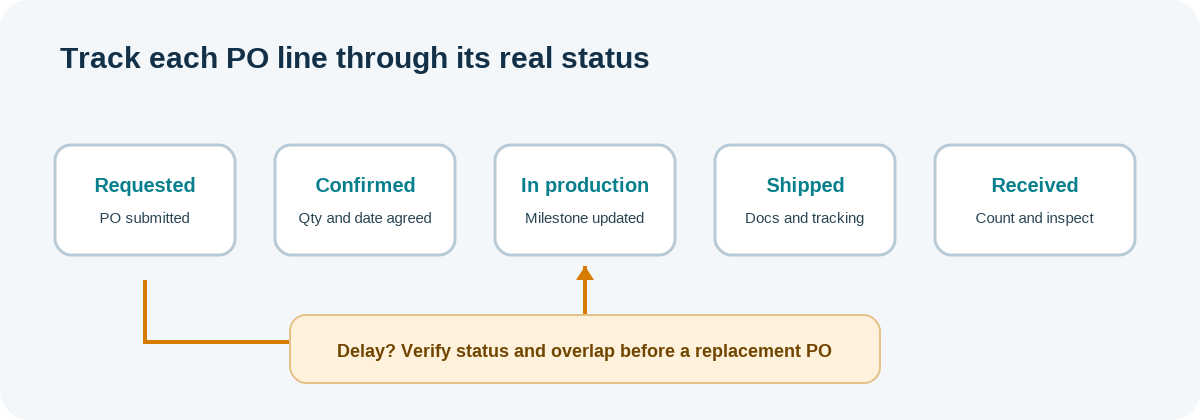
How do duplicate orders happen?
Duplicate orders usually happen when a buyer reacts to a shortage using an incomplete view of the original order. One team sees an overdue delivery, another team sees an empty shelf, and a replacement order is submitted before anyone confirms whether the first supplier has shipped or rescheduled the goods.
In visible comments on a January 2, 2025 Reddit r/cycling thread, a commenter who said they worked in the industry described shops repeating orders with alternate suppliers after original orders were delayed. When the delayed stock later arrived, shops were left overstocked and discounting. The original post has been removed, so this is comment-level anecdotal evidence, not a complete record of the discussion or an industry-wide measurement.
The same control problem appears in the wider industry. The Roland Berger report on the European bicycle industry describes pandemic demand, very large dealer orders, and subsequent inventory surpluses. That report concerns the broader market and does not attribute every excess unit to duplicate orders. It supports the need to manage order visibility and demand assumptions carefully.
What should a bicycle purchase-order register contain?
Record each order at line level, not just by supplier or total value. A single bicycle order can contain different models, sizes, colors, components, shipping dates, and customer commitments. A line-level record makes it possible to replace one unavailable variant without accidentally rebuying the rest of the purchase order.
| Register field | What to record |
|---|---|
| Purchase order and line ID | Internal reference, supplier reference, SKU, and revision |
| Ordered quantity | Approved quantity and unit of measure |
| Confirmed quantity | Quantity acknowledged in writing by the supplier |
| Status | Requested, acknowledged, in production, ready, shipped, received, cancelled, or disputed |
| Date basis | Original promised date, latest revised date, and date source |
| Partial shipment | Quantity shipped, tracking or document reference, balance remaining |
| Substitution | Proposed part, compatibility evidence, approver, and customer impact |
| Financial exposure | Deposit, balance, freight, and cancellation or change terms |
| Owner and next action | Named person, deadline, and escalation route |
Separate the following quantities in reports:
- On hand: physically received and saleable stock.
- Confirmed inbound: written supplier acknowledgement with a current delivery window.
- Unconfirmed or at-risk: requested, delayed, or disputed quantity that should not be treated as reliable supply.
- Committed: customer-reserved or production-allocated units.
- Replacement exposure: any quantity in a proposed second order that overlaps the original.
For a small buyer, Tyride’s first wholesale stock-order guide shows how a purchasing record can separate stock roles, incoming quantities, lead times, and order decisions. Adapt the fields to a line-level open-order register rather than using an on-hand-only total.
When is a replacement order justified?
A replacement order is justified when the original line is formally cancelled, the supplier confirms it cannot fulfill within the buyer’s acceptable window, or the responsible buyer approves a documented risk decision. If the original order remains open, the buyer should model both outcomes before creating overlapping exposure.
Use this approval sequence:
- Ask the original supplier for a written status, quantity, ship date, and options.
- Check whether the goods are in production, at a consolidator, or already dispatched.
- Identify the exact SKU and quantity needed to cover confirmed demand until the next review.
- Ask the alternate supplier about availability, minimums, cancellation, and return terms.
- Calculate the overlap if both suppliers deliver.
- Approve a replacement quantity and assign responsibility for cancelling or reselling any excess.
Do not replace an entire line when only one size or a portion of the quantity is urgent. A partial substitute may reduce the gap while keeping total exposure controlled, provided compatibility and commercial terms are confirmed.
How should buyers handle supplier updates and internal handoffs?
Use dated updates with a clear owner and decision deadline. A note such as “supplier says soon” cannot support a reliable inventory decision. Record what was confirmed, who confirmed it, and what action becomes necessary if the date slips again.
An earlier LinkedIn discussion by cycling-industry practitioner Silas Obrist called out excess inventory and argued for better shared stock and sales visibility between retail and brands. It is a practitioner viewpoint, not a measured causal study. Its operational lesson is useful: when sell-through and open-order data are fragmented, buyers can mistake a downstream shortage for a system-wide shortage.
For supplier selection and first-article controls, use Tyride’s bicycle parts supplier-check guide. If a substitute component is proposed, also compare its technical specification and sample against the approved item before release. The quality-control service page describes Tyride’s published inspection services; buyers should confirm the exact checks, acceptance criteria, and responsibility for each order.
What should be written into a delay or backorder agreement?
Agree the decision rules before the order becomes urgent. Ask the supplier to state how it reports production progress, when it must notify the buyer of a delay, whether partial shipments are allowed, and who authorizes substitutions. Confirm whether a revised ship date changes the payment schedule or cancellation rights.
| Term | Buyer should clarify |
|---|---|
| Order acknowledgement | Which line items and quantities are accepted |
| Lead-time trigger | Deposit, drawing approval, sample approval, or another milestone |
| Delay notice | How quickly the supplier reports a risk and what evidence it provides |
| Partial shipments | Whether they are permitted and how freight is allocated |
| Substitution | Required documents and buyer approval before shipment |
| Cancellation | Which quantities can be cancelled and any charges that apply |
| Allocation | How scarce stock is allocated across open orders |
| Remedy | Agreed response for shortages, damage, or nonconformance |
Tyride’s components sourcing service lists inquiry, quotation, contract, production, and delivery as its process stages. Use those stages to structure a conversation, then get the actual order-specific promises in writing.
Frequently asked questions
Should a buyer place a second order when the first supplier misses its date?
Not automatically. First obtain the latest written status and compare it with confirmed demand, replacement availability, overlap exposure, and the terms for cancelling either order.
Can an alternate component solve a backorder?
Possibly, but a similar appearance or category does not prove compatibility. Confirm the exact part number, interface, applicable technical evidence, and sample approval before using it in a bicycle assembly.
How often should open orders be reviewed?
Set a review cadence that matches lead time and sales velocity. Review more frequently when the expected receipt date approaches, the supplier reports a risk, or customer commitments depend on the shipment.
Make the next order easier to control
Send a supplier a line-level specification, required quantity, destination, delivery window, permitted split, substitution rule, and approval contact. For a sourcing or manufacturing inquiry, contact Tyride with the open-order context and the exact items needing coverage.
Method note: The Reddit thread’s original post is unavailable; the January 2025 example is based on visible comments. The LinkedIn post is a practitioner opinion, while the Roland Berger report covers wider European industry conditions. The register and approval steps are proposed controls, not a guarantee that every supplier will accept them.