
Quick answer: A sound bulk bicycle parts order balances SKU-level minimums, expected demand during replenishment lead time, shipping economics, and the cost of excess stock. Compare like-for-like landed cost, set reorder triggers for frequently used parts, and negotiate staged releases or mixed-SKU orders only when the supplier confirms those terms in writing.
This guide is for bicycle brands, distributors, wholesalers, and retailers buying components for resale, service, or assembly. It explains how to plan a bulk order without treating a low unit price or a free-shipping threshold as the whole purchasing decision.
Key takeaways
- Ask whether MOQ applies per SKU, color, specification, production run, or total purchase order.
- Calculate a reorder point from demand during lead time plus a chosen safety-stock allowance; review it as demand and lead time change.
- Compare landed cost and usable inventory, not just quoted unit price or freight threshold.
- Separate routine replenishment from special-order parts so customer urgency does not distort the regular buying plan.
- Put SKU substitutions, delivery terms, inspection, and staged shipment dates in the written order.
Minimum order quantity (MOQ) is the least amount a supplier will sell or make under a stated set of terms. Landed cost is the cost to bring goods to the agreed delivery point. A reorder point is the stock level that triggers a new order.
Safety stock is a small buffer kept to cover demand or delivery changes.
What does “bulk” mean for bicycle parts procurement?
“Bulk” can describe a large total shipment, a minimum quantity for one SKU, a production run, or a consolidated order across several categories. These are different commercial rules. A supplier may allow mixed SKUs to meet a shipping threshold while still requiring each custom color or product to meet its own MOQ. Get the definition in writing before building the order basket.
A practical RFQ should ask for price breaks by SKU. It should list any tooling, color, packaging, or custom-order minimums. Ask about minimum order value, shipping terms, carton size, and scheduled releases. A stocked item may have a different MOQ from a custom color or branded part.
Tyride says its bicycle parts sourcing service supports flexible MOQ for standard stocked parts, while custom OEM/ODM requirements may have item-specific minimums. Treat that as a starting point for a project conversation, not as a universal rule for all bicycle suppliers or product categories. Tyride’s existing low-cost parts supplier checklist can help standardize what you request from competing suppliers.
Tyride describes its work with bicycle brands, distributors, wholesalers, and OEM buyers on its About us page. Use the same RFQ and evidence checklist when you compare Tyride with another supplier.
Why can a shipping minimum change the real order cost?
A shipping threshold can make a consolidated order cheaper per unit, but it can also encourage a buyer to purchase slow-moving parts just to qualify. The right comparison includes the timing and carrying cost of the additional stock, not only the freight line.
In an August 2026 Reddit discussion about a bike shop ordering parts, riders and shop workers described a choice: wait for the next combined order or pay more to get one part sooner. Replies also showed that shipping rules and order timing vary by supplier and account. This is one discussion, not a survey of distributor policy. It shows why buyers should weigh the shipping threshold and the delay together. Read the Reddit discussion. This case is later than the February 20 to March 9, 2026 window from the earlier discourse brief. It is included as an additional example, not as a trend from that window.
Ask these questions before you enlarge an order to qualify for better freight:
- Which extra SKUs are likely to sell or be consumed before the next review date?
- How much cash will be tied up in those units, and how much storage space will they use?
- Could an alternative shipment mode, a scheduled release, or a second supplier reduce total cost without adding obsolete inventory?
- What is the customer or production impact of waiting for the next consolidated shipment?
Make the threshold a decision input, not a target. If the parts do not fit a real demand plan, freight savings may be smaller than the cost of holding or discounting the excess stock.
What does a current bicycle industry example show about ordering?
On March 5, 2026, Bicycle Retailer and Industry News reported that NÜDL Helmets and Sprokut Supply Co. launched a wholesale ordering platform for independent bicycle retailers. The announcement lists live stock, wholesale pricing, and quick reorders as features. This is a company announcement, not an independent test of results. Still, it shows that stock visibility and easy reorders matter to wholesale buyers. Read the industry announcement.
For buyers, the operational lesson is straightforward: a quote should help you see what is available now, what must be produced, and when the next replenishment can arrive. Ask suppliers for SKU-level availability, realistic production lead time, order status updates, and an agreed process for backorders or discontinued items. A clean digital catalog is useful only when the underlying stock and delivery information is current.
How should a buyer set reorder quantities?
Start with demand and lead time for each SKU. SAP’s inventory guide sets reorder point as demand during lead time plus recommended safety stock. In a simple model:
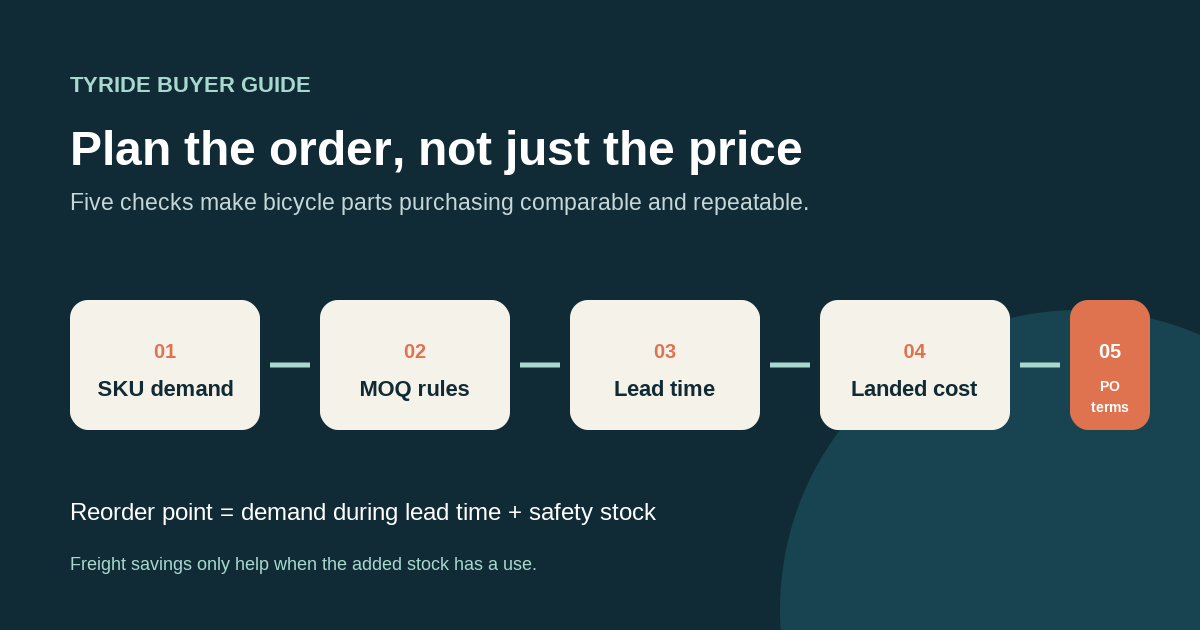
Reorder point = expected demand during replenishment lead time + safety stock
The formula is a planning aid, not a forecast. Set safety stock based on demand swings, supplier reliability, and the cost of a stockout or excess stock. Review it when sales or lead time changes. See SAP’s reorder-point explanation. ASCM also explains how safety stock can change when demand or lead time varies. Read ASCM’s safety-stock overview.
For example, say a shop uses 10 units of a common part each week. A supplier needs three weeks to replenish it. The shop chooses 12 units as safety stock. Its reorder point would be 42 units: 30 for expected lead-time demand plus 12 for the buffer. These are made-up values to show the math, not a recommended stock level.
Think through a small shop’s order. The shop needs brake pads, chains, and one rare part. Keep the common items in the regular stock plan. Order the rare part only when a real need appears. If a customer needs it now, price a separate shipment. Then compare that freight cost with the cost of waiting. If the need can wait, add it to the next planned order. Write down the reason for the choice. Next month, compare cost and wait time. If the same choice keeps coming up, change the stock rule or ask the supplier for a better plan.
Use different policies for different items:
| Part profile | Example planning approach | Buyer control |
|---|---|---|
| Frequent service consumable | Reorder from usage history and lead-time demand | Review stock and open orders on a fixed cadence |
| Seasonal accessory | Plan to a season or campaign, then cap the remaining exposure | Set a sell-through checkpoint and markdown decision date |
| Low-volume compatibility-specific part | Hold a limited service quantity or source to confirmed demand | Confirm exact compatibility and avoid speculative variants |
| Custom-branded component | Coordinate forecast, MOQ, packaging, and production slot | Consider staged releases only if storage and quality terms are agreed |
Avoid using the same safety-stock rule for a fast-moving tube and a rare proprietary replacement part. If the SKU is compatibility-sensitive, first verify the assembly data using Tyride’s bicycle parts compatibility checklist; an inexpensive part that cannot fit the intended bicycle is not usable inventory.
How do you compare supplier quotes on a like-for-like basis?
Use one RFQ specification for every supplier and normalize the quote into landed cost per sellable unit. Record which costs are included and who is responsible for each step. Incoterms® rules allocate certain delivery obligations, costs, and risks between buyer and seller, but they do not replace the sales contract. The International Chamber of Commerce’s Incoterms® overview explains their role.
| Quote field | What to confirm |
|---|---|
| Exact part number and revision | No unapproved substitution or ambiguous family name |
| Quantity basis | MOQ per SKU, color, model, carton, or total order |
| Unit price and tiers | Quantity break, currency, validity date, tooling or setup charge |
| Packaging | Units per carton, labeling, barcode, retail or bulk packaging |
| Delivery | Lead time, named Incoterms® rule and place, shipping mode, split-shipment cost |
| Quality | Sample, inspection scope, relevant reports, remedy for nonconforming goods |
| Payment | Deposit, balance trigger, credit terms, bank charges, currency risk |
Then compare:
Landed cost per usable unit = product cost + allocated freight + insurance + duties and import charges + inspection and handling + expected defect or rework cost, divided by usable units.
The U.S. International Trade Administration describes landed cost as the total price after goods reach the buyer. Its guide lists product price, insurance, freight, tariffs, taxes, and other fees as inputs. Use it as a starting list, then check the rules for your own destination market. Read the ITA landed-cost guide.
This buyer’s model is not a tariff ruling. Check duty codes, taxes, and import rules with a customs professional in the destination market. Write down your assumptions so another buyer can repeat the comparison. The ICC Incoterms® rules define some buyer and seller duties, costs, and risks. They do not replace the sales contract.
When should a buyer consolidate, split, or stage an order?
Consolidate when the SKUs have compatible demand timing and packaging, and the freight savings exceed the cost of extra inventory. Split an order when one urgent or high-turn SKU should not wait for slower custom items. Consider staged releases when a supplier can commit finished goods and the buyer can agree on storage, inspection, ownership, shipment windows, and payment triggers.
Before splitting or staging an order, document:
- Which SKUs and quantities are in each shipment.
- Whether the same approved revision and materials apply to every release.
- The release window and what happens if the buyer changes a forecast.
- Who pays storage, extra picking, export documentation, or additional freight.
- When payment is due and when risk transfers under the named delivery term.
- How a delayed or short shipment affects the remaining production plan.
Never let a freight threshold silently become a substitution rule. The supplier should request written approval before changing a product, color, pack size, or revision. If the part is safety- or fit-critical, hold the shipment until the exact approved item is confirmed.
What should be included in a bulk bicycle parts purchase order?
A purchase order should be usable by the buyer, supplier, warehouse, and quality team without relying on a phone call to interpret it. Attach the approved RFQ and sample reference when those documents define the product.
- List every SKU, revision, quantity, unit, price, and agreed quantity tier.
- Identify the accepted sample, drawing, finish, packaging, barcode, and labeling.
- State the quality checks, inspection record, and disposition for nonconforming units.
- Prohibit substitutions unless a named buyer approves them in writing.
- Record production lead time, shipment windows, delivery term and place, and split-shipment permissions.
- Define how backorders, shortages, defects, and corrective actions will be handled.
For a multi-part order, use a single controlled parts list with one row per SKU. Tyride’s component sourcing and supply service can be asked to quote against that list, with the target market, expected order volume, and evidence requirements attached. For saddle lines, connect the order plan to the bulk saddle quality checklist so sample approval and production inspection use the same specification.
Frequently asked questions
Is MOQ always applied per product?
No. Suppliers may define MOQ by SKU, model, color, custom finish, packaging, production run, or order value. Ask which quantity basis applies to each line. A mixed-SKU shipment may satisfy freight economics without satisfying a custom-production MOQ.
Should I order more to reach free shipping?
Only when the extra quantity has a reasonable demand or service use before the next replenishment. Compare freight saved with inventory carrying cost, storage, expected discounting, and obsolescence risk. If the added quantity is uncertain, ask about a scheduled release or a smaller shipment option.
How much safety stock should a bicycle parts buyer keep?
There is no universal unit count. Estimate demand during replenishment lead time and add a safety-stock allowance based on demand variation, service expectations, supplier performance, and the cost of shortage. Recalculate as the data changes.
What is the most useful supplier lead-time commitment?
Ask for separate estimates for sample approval, production, final inspection, booking, transit, customs, and receiving. A single “delivery time” can hide where delay risk sits. Use a named delivery term and destination point so both sides understand their responsibilities.
Build the order plan before asking for the final quote
Send suppliers a SKU list, forecast horizon, first-order quantity, target replenishment cadence, customization needs, shipping destination, and quality requirements. Ask them to return MOQ by SKU, quantity tiers, stock status, lead time, shipment options, and quote assumptions in the same format. This makes the offers comparable and reveals whether a bulk price actually supports your inventory plan.
To discuss a sourcing proposal with Tyride, use the contact page and include the components, destination market, annual demand estimate, first order, and preferred delivery schedule.
Research method: This guide combines one Reddit discussion, one March 2026 industry announcement, and published inventory-planning guidance. It does not report a survey of bicycle suppliers. The Reddit thread is a single case, not a market-wide measure of shipping policy. Supplier terms vary by country, part, account, and order date.
Historical context also matters. An Associated Press report in 2024 described post-pandemic excess bicycle inventory across factories, suppliers, distributors, and retailers. That report is not a measure of current 2026 stock. It is a reminder that inventory swings can affect more than one point in the chain. Read the AP report.