
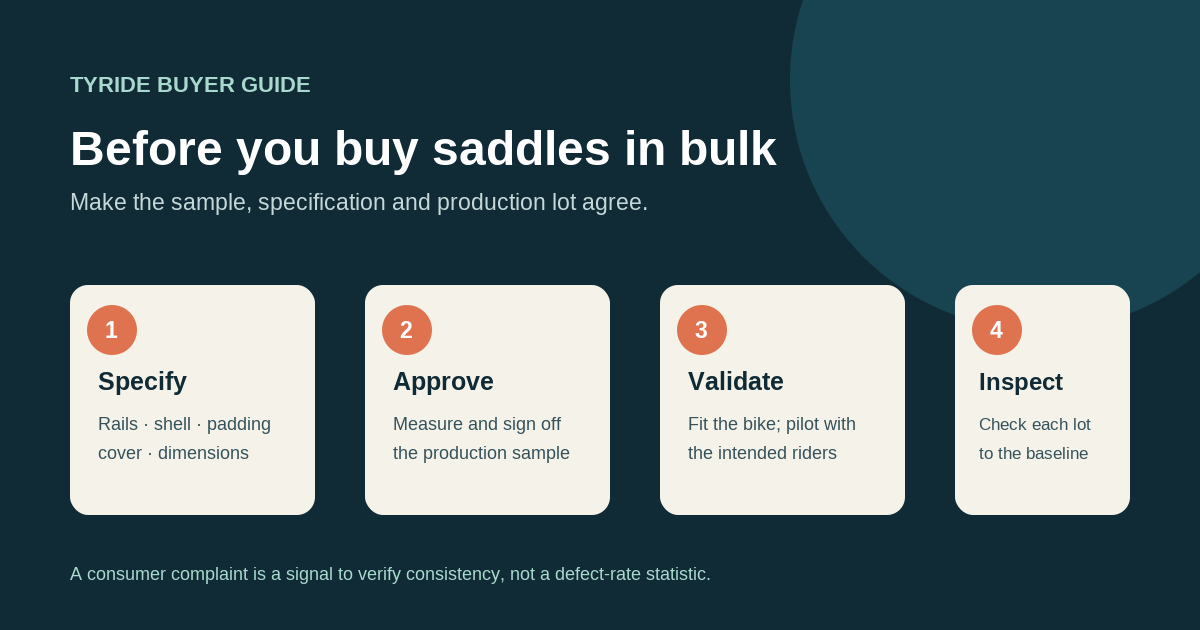
Quick answer: Before placing a bulk bicycle saddle order, approve a representative sample against a written specification, verify the saddle and seat-post test scope for the target market, pilot the product with the intended riders, and inspect production against the approved sample. A low unit price cannot compensate for inconsistent padding, fit, or finish across a shipment.
This guide is for bicycle brands, importers, distributors, and retailers comparing saddle suppliers or launching a private-label saddle. It turns a real customer complaint into a buyer-side quality process. The Reddit post cited below is an individual consumer report, not a defect-rate study or proof that any country or supplier category is unreliable.
Key takeaways
- Convert comfort language such as “supportive” or “soft” into measurable dimensions, materials, and acceptance criteria.
- Sign off on a sample that represents the exact production construction, including shell, rails, foam, cover, bonding, stitching, and packaging.
- Treat comfort validation and safety testing as separate activities. ISO 4210-9:2023 specifies saddle and seat-post test methods for ISO 4210-2; it does not measure whether a saddle feels comfortable to every rider.
- Define change control, inspection records, and remedies before the production order, not after a batch fails.
Bicycle saddle bulk sourcing is buying or arranging production in quantities that need a supplier quote and production controls. A golden sample is the signed unit used as a quality reference for later production. A rider pilot is a small test with people from the product’s intended customer group.
Why does saddle consistency matter in a bulk order?
A saddle is a rider-contact product. The customer experiences its shape, support, cover, and movement directly, while the buyer has to control the parts and process that create those characteristics. A sample may feel good and still fail to represent later production if materials, dimensions, suppliers, or assembly settings change.
On February 20, 2026, a Reddit user posted a warning about a low-cost, no-name saddle after reporting that its padding was uneven from side to side. The post showed 134 votes, and a highly visible reply advised riders to seek a known brand with a comfort guarantee. This is one customer’s experience, not a representative market survey, but it illustrates how a small production inconsistency can become a visible product complaint. Read the Reddit case.
For a wholesale buyer, the practical lesson is not “avoid low-cost saddles.” It is “make the expected construction repeatable.” That means the quote, sample, purchase order, and inspection checklist must describe the same saddle. If product development is already underway, Tyride’s guide to specifying and sourcing bicycle saddles for brands and OEMs covers the broader RFQ and supplier-qualification process. This article focuses on sample approval and production consistency.
What should a bicycle saddle specification include?
A useful saddle specification identifies the product, its intended rider and bicycle application, and the characteristics the supplier must keep stable. Do not rely on a catalog photo or a single phrase such as “ergonomic comfort.”
| Specification area | What the buyer should record | How to verify it |
|---|---|---|
| Application | Road, MTB, e-bike, commuter, kids’ bike, or another defined use | Confirm the target bicycle and rider group |
| Shape and dimensions | Overall length and width, nose and rear profile, channel or cutout, measurement points | Drawing with revision and tolerances |
| Shell and rails | Material, rail profile and dimensions, finish, approved clamp interface | Material declaration, drawing, and fit check |
| Padding | Material, density or hardness where controlled, thickness by zone, construction | Sample measurement and agreed test method |
| Cover and seams | Material, texture, color reference, seam location, bonding or stitching | Signed color/material standard and visual limit samples |
| Branding and packaging | Logo placement, label, barcode, carton quantity, protective materials | Artwork proof and approved packaging sample |
| Change control | Which substitutions require written approval | Contract or purchase-order clause |
The specification should separate a must-match feature from a preference. The rail and clamp fit may be fixed. Color may allow a range. Set a limit or check for each must-match feature. If a feature is hard to measure, name who will judge it. Record how that person will make and log the call.
How do buyers validate a saddle sample before production?
Use a staged approval. One sample can screen an idea. It cannot prove that the full run will match. Keep the design, rider test, and factory checks tied to one spec.
- Confirm the sample matches the quote. Record model, revision, shell, rails, padding, cover, color, logo, and packaging. Ask the supplier to identify any provisional material or process.
- Measure critical dimensions. Use the drawing’s named measurement points. Record the tool and method so that buyer and supplier are comparing the same locations.
- Inspect construction. Check left-right symmetry, cover tension, seams, adhesive edges, rail alignment, visible marks, and the saddle-to-seat-post interface.
- Install it on a representative bicycle. Verify that the clamp secures the rails as intended and that the saddle can be positioned within the target range. Follow the component manufacturer’s installation instructions.
- Run a rider pilot. Use riders from the target group. Give them the same route or ride time. Ask about fit, pressure, movement, heat, and pain as separate questions. This does not replace a mechanical test.
- Approve a controlled “golden sample.” Sign and date the sample, photograph it, label its revision, and retain one unit with the buyer and one with the supplier if practical.
Tyride lists sample support and pre-shipment checks among its bicycle parts sourcing and quality services. Confirm the scope, lead time, and fee for your project. See the bicycle saddle range for product examples.
Tyride supports saddle manufacturing and component sourcing for bicycle brands, wholesalers, and OEM buyers. Read about us before you send an RFQ.
A small peer-reviewed study helps explain why the rider group matters. In a 2023 study of 10 healthy women, a saddle 1 cm wider than each rider’s ischium width improved pressure distribution in the tested setup. The study is small and narrow in scope. It does not establish one best width for every rider or saddle. It does support testing fit with the intended group instead of choosing a single shape by guesswork. Read the study abstract on PubMed.
Which tests should a buyer request?
Ask for test evidence that matches the saddle model, revision, build, and target market. ISO says ISO 4210-9:2023 sets test methods for saddles and seat posts under ISO 4210-2. The parent ISO 4210-2:2023 standard sets safety and performance rules for several bicycle types. These standards cover mechanical tests. They do not measure comfort or cover every law in every market.
Before approving an order, ask the supplier to state:
- Which standard and edition were used, and which clauses or methods apply to this product.
- Whether the tested sample matches the quoted materials, dimensions, rail design, and production revision.
- Who performed the test, when it was performed, and whether the report identifies the model and sample.
- Which additional market-specific requirements, if any, the buyer must verify with its compliance team or testing laboratory.
Do not accept “ISO tested” as a complete answer. Request the actual report or an agreed summary with enough details to confirm that it applies to the product being purchased. If a new rail, shell, bonding method, or material is introduced after testing, ask whether the change affects the evidence and whether re-testing is needed.
How should production inspection be defined?
Use the approved sample and spec as the baseline for incoming or pre-shipment checks. The order should say when to inspect, how to pick samples, how to sort defects, what passes, what records to keep, and when to hold or reject a lot. If you use attribute sampling, agree on the plan first. ISO 2859-1:2026 describes lot-by-lot sampling schemes linked to acceptance quality limits. It does not pick the right plan for your business.
Separate defects by consequence. A rail crack, unstable clamp area, or dimension outside a safety-critical limit needs a different disposition from a minor cosmetic mark. Define which defects trigger a stop-ship, which can be reworked, and which are acceptable within an agreed visual limit. Keep the inspection record with the purchase order and lot identifier.
For a recurring order, check the first production units before the full run is packed. Then compare later lots against the signed sample and the same key measurements. Require written approval before the supplier changes a material source, component, process, factory, or packaging detail that could affect fit, feel, durability, or compliance.
Consider a team buying 200 saddles for a new line. The first sample feels right. Still, one sample cannot show whether every unit in the run will match. The team signs one sample and keeps the spec with it. The shop checks width, rail fit, cover, and foam on early units. It also saves a few units from the run. Later, the team compares them with the signed sample. If a part or material changes, the supplier must flag it first. The buyer can test a new sample before saying yes. This takes time. It can also keep a full lot with a hidden fault from reaching the shop.
How can a buyer compare saddle suppliers fairly?
Compare suppliers against the same specification and evidence request. A lower quote may reflect different rails, cover material, test coverage, packaging, or delivery terms. Put those differences in view before ranking the offers.
| Buyer decision | Evidence to compare |
|---|---|
| Product fit | Sample, dimensional drawing, application details |
| Repeatability | Control plan, revision control, material traceability, inspection record |
| Safety evidence | Applicable test report tied to exact model and revision |
| Commercial terms | Unit price, tooling, sample charge, packaging, payment schedule |
| Delivery risk | Production lead time, named shipping term and place, shipment plan |
| After-sales response | Defect reporting window, corrective action, replacement or credit terms |
Use total landed and usable cost rather than unit price alone. Include freight, duties, inspection, packaging, expected rework, customer returns, and the cost of unsellable inventory. For different saddle options, compare the claims and specifications on the individual product pages, such as Tyride’s honeycomb road saddle or Brompton-compatible road saddle, then request a sample of the actual configuration under consideration.
Common questions about bulk saddle orders
Does one good sample guarantee a consistent bulk order?
No. A sample demonstrates one unit. Repeatability depends on the production specification, materials, change control, process checks, and inspection records. Approve the sample and the production controls that are supposed to reproduce it.
Does a comfort test replace ISO saddle testing?
No. A rider pilot helps evaluate comfort for the intended use and audience. ISO 4210-9:2023 specifies saddle and seat-post test methods for ISO 4210-2. Use the relevant mechanical evidence for the product and market separately from rider feedback.
Should every saddle SKU use the same test and inspection plan?
Not necessarily. A different rail design, shell, material, or application may change which checks are relevant. Use one master process where helpful, but map each SKU and revision to its own specification and evidence.
What should a buyer do when the supplier proposes a substitute material?
Pause approval until the substitute is documented. Request its technical specification, impact on the sample and test evidence, and an updated sample if the change can affect fit, comfort, strength, appearance, or compliance. Record who approved it and for which production lots.
A practical next step
Prepare a one-page saddle RFQ with application, drawing, material requirements, target volume, sample request, test evidence, packaging, delivery term, and change-control rules. Then ask suppliers to quote against the same revision. To discuss a project with Tyride, use the saddle sourcing and OEM/ODM contact path and include the intended market and order plan.
Research method: This guide uses one Reddit customer report, a small rider study, and ISO summaries. It does not report Tyride lab tests. The Reddit case is a product-quality signal, not a defect-rate study. Confirm standards and market rules for the bicycle and destination market.
CMS metadata (not article body)
Add these tags to the page head or SEO plugin, and replace the relative image path with the uploaded asset URL if required by the CMS.
<meta property="og:title" content="Bulk Bicycle Saddle Sourcing: A Buyer’s QC Checklist" />
<meta property="og:description" content="Specify, test, and inspect bicycle saddles before committing to wholesale or OEM production." />
<meta property="og:image" content="./saddle-bulk-quality-flow.svg" />
<meta name="twitter:card" content="summary_large_image" />