
The first bulk bicycle-saddle order should be treated as a controlled pilot lot. Approve a physical reference sample, freeze the features that matter, inspect the production lot against that reference, and release repeat purchasing only after test and defect records have been reviewed. A comfortable showroom sample does not prove that every production saddle will have the same rail geometry, cover finish, or structural performance.
This article is for bicycle brands, assemblers, and distributors preparing a first or newly revised saddle order. It starts after the design brief. If width, rider posture, shell, and rail choice are still open, use Tyride’s Bicycle Saddle OEM Specification Guide first.
Golden sample is a labeled, approved physical reference for a defined saddle revision. Pilot lot is the first controlled production batch used to check whether the intended manufacturing process reproduces that reference. Lot release is the documented decision to accept, hold, or reject that batch against agreed criteria. These are buyer controls, not badges that a supplier can award itself.
Key takeaways
- Keep one approved, labeled physical sample and one controlled drawing for the exact revision being ordered.
- Separate fit and structural test evidence from cosmetic lot inspection. A visual check cannot establish fatigue strength.
- Define who can hold, rework, reject, or release a lot before production starts.
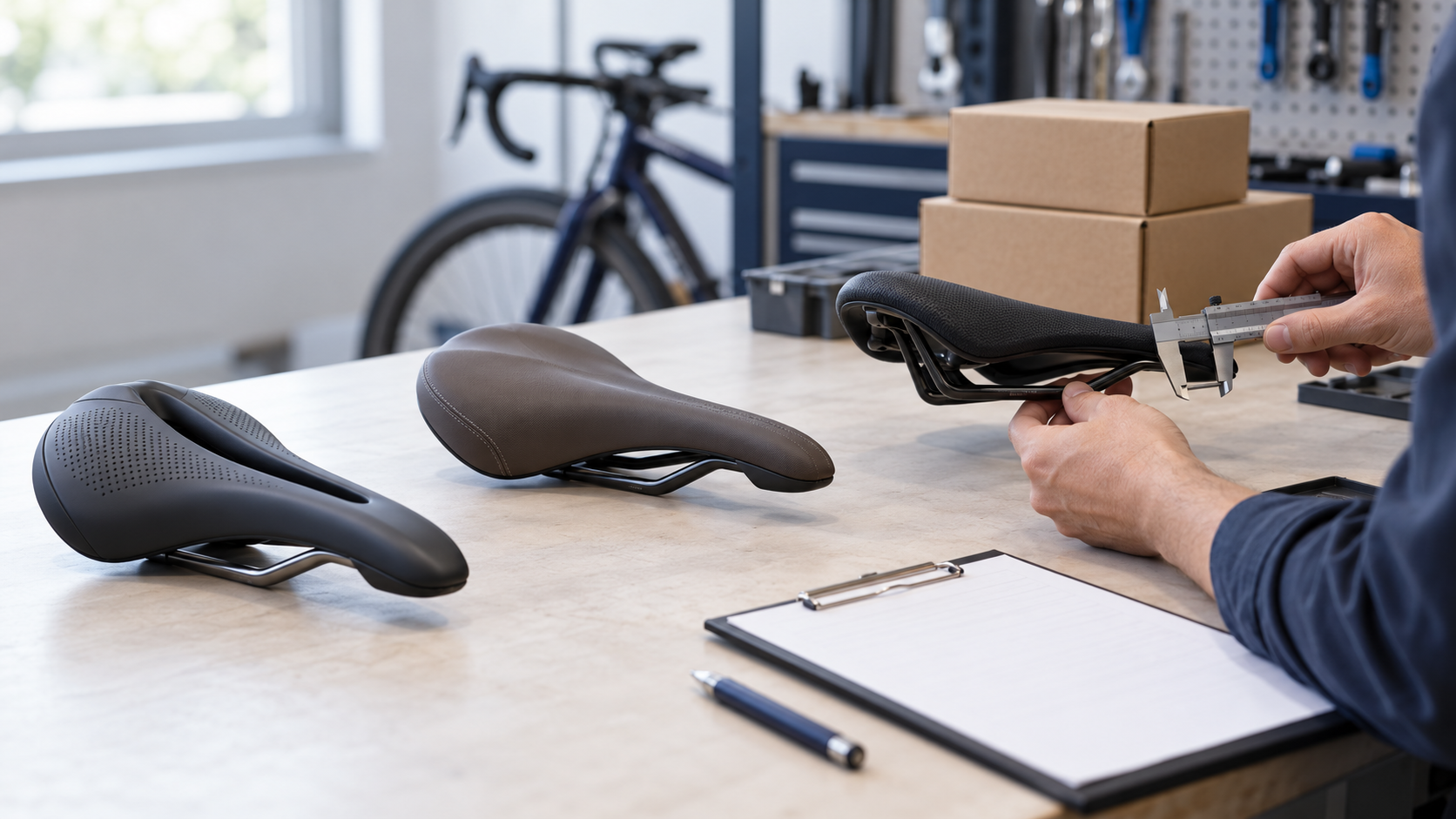
Editorial illustration. The pictured saddles are generic; they are not identified as Tyride products or a documented customer order.
What the Reddit discussion does and does not show
In a May 12, 2026 r/bikewrench discussion, buyers compared local shops, specialist retailers, and marketplaces. One participant described some low-priced components as bulk-packaged OEM parts, while others worried about authenticity and support. The thread is about general parts sourcing, not a verified saddle wholesale inquiry. It illustrates why packaging and price alone are weak evidence of product identity.
A May 25, 2026 pricing discussion adds the commercial pressure: buyers see large differences between local and online prices, while shop voices describe distributor, freight, and inventory costs. These forum examples motivate better purchasing records. They do not establish a normal saddle MOQ, margin, defect rate, or market price.
Gate 1: Freeze the approved saddle configuration
A first-order purchase order should identify the exact product revision. Put the following in a controlled specification and make any supplier exception explicit:
| Control | Record before ordering | Check on the pilot lot |
|---|---|---|
| Identity | Model, SKU, drawing revision, approved sample ID | Unit and carton labels match |
| Geometry | Overall length and width, usable support area, profile | Measured dimensions within agreed tolerances |
| Structure | Shell material, rail material, rail cross-section, rail-to-shell connection | Material evidence and rail fit on target clamps |
| Contact surfaces | Padding construction, cover material, seam and edge finish | Match approved sample; no defined unacceptable defects |
| Branding and pack | Artwork, label, carton count, care or fitting information | Correct print, quantity and traceable lot code |
| Change control | Written approval required for material, tooling or sub-supplier change | No unapproved substitutions |
This is a production-control checklist, not a claim that one construction suits every rider. Width and profile belong to the intended bicycle and riding position. Tyride’s road saddle OEM guide explains those design choices in more detail.
Name a golden sample: a signed and dated physical sample representing the approved build. If the supplier and buyer each retain one, record that both match the same drawing revision. Photographs help, but cannot replace dimensions, materials, or a fit test. If a rail supplier or cover material changes later, return to approval rather than silently treating the new build as equivalent.
Gate 2: Decide what must be tested, and on which version
ISO 4210-9:2023 specifies saddle and seat-post test methods for ISO 4210-2. It is a method reference, not a blanket certificate for every saddle advertised online. Ask for a report that identifies the exact model, revision, test method, result, date, and laboratory. Confirm that the intended bicycle category and target market are covered by the chosen requirement set. If the first bulk lot uses a different rail or shell from the tested sample, the earlier report may no longer describe the product being shipped.
For bicycles in the United States, the U.S. Consumer Product Safety Commission’s bicycle guidance describes requirements for the seat, seat-post insertion mark, and adjustable seat clamp under 16 CFR part 1512. The buyer should identify which requirements apply to its complete bicycle and destination market. An ISO method report and a U.S. requirement are separate checks; neither should be silently substituted for the other.
Separate three kinds of evidence:
- Design validation: fit, rider evaluation, and structural testing on the intended configuration.
- First-article approval: dimensions, assembly, materials, and appearance from production tooling and the intended production route.
- Routine lot control: the agreed measurements, visual criteria, labels, and any periodic test plan for subsequent batches.
A pre-shipment visual inspection can find scratches, crooked rails, poor seams, and pack errors. It cannot prove hidden structural durability. For carbon-rail or other special clamp systems, confirm the rail profile and compatible clamp hardware on a representative bicycle. Tyride’s carbon saddle safety checklist explains why a generic certificate or visual appearance is inadequate.
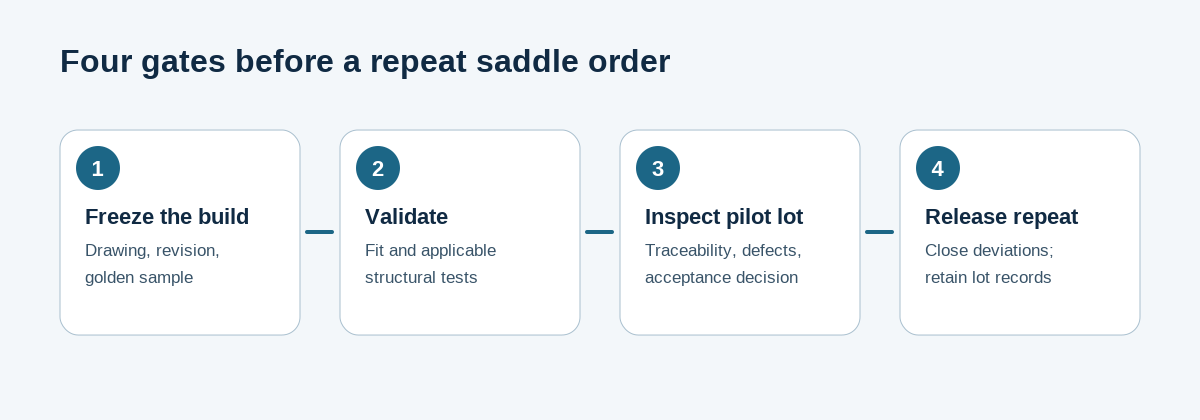
Gate 3: Define the pilot lot and inspection decision
The pilot lot should come from the manufacturing route intended for repeat orders. Agree on its size, production date, lot identifier, packaging, and inspection location in advance. Avoid calling several days of production one lot if materials, tooling settings, or operators change in ways that break traceability.
The buyer and supplier should classify defects before inspection. A structural crack, rail separation, or wrong rail profile needs a different response from a minor cosmetic mark. Document examples with photos and measurable thresholds where possible. Do not let an inspector invent defect categories on the loading dock.
For example, consider a hypothetical first lot of commuter saddles. The approved sample uses a round rail that fits the buyer’s seat-post clamp. In the pilot lot, several sampled saddles arrive with a different rail profile while the covers look correct. The decision is hold, because fit differs from the approved configuration. A discount or a good cosmetic inspection cannot resolve the mismatch. Record the affected lot. Check whether all units share the changed rail. Obtain a corrective action, then recheck a revised production sample. This scenario illustrates the release logic. It does not describe a Tyride customer order or an observed defect rate.
ISO 2859-1:2026 provides sampling schemes for lot-by-lot inspection by attributes. It does not choose the acceptance criteria for your saddle. If a sampling plan is used, agree on the standard edition, inspection level, AQL values, sample selection method, and accept/reject rule with a qualified quality lead. Do not copy a generic AQL number into an RFQ and assume it controls safety risk. Critical defects may require a separate zero-tolerance release rule or further testing.
Tyride’s published saddle product listings show that some models have a stated 300-piece MOQ, but that figure is product-page information, not a universal MOQ for every configuration or customized project. Confirm the current quantity, price, packaging, and lead time for the exact version on the quotation.
Gate 4: Record a release decision that survives the next order
A pilot order is successful only if the buyer can repeat it. The release record should contain:
- The signed sample ID and current drawing revision.
- Test reports mapped to the shipped configuration.
- Production and carton lot IDs, received and accepted quantities.
- The inspection plan, findings, defect photos, and disposition.
- Any rework, replacement, credit, or corrective action with an owner and due date.
- The names or roles authorized to approve a repeat order.
The decision can be release, hold for correction, or reject. A price concession should not turn an unresolved structural or fit defect into an accepted product. If a cosmetic deviation is accepted, document its scope so it does not quietly become the new standard. For broader source checks, use Tyride’s component supplier qualification guide.
After sale, retain enough lot identity to connect a complaint to the relevant build and inspection record. That makes a repeat problem diagnosable and lets the next purchase order specify the corrected revision. It is more useful than a one-time statement that the first carton looked acceptable.
Send a first-order RFQ that can be answered
An effective request names the saddle application, target rider, bike category, and approved sample or design stage. Add the annual forecast, proposed pilot quantity, packing method, destination, test and inspection expectations, and decision date. Ask the supplier to identify any gaps before quoting. If you need a starting platform, review Tyride’s bicycle saddle range. If you already have a controlled design, send the documents through the Tyride contact page.
The purchasing milestone is not the lowest quoted price. It is an approved, traceable production configuration that the next order can reproduce.
Learn about us and Tyride’s manufacturing and sourcing services. This editorial checklist is based on the linked standards, Tyride’s published product information, and clearly identified Reddit anecdotes. It does not claim that any specific saddle lot has passed inspection.