
Bulk bike parts buying can lower the unit price, but a lower quote does not guarantee a better buy. The right order amount depends on repeat demand, variant fit, supplier minimums, lead time, delivery cost, and how long your cash will sit in stock. This guide is for bike brands, distributors, repair businesses, and retailers placing repeat or multi-SKU orders. It explains how to decide what to buy in bulk, how to test an MOQ against demand, and when to split or defer an order.
Bulk bike parts buying is buying parts in quantities intended to meet repeat demand. MOQ means minimum order amount, the smallest amount a supplier will sell for one item or run. Stock cover means how long stock may last at the expected rate of use.
Key takeaways
- Set quantities from observed sell-through, repair jobs, and confirmed programs, not a supplier’s volume break alone.
- Calculate stock cover and total landed cost before accepting a minimum order amount.
- Treat Reddit discussions as useful buyer anecdotes, not market-wide data.
- Use samples, a written SKU schedule, and a restock trigger before scaling a new part.
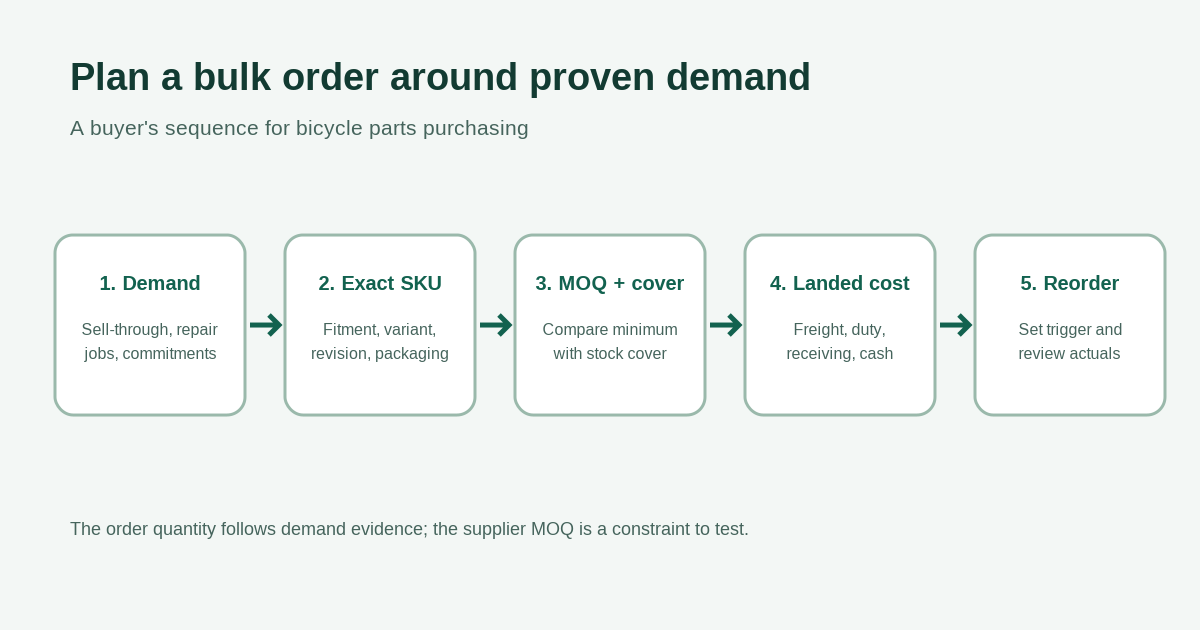
Bulk bike parts buying follows demand, MOQ, landed cost, and restock steps.
Why bulk buying can turn into excess stock
The central risk in a bulk order is buying product faster than the channel can sell or consume it. During the COVID-era cycling boom, shortages encouraged larger forward orders. As demand cooled and supply caught up, stock accumulated at supplier, factory, distributor, and retailer levels. In a June 2024 report, the Associated Press described that shift and cited Circana data showing U.S. bike sales at $4.1 billion in 2023, 24% below 2020, though still 23% above 2019. Those figures describe the U.S. market and that period; they are context, not a forecast for your business (AP News, May 16, 2024).
Reddit showed the buyer-facing side of the same uncertainty. A June 5, 2024 r/cycling discussion, “How are bikes STILL so expensive?”, had 97 visible votes in the search snapshot. Replies discussed clearance pricing on older models and questioned how much excess stock remained. This is an individual community discussion, not a retailer survey, but it illustrates the commercial tension: buyers see discounts while sellers still need to move aged stock.
For a parts buyer, the lesson is not “never buy in bulk.” It is “make the amount earn its place.” A discount can be outweighed by slow turnover, financing cost, variant obsolescence, or a mismatch between the part ordered and the jobs customers actually bring in.
Start with demand evidence by SKU
Use a separate demand estimate for each exact product variant. “Brake pads” or “saddles” is not specific enough for an order plan. Record the SKU or part number, compatible system, size or color, units sold or used, lost sales caused by stockouts, and any customer-specific commitments.
Separate demand into three buckets:
| Demand bucket | Evidence | Buying treatment |
|---|---|---|
| Repeat core | Repeated sales, repair usage, or contracted programs | Consider planned restock and a measured buffer |
| Trial or emerging | A new model, color, or category with limited history | Use samples or a small first run, then review results |
| Special order | A one-off customer request or uncommon fit | Buy against confirmation where possible |
This matters especially for bike parts with many fitments. A popular category can still contain slow-moving variants. Your first wholesale stock order planning guide covers line-level specs and an illustrative opening-stock plan; use the same SKU discipline for repeat orders, then replace assumptions with your own actuals.

Example only: confirm the actual MOQ and demand with your supplier and sales records.
Test the MOQ against stock cover
MOQ means the minimum amount a supplier will accept for an item, configuration, or production run. Before accepting it, compare the minimum with expected demand during the period you are willing to hold stock.
Stock cover in weeks = usable on-hand units ÷ average weekly demand.
If you sell 20 units of a verified SKU each week and a 200-unit MOQ arrives when you have 40 usable units, the post-receipt stock position is 240 units, or 12 weeks of cover at that sales pace. This is a simple planning example, not a recommended universal cover target. If demand is seasonal or volatile, calculate scenarios rather than relying on a single average.
Check the number against:
- Existing stock: Count sellable units, excluding quarantined, reserved, or obsolete stock.
- Open order orders: Include confirmed incoming units and expected receipt dates.
- Committed demand: Subtract orders or projects already allocated to customers.
- Supplier minimums: Confirm whether MOQ applies per SKU, color, size, or combined order.
- Review period: If you review stock monthly, include demand through the next review and restock cycle.
Do not let the supplier’s MOQ silently rewrite your product mix. If a planned 24 units becomes a 100-unit minimum, compare a smaller distributor pack, a mixed-SKU arrangement, a phased order, or a special-order approach. Tyride describes its bike component sourcing service as offering flexible MOQ for standard stocked parts and states that custom OEM/ODM minimums vary by product. Treat those statements as supplier information and confirm exact quantities, timing, and terms in a written quotation.
Compare total cost, not the unit quote
The unit price is one line in the order decision. Compare the same spec and delivery scope across offers:
| Cost or risk | What to confirm |
|---|---|
| Product | Unit price, configuration, packaging, and approved revision |
| Minimums | MOQ by SKU and variant, tooling, setup, or sample charges |
| Freight | Mode, shipment size, insurance, and destination delivery |
| Import costs | Applicable duty, tax, brokerage, and clearance responsibility |
| Receiving | Inspection, handling, storage, and likely defect disposition |
| Cash | Payment milestones and the time until stock is sold or used |
For imported orders, write the delivery term and named place into the quote comparison. The International Trade Administration’s Incoterms guidance explains how Incoterms allocate costs, tasks, and risks between buyers and sellers. A term alone does not replace a full quote: ask which charges are included, which are excluded, and where responsibility changes.
Tyride’s factory-direct versus distributor landed-cost guide provides a comparison framework for those channels. Use your destination, shipment details, and actual quotations; do not reuse an illustrative example as a supplier price.
Set a restock trigger before stock runs low
For a stable SKU reviewed continuously, a basic reorder point is:
Reorder point = expected demand during restock lead time + safety stock.
Suppose a shop uses eight units per week, restock takes two weeks, and the buyer chooses an eight-unit buffer. The example trigger is 24 units. The 8-unit buffer is a planning choice, not an industry standard. Record actual supplier lead times and demand variability, then revise the buffer when evidence changes.
Keep the reorder point separate from the order amount. The trigger tells you when to review or release restock; the amount should also reflect pack sizes, forecast demand, cash limits, and the next review date. Avoid reordering stock already covered by open order orders.
Use a staged commitment for a new product or supplier
Before a large commitment, define what must be true for the product to scale. For a component, that can include a spec sheet, fit confirmation, approved sample, packaging and labeling details, and acceptance criteria. For a private-label product, also define which design or material changes require approval.
Tyride’s website says it offers sample options so buyers can assess a product before a bulk commitment. Confirm the sample scope, cost, production match, and how approval will be documented. The bike saddle products page can help buyers identify relevant categories, while a product inquiry should specify intended use and exact configuration rather than relying on a category name alone.
A practical bulk-order release checklist
Before issuing a order order, confirm that:
- Each line maps to documented demand or an approved trial.
- Existing, reserved, and incoming stock has been reconciled.
- The MOQ and pack sizes fit the planned stock cover.
- Landed cost includes all known delivery and receiving charges.
- The spec, fit, and sample approval are recorded.
- Lead time and shipment milestones are defined in writing.
- A reorder trigger and stock-review date are assigned.
If one of these inputs is unknown, label it as an assumption and calculate what happens if it changes. A lower unit price is worth pursuing when the business can use the product within a reasonable planning horizon and the quality and delivery terms are clear.
Frequently asked questions
Is a higher MOQ always a better deal?
No. A higher MOQ may reduce the quoted unit price, but it also increases cash committed and the time stock may remain unsold. Compare total landed cost and expected stock cover for the exact SKU.
How much safety stock should a bike-parts buyer keep?
There is no single correct amount. Use the SKU’s demand variability, supplier lead-time variability, stockout impact, and review frequency. Start with a documented assumption and adjust it using actual receipts and usage.
Should a buyer combine different bike parts to meet an MOQ?
Only if the supplier confirms that the minimum can be combined across those exact items and the resulting stock remains useful. Do not assume separate SKUs, colors, or factories share one minimum.
What should I send a supplier for a bulk quote?
Send the exact SKU or drawing, spec revision, amount by variant, destination, sample requirements, required delivery window, and any packaging or branding needs. Ask the supplier to list MOQ, exclusions, substitutions, and quote expiry.
Build the next order from what actually moved
Use bulk buying to support repeatable demand, not to create demand on paper. Reconcile sales, repairs, reservations, and open orders; test MOQ against stock cover; and compare delivered, usable-unit cost rather than the headline price. Then review the plan after receipt and update it with actual demand and lead time.
For a project-specific parts list, Tyride buyers can submit the exact specs, quantities, and destination through the contact page. A clear request makes it easier to compare a bulk offer with smaller or phased alternatives.
Tyride shares its company and sourcing background on the About Tyride page.
Editorial note: Reddit examples are anecdotal and represent individual posts and replies. Market figures above are attributed to AP’s May 2024 report and are not current forecasts. All numerical stock examples are illustrative, not a Tyride quote or recommended universal target.