
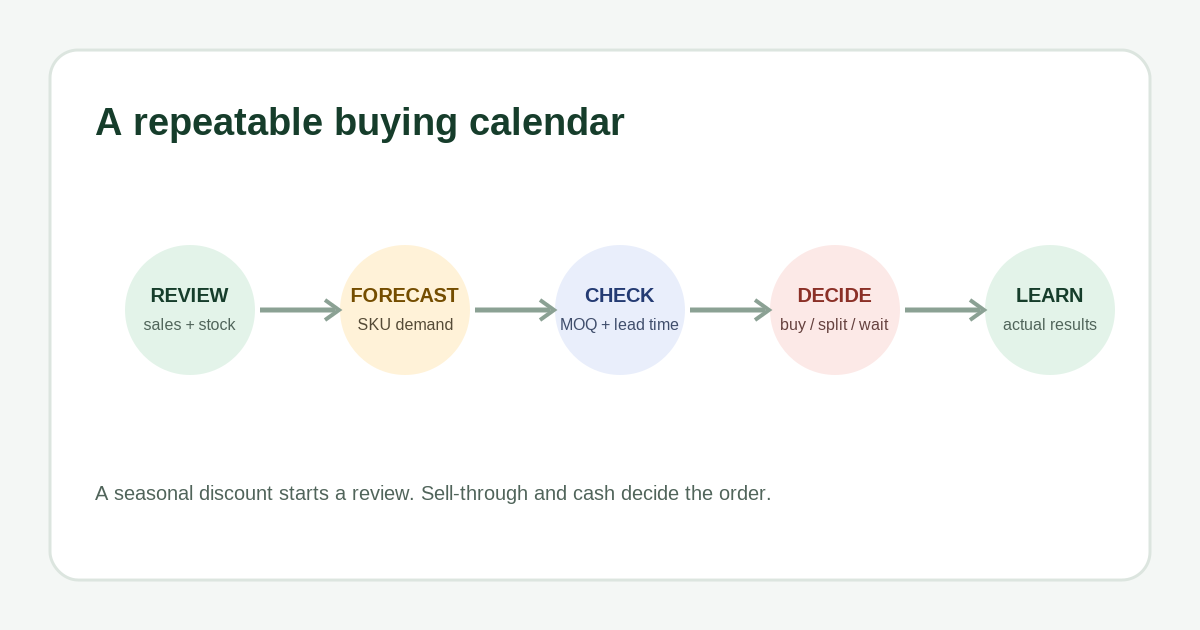
A seasonal discount is worth considering when the product still fits customer demand, the price reduction exceeds the cost of holding stock, and the order does not block cash needed for faster-moving goods. The calendar can prompt a review, but sell-through and product life should determine the purchase.
This guide is for bicycle retailers, distributors, and brands deciding whether to buy end-of-season stock or wait. It uses two dated Reddit discussions and a 2026 industry survey update as bounded evidence. None of these sources provides a universal buying calendar for every bicycle category.
Key takeaways
- Separate model-year bicycles from replacement parts and consumables.
- Compare the discount with likely sell-through, cash timing, and remaining product life.
- Confirm specification continuity before buying parts in larger quantities.
- Treat Reddit timing advice as a local observation, not a market-wide rule.
What retailers said about timing in August 2024
In the August 20, 2024 Reddit bicycle-industry Q&A, one Canadian commenter said stores often discounted prior-season bicycles near the end of September or October. Another user in Australia described buying previous-year models before new stock arrived. These are local experiences about complete bicycles and frames, not a verified schedule for parts or every geography.
A separate July 2024 mountain-bike Reddit discussion collected competing claims about inventory, discounts, and availability. The comments disagreed about how much stock remained and when prices might fall. That disagreement matters: a sale in one category or region does not prove a similar opportunity exists in another.
Separate products by how quickly they become outdated
| Product type | Main timing question | Buying check |
|---|---|---|
| Complete bicycle | Is a new model or specification arriving? | Compare model-year demand, fit coverage, and markdown risk |
| Model-specific part | Will the replacement remain compatible? | Confirm revision and supported bicycle models |
| Common consumable | Does local use create steady replacement demand? | Use sales and service records to set a reorder point |
| Custom or branded item | Will the design remain in the range? | Tie the order to a product plan and approved sample |
Replacement parts can have a different demand cycle from complete bicycles. A model-year change can reduce demand for a specific frame or proprietary component, while a common wear item may still sell across several years of bicycles. Confirm the exact use instead of applying a complete-bike discount calendar to all components.
Use current industry evidence with its limits
European Cycling Industries reported in 2026 that 50% of survey respondents said overstocking of complete bicycles continued to affect their businesses. The same update described reports of shortages in some parts, frames, and electrical components. This is a member survey result, not a census of all businesses, and the overstock figure refers to complete bicycles rather than all bicycle parts. Read the ECI market update.
The finding is a reason to examine each product group separately. It does not tell a specific buyer whether a particular component will be discounted or available. For broader inventory planning, use Tyride’s first stock order guide and compare any import offer using its factory-direct versus distributor landed-cost guide.
Test a seasonal order against the wait option
Before accepting a deal, compare two scenarios. In the buy-now case, record the quoted price, quantity, freight, payment timing, storage, expected sell-through, and markdown risk. In the wait case, estimate the cost of replenishing later, including the risk of a stockout or a longer lead time. Label assumptions as estimates and update them when a supplier provides a firm quote.
For example, a shop can buy a familiar tire model at a seasonal discount, but the minimum quantity is more than its expected sales before the next review. The shop can ask for a smaller pack, split delivery, or a price at its normal order size. It should not spend the entire seasonal budget just to qualify for a discount if the excess stock is unlikely to move.
For instance, a buyer comparing two suppliers can test the discount only after adding the freight and import charges that apply to each quote. Where cross-border delivery is involved, the U.S. International Trade Administration’s landed-cost guidance explains that freight, insurance, tariffs, taxes, and other fees affect the total delivered price. The details vary by destination and transaction, so confirm them with a customs or logistics professional.
A seasonal buying decision in five steps
- Review actual movement: Use sales and service records by product and variant.
- Check product life: Confirm model year, revision, and compatibility with planned bicycles.
- Compare order sizes: Include the supplier minimum and any staged-delivery option.
- Protect operating cash: Reserve funds for delivery, returns, and unexpected replacement needs.
- Set a review date: Record how the deal performed and update the next forecast.
For components that require a fit check or revised specification, use Tyride’s compatibility checklist before increasing order quantity. If the item is a custom part, confirm sample, minimum, and timing terms with the sourcing team.
Buy when the product still has a job
The strongest seasonal purchase is a product the business can use or sell within a defined plan, at a total cost that supports its cash needs. Community discussions can show what buyers are noticing. Your own sales, supplier terms, and product records should decide whether to act.
Methodology: We compared two dated Reddit discussions with the ECI survey update, kept complete-bike findings separate from parts, and used hypothetical examples only for the decision steps.
Evidence note: Reddit posts are individual discussions, and their timing comments are region-specific. ECI’s 2026 survey figure relates to complete-bike overstock among respondents. The example is hypothetical. See About Tyride for the company’s sourcing scope.