
The safest wholesale bicycle parts order is sized to realistic sell-through and replenishment time, not to the largest discount tier. Retailers and distributors can reduce inventory risk by splitting uncertain demand from repeatable demand, testing new SKUs in smaller quantities, and agreeing on clear reorder and quality terms with suppliers.
Key takeaways
- Bulk discounts can be outweighed by slow-moving stock, markdowns, and cash tied up in inventory.
- Separate proven SKUs from new or seasonal products before setting order quantities.
- Use samples and small initial buys to validate product fit, quality, and customer response.
- Agree on reorder lead times and stable specifications before relying on replenishment.
Why large orders can create a bullwhip problem
Bicycle buyers have seen how forecasts can amplify demand signals. In its July 2025 industry review, private-equity firm RAF Equity describes pandemic-era orders that exceeded historical demand, followed by elevated inventory, discounting, and dealer pressure. Its model estimates that U.S. bicycle sales by the end of 2021 were about 9.5 million units above a modeled baseline; it also explains that advance seasonal commitments left some dealers exposed when demand weakened (RAF Equity, “Beyond the Bullwhip”). This is one firm’s analysis and model, not an audited count of unsold bikes.
The lesson for a parts buyer is practical: do not let a unit-price break determine your forecast. An order that saves a few cents per piece can lose money if stock turns slowly, needs discounting, or occupies cash that could support faster-moving products.
What bicycle buyers are saying in public discussions
A November 2025 Reddit thread asking which cycling businesses were thriving drew 163 votes in the search result. A commenter described repair workshops benefiting as riders chose to service existing bikes rather than replace them, citing the high cost of new bikes. Another commenter described lower-priced Chinese frames being sold through local Brazilian brands. These are individual observations, not a representative market survey, but they suggest two useful questions for buyers: which parts support repair demand, and which price points are realistic for your customers? (Reddit: “Which cycling businesses are actually thriving right now?”)
The discussion does not prove that demand for any specific component has increased. Use your own sales history, repair requests, customer inquiries, and local competitor checks to decide which SKUs deserve deeper stock.
Segment inventory before you set order quantities
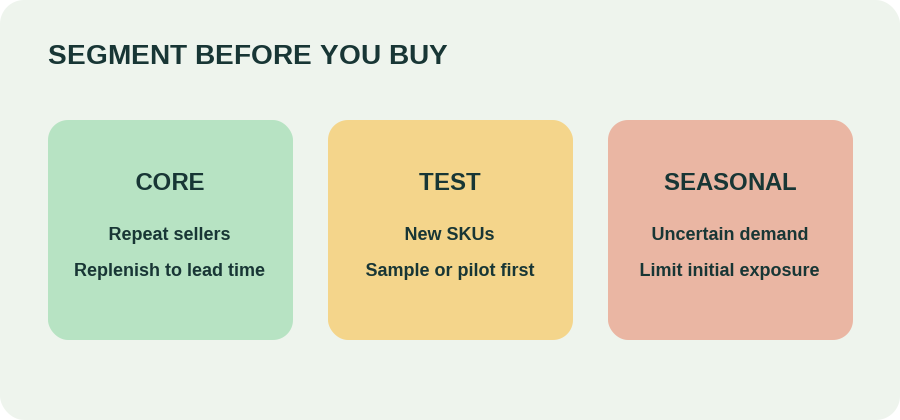
Classify items into three groups:
| SKU group | Examples | Buying approach |
|---|---|---|
| Proven core | Repeat sellers with stable fit and demand | Replenish against recent sell-through and supplier lead time |
| Test items | New materials, designs, or price points | Start with samples or a controlled pilot quantity |
| Seasonal or uncertain | Products with narrow use cases or short selling windows | Buy only against a conservative forecast or confirmed demand |
This simple segmentation prevents an untested color or product design from receiving the same commitment as a repeat seller. For bicycle saddles, for example, a buyer can test fit and comfort feedback across a small customer group before expanding the order. Tyride’s bicycle saddle range provides product categories for evaluating the assortment before requesting a quote.
Calculate a reorder point that includes real lead time
A reorder point is the stock level at which you place a replenishment order. A practical starting formula is:
Reorder point = average units sold per day × replenishment lead time in days + safety stock
Use actual daily or weekly sales where possible. Include production time, transit, customs clearance, receiving, and a buffer for delays. If demand is seasonal, calculate the rate for the relevant season instead of using a full-year average. Revisit the estimate when sales or supplier lead times change.
Ask your supplier whether the same component specification can be replenished consistently. A reorder plan fails if color, materials, packaging, or dimensions change between batches without approval. Tyride’s sampling service describes a sample-first process buyers can use to compare materials and review a product before committing to a larger run.
Balance MOQ against cash and storage costs
MOQ is a commercial constraint, not a demand forecast. If a supplier’s minimum exceeds your likely near-term sales, ask about stocked alternatives, shared packaging, a trial order, or separating customization from the first purchase. A lower custom MOQ may still be less valuable than a standard stocked item if tooling, artwork, or unique packaging increases the total commitment.
Tyride says stocked components have flexible MOQ support and that custom OEM/ODM orders typically start at 50 to 200 units per item. These are Tyride’s terms; confirm current availability, SKU-level minimums, and customization charges in writing (Tyride wholesale and sourcing service).
Compare gross margin with inventory risk
A wholesale decision should account for more than gross margin at the planned retail price. Track at least:
- Landed cost: product, freight, duty, insurance, customs, and local delivery.
- Sell-through: units sold over the period the stock was available.
- Weeks of supply: on-hand units divided by average weekly sales.
- Markdown exposure: expected price reductions if the product moves slowly.
- Cash tied up: inventory cost that cannot fund other products or operations.
Review these numbers by SKU, not only across the whole category. A profitable category can conceal a few slow-moving items that absorb too much cash.
Build a safer wholesale buying cycle
- Review sales and service signals. Separate repeat requests and repair demand from one-off interest.
- Set a maximum initial exposure. Decide how much cash and storage you can commit to unproven SKUs.
- Test the product. Use a sample to check dimensions, materials, finish, and customer fit.
- Quote the complete shipment. Compare the same quantity, destination, Incoterm, packaging, and payment schedule.
- Agree on replenishment. Record lead times, specification control, quality checks, and remedies for defects.
- Reorder from actual performance. Expand only when sell-through and customer feedback support it.
Safety stock is extra inventory held to cover demand or supply variation during replenishment. Sell-through is the share or number of units sold from available inventory over a stated period. Reorder point is the stock level that triggers a new order based on demand during supplier lead time and planned safety stock. These measures help a buyer set buffers by SKU instead of applying one bulk quantity to every product.
In its 2026 Business Impact Survey, European Cycling Industries (ECI) reported that 50% of respondents said overstocking of complete bicycles still affected their business (ECI, 2026 survey). The survey also reported that 69% expected 2025 revenue to be higher or similar to 2024 (ECI, revenue outlook), 31% expected staffing to fall over the next two years (ECI, staffing outlook), and 79% were exploring new partnerships (ECI, partnership outlook). These are survey responses, not a census of all bicycle businesses. The overstock finding concerns complete bikes, not parts. Use it as context, then size component orders from your own SKU sales.
For EU-bound products, the General Product Safety Regulation assigns obligations to importers and distributors. Buyers should verify documentation and safety duties for each product and role under the applicable rules (Regulation (EU) 2023/988). U.S. importers can use CBP guidance to understand how product classification affects duty research (CBP duty-rate guidance).
Frequently asked questions
Is it always cheaper to buy bicycle parts in bulk?
No. Bulk buying may reduce the unit price, but the total result depends on landed cost, sell-through, storage, financing, and markdown risk. Compare the total expected cost of holding the order with the savings from the quantity discount.
How much safety stock should a bicycle retailer keep?
There is no universal number. Estimate demand during the full replenishment lead time, then add a buffer based on demand variability and the cost of a stockout. Review it by SKU and season rather than applying one percentage to every product.
How can a small retailer meet a supplier MOQ?
Ask about stocked items, mixed-SKU orders, trial quantities, or phased customization. Confirm which MOQ applies to the product, color, logo, and packaging. Tyride’s sourcing team states that stocked parts may have flexible MOQ support; obtain a current written quote for your list.
Turn sales evidence into your next order
Before your next order, compare recent sell-through with supplier lead time, landed cost, and available cash. Test uncertain products before scaling them and document the approved specification so replenishment stays consistent. Tyride provides wholesale bicycle parts sourcing and sample testing options for buyers assessing bicycle components and saddles.
Editorial note: The Reddit discussion is anecdotal and the vote count is a search-result snapshot. It is included to illustrate practitioner observations, not to quantify market demand.