
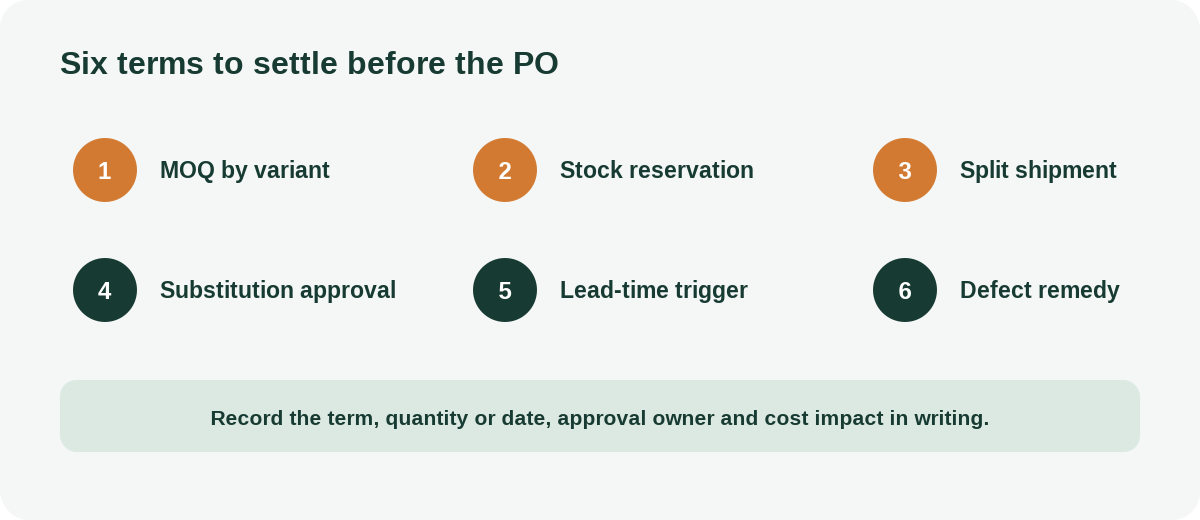
A bicycle parts purchase order should define more than price and total quantity. When demand is uneven and product availability varies by SKU, buyers and suppliers need clear terms for variant mix, stock reservation, delivery timing, substitutions and nonconforming goods.
These terms do not guarantee that a supplier can offer every requested flexibility. They make the proposal comparable and give both sides a written basis for deciding what happens when reality differs from the quote.
Key Takeaways
- State MOQ by product and variant, not only as one total order threshold.
- Define whether stock is reserved, allocated or still subject to prior sale.
- Agree in writing on split shipments, substitutions, inspection and remedies.
- Compare the commercial value of flexibility with its effect on unit price, cash and logistics.
MOQ means minimum order quantity: the smallest quantity a supplier agrees to sell under a stated product and commercial configuration. Stock reservation is a written commitment to hold identified available units for an agreed period; it is different from an unreserved stock indication.
Change control means the written approval process for modifications to an accepted product or order, such as a different material, revision, factory or packaging specification.
Start with the exact order structure
Before requesting a quote, separate the order into lines that can be identified and accepted independently. Each line should include product name, SKU or part number, revision, variant, quantity, packaging and destination. For custom products, attach the approved drawing or specification and identify sample status.
A vague request such as “500 bicycle saddles in assorted colors” leaves major commercial questions open. Can colors share one MOQ? Does the minimum apply to each model or the full program? Are logos and packaging included? Can the supplier produce all colors in one run? Which sample represents the approved production version?
Tyride’s bulk bicycle saddle guide discusses quantity by color, samples, and the difference between illustrative quantity tiers and confirmed MOQ. For multi-category orders, the same discipline applies: itemize each component and ask suppliers to state exceptions instead of hiding them in a blended price.
Put flexibility into measurable terms
“Flexible MOQ” is not a complete commercial term. Record the smallest accepted quantity for each SKU and variant, the price at each quantity tier, any setup or tooling charge, and whether the next order can reuse the same configuration. If variants can share a minimum, identify the permitted mix and any price effect.
| Term | Question to settle | Why it matters |
|---|---|---|
| MOQ | Is the minimum per model, color, size or total PO? | Prevents a total threshold from concealing excess variant stock |
| Reservation | Is quoted inventory reserved, and until what date? | Separates confirmed availability from a live stock indication |
| Split shipment | Can quantities ship in stages? What are the extra charges? | May align receipts with demand, but can add freight or handling cost |
| Substitution | Can the supplier change materials, revision or source without approval? | Protects fit, quality and branding requirements |
| Lead time | When does the clock start, and what event confirms the date? | Avoids confusion between deposit, sample approval and production release |
| Defect remedy | What evidence, deadline and response apply to a claim? | Makes the quality process operational rather than aspirational |
If the supplier cannot accept a preferred term, ask for the alternative and its cost. A smaller minimum may carry a higher unit cost; a staged delivery may require storage charges; reserving stock may require a deposit. The buyer can then compare explicit trade-offs.
For international purchases, specify the named delivery place and the Incoterms rule and version rather than writing only “FOB” or “delivered.” The International Chamber of Commerce explains that Incoterms allocate defined delivery responsibilities, costs and risks between seller and buyer; they do not replace the rest of the sales contract (ICC Incoterms rules). Confirm customs, product compliance, payment, quality acceptance and remedies separately.
Match terms to the risk in the market
A July 3, 2024 discussion in r/MTB described discount expectations amid excess bicycle inventory, but replies disputed whether the stock was widespread and how long discounts might last (Reddit discussion). The post reflects one community discussion rather than a verified market inventory dataset.
On July 10, a different Reddit thread described difficulty finding selected bikes in stores and online (r/bicycling discussion). These accounts are not proof of market conditions; they show that the available item and location matter. A B2B agreement should therefore name the exact units and the condition under which they will be supplied.
The Associated Press likewise documented a post-boom period of excess bicycle inventory and discounts, alongside different outcomes across shops (AP report). A December 2024 review in BIKE described full warehouses coexisting with shortages in selected popular models (BIKE market review). These sources support the need to check the actual item and supplier commitment, not a prediction that every product is either abundant or scarce.
BIKE reported that a July 2024 dealer survey found 75% of respondents had unusually full warehouses; the article does not state the survey sample size (BIKE market review). The AP reported Circana’s estimate that U.S. bicycle sales rose 64% to $5.4 billion in 2020, before the market corrected (AP report). Forbes reported a 2% year-over-year fall in U.K. bicycle unit sales in 2024, citing Bicycle Association data (Forbes report). These figures do not predict demand for a particular part; they show why B2B terms should identify the actual product, quantity and delivery commitment.
BIKE reported that a July 2024 dealer survey found 75% of respondents had unusually full warehouses; the article does not state the survey sample size (BIKE market review). The AP reported Circana’s estimate that U.S. bicycle sales rose 64% to $5.4 billion in 2020, before the market corrected (AP report). Forbes reported a 2% year-over-year fall in U.K. bicycle unit sales in 2024, citing Bicycle Association data (Forbes report). These figures do not predict demand for a particular part; they show why B2B terms should identify the actual product, quantity and delivery commitment.
For future production, confirm the production slot, deposit schedule, sample approval gate, expected completion window and process for communicating delays. For stock goods, confirm that units are physically available, how long the reservation lasts and whether shipment can occur from the stated location. Do not treat a forecast or catalog listing as reserved inventory.
Define a controlled substitution process
A supplier may propose an alternative when a line becomes unavailable. The purchase order should state whether substitution is prohibited without written buyer approval. If alternatives are permitted, define which attributes can change and which require renewed technical approval: dimensions, materials, color, packaging, manufacturing site, revision, test evidence or branding.
A substitution can affect the customer-facing product, compatibility, warranty, compliance or inventory system. Even if the substitute appears equivalent, the buyer should review the exact documentation and sample required for its use. Keep the original and replacement SKUs distinct in the purchase records.
Tyride’s guide to specifying bicycle saddles for brands and OEMs shows why rider use and technical specification should precede supplier selection. For broader component qualification, see how to verify OEM and gray-market bicycle components.
For safety-relevant saddle and seat-post products, identify the applicable market requirements and agree on the test evidence before approving the order. ISO 4210-9:2023 specifies saddle and seat-post test methods for ISO 4210-2; it does not by itself decide every market’s legal obligations or prove that a specific shipment passed testing (ISO 4210-9:2023).
For products entering the United States, the Consumer Product Safety Commission says bicycle requirements are in 16 CFR Part 1512 and cover areas such as assembly, braking, structural integrity and reflectors (CPSC bicycle guidance). Buyers should confirm the rule’s applicability to the product and market with qualified compliance counsel; the purchase-order checklist does not replace that review.
For products entering the United States, the Consumer Product Safety Commission says bicycle requirements are in 16 CFR Part 1512 and cover areas such as assembly, braking, structural integrity and reflectors (CPSC bicycle guidance). Buyers should confirm the rule’s applicability to the product and market with qualified compliance counsel; the purchase-order checklist does not replace that review.
Make defect handling specific
A promise of “quality assurance” does not explain how a buyer should respond to a defect. Agree on the inspection window, evidence needed, contact route, quarantine process, remedy options and who pays reasonable return or replacement freight. Define whether the remedy is replacement, repair, credit or refund, subject to the product and transaction terms.
Where the component has a safety role, use a product-specific specification and appropriate technical review. A sample inspection is useful but cannot demonstrate every lot characteristic. The buyer should state the acceptance criteria, identify lot records and retain the right to hold affected stock while a claim is reviewed.
Tyride describes its current inspection and quality support on its quality control page. Buyers should verify that the quoted process, warranty scope and remedy are expressly included in the commercial offer for their order; a general website description is not a substitute for order-specific terms.
Turn the quote into a decision record
Before approving the order, create a one-page comparison that includes the approved specification, variant quantities, unit price, one-time fees, delivery scope, lead time, payment schedule, MOQ, reservation status and remedy terms. Mark any unconfirmed point as an open issue, not as an assumed benefit.
A useful supplier response should make it clear what is included, excluded, available now, made to order and subject to later confirmation. Compare that response with your demand plan. Tyride’s first stock order planning guide provides a purchasing template and illustrates why freight allowances and replenishment assumptions should remain visible.
For instance, if the buyer needs a current-version black component for a launch, while a supplier can only reserve a previous revision in mixed colors, the offers are not equivalent. Record the mismatch, request a separately priced alternative and do not release a substitution until the technical owner approves it. The decision should appear in both the quote comparison and the PO revision history.
Frequently Asked Questions
Can a buyer negotiate a lower MOQ without changing the product?
Possibly, but it depends on the supplier, production method and configuration. Ask what changes in price, setup cost, production timing, material availability or variant mix. Get the revised scope in writing.
Should a purchase order allow substitutions automatically?
Usually the buyer should require written approval for changes that affect identity, fit, materials, revision, packaging or branding. Any pre-approved substitutions should be listed specifically.
Is a stock reservation the same as a delivery guarantee?
No. A reservation can hold identified units for a period, while delivery still depends on agreed shipping and fulfillment terms. Confirm both the reservation scope and the shipment commitment.
Make the commitment clear on both sides
Flexible terms help only when they are concrete. Define the order line by line, state how variants and changes are approved, and compare the cost of flexibility with the inventory risk it reduces. A well-formed purchase order is easier to execute, inspect and resolve when conditions change.
To discuss a defined parts list, quantity mix and destination, contact Tyride through its component sourcing service.