
Buying bicycle components in bulk can lower unit costs, but a low quote does not guarantee a profitable order. Retailers, distributors, and bicycle brands need to verify fit, sample quality, minimum order quantity (MOQ), landed cost, and replenishment terms before committing cash. This checklist explains how to compare suppliers and reduce avoidable surprises on a wholesale bicycle parts order.
Key takeaways
- Compare total landed cost, not just the factory unit price.
- Approve a production-representative sample and written specifications before confirming a bulk run.
- Match order size to sell-through, cash flow, and replenishment lead time.
- Put inspection standards, defect remedies, packaging, and delivery terms in writing.
A 2026 European Cycling Industries survey offers a timely reminder to check market exposure before ordering: 50% of respondents said overstocking of complete bicycles still affected their business (ECI survey). The same survey found 69% expected 2025 revenue to be higher or similar to 2024 (ECI revenue outlook), 31% expected staffing to fall in the next two years (ECI staffing outlook), and 79% were exploring new partnerships (ECI partnership outlook). The survey reflects respondent views, not the whole market. Its overstock finding concerns complete bikes, not parts, so use it as context rather than a forecast for a component SKU.
1. Define the exact components and the buyer they serve
Start with a product brief, not a vague request for a “best price.” Identify the component, intended bike type, rider use, compatibility requirements, target retail price, and sales channel. For a saddle, specify dimensions, rail material and diameter, cover material, foam or shell construction, color, logo placement, packaging, and any weight target. For a grip, pedal, tire, or other part, document its fit interfaces and performance requirements just as carefully.
A specification sheet makes competing quotations comparable. It also reduces the chance that a supplier quotes a lower-cost substitute that does not match the product you plan to sell. Tyride’s bicycle saddle product range can help buyers identify product categories before requesting a tailored quotation.
2. Ask for the MOQ by configuration, not as one headline number
MOQ often changes with customization. A stocked component may have a different minimum from a part with a custom color, logo, mold, or retail box. Ask the supplier to itemize the minimum for each SKU and each customization, then confirm whether the minimum applies per order, per model, or per color.
Tyride states that its standard stocked bicycle parts have flexible MOQ support, while custom OEM/ODM orders typically start at 50 to 200 units per item. Those are supplier-specific terms, not a universal industry standard, so request a written quote for your exact product list (Tyride bulk supply and sourcing service).
3. Test a sample against a written acceptance checklist
A sample is useful only when you know what you are checking. Record critical dimensions, weight tolerance, finish, color, packaging, markings, and functional tests. For a saddle, include fit and comfort feedback from representative riders, rail alignment, cover durability, and any load or fatigue requirements relevant to the use case. Keep an approved “golden sample” and make the purchase order refer to the same specification revision.
Tyride recommends sample testing before a bulk commitment and says sample product cost can be credited or refunded toward a first official bulk order, subject to its stated terms. Buyers can review the Tyride sampling service and confirm timing, sample charges, shipping, and what happens if the sample fails acceptance.
A Reddit discussion about importing Surron electric off-road motorcycles is not bicycle-component evidence, but it illustrates a useful procurement habit: commenters advise requesting several delivered-duty-paid (DDP) quotes, comparing them, checking sellers, and negotiating against verified offers. Apply the comparison method carefully, while recognizing the product and import rules differ (Reddit: “Savings on surron from china”).
4. Compare landed cost and payment exposure
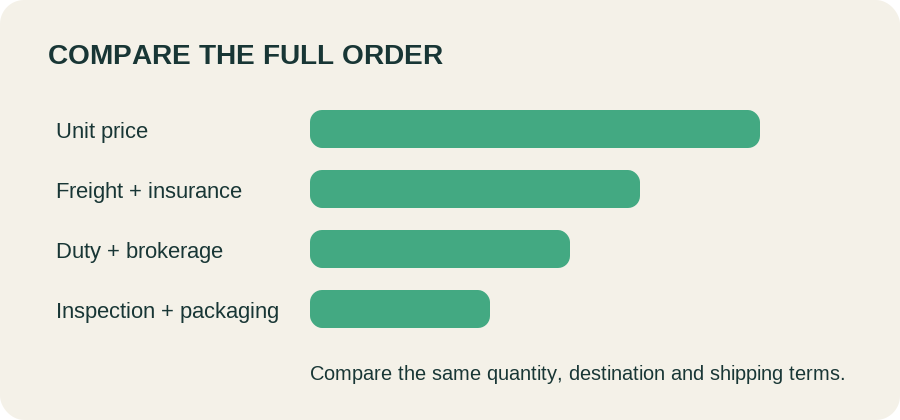
The useful price is the cost to receive saleable inventory at your warehouse. Build a landed-cost sheet that includes:
- Unit price and tooling or setup charges.
- Sample, inspection, packaging, and labeling costs.
- Freight, insurance, customs duties, brokerage, and local delivery.
- Payment fees, currency conversion, and financing cost.
- Expected defect, replacement, or rework allowance.
Ask each supplier to quote the same Incoterm, destination, packaging format, and shipment size. If you compare an FOB quote with a DDP quote as though they were equivalent, you can choose the option that only looks cheaper. For a practical quotation workflow, start with Tyride’s bulk bicycle parts service details and request a line-by-line estimate for your destination.
5. Verify quality controls and remedies before production
Ask what the supplier inspects, how often, which test methods apply, and whether you can receive inspection records. Agree on the acceptable defect level, who pays for reinspection, how nonconforming items are replaced or credited, and the deadline for reporting defects. “Quality checked” is not a measurable acceptance standard.
Tyride describes batch testing that includes fatigue, impact, and salt-spray corrosion testing, along with pre-shipment inspection and a stated 12-month quality warranty for mass orders. Confirm which tests apply to the component in your quotation and make the agreed standards part of the purchase documents (Tyride service and quality information).
6. Plan the first order around sell-through and replenishment
For example, a retailer that sells 10 units of a proven part each week and needs three weeks to replenish can use 30 units as a simple lead-time demand estimate, then add a buffer based on variability. This is an illustrative calculation, not a sales benchmark. For instance, a new custom-color part may be better tested through samples or a pilot before the retailer commits to a larger MOQ.
Do not use a discount tier as your demand forecast. Estimate demand by SKU and season, then include the time needed for production, freight, customs, and receiving. A reasonable first order may be smaller than the best unit-price tier if it keeps cash available and gives you a chance to validate demand. Ask whether the supplier can replenish the same specification, color, and packaging later, and what lead time or price changes to expect.
7. Put the complete order agreement in writing
Before paying a deposit, confirm product specifications, quantities, unit prices, payment milestones, production start conditions, ship date, Incoterm, packaging, inspection rights, document requirements, warranty, and remedies. Include the approved sample and drawing revision by reference. Ask who owns custom artwork or tooling and what happens if the shipment is late or incomplete.
8. Use a staged buying process
| Stage | Buyer action | Decision gate |
|---|---|---|
| Define | Share SKU-level specifications and destination | Can suppliers quote the same product? |
| Compare | Review MOQ, landed cost, lead time, and payment terms | Is the total cost commercially viable? |
| Validate | Approve samples and acceptance criteria | Does the sample meet the written spec? |
| Contract | Record inspection, delivery, and defect remedies | Are risks and responsibilities explicit? |
| Reorder | Track sell-through and supplier performance | Does actual demand support a larger order? |
Minimum order quantity (MOQ) is the smallest quantity a supplier accepts for a product or configuration. The MOQ may change when a buyer adds a custom logo, color, or package. Landed cost is the full cost of getting saleable goods to the buyer’s destination, including product, freight, duty, and handling. Incoterms are internationally recognized trade terms that define key responsibilities between sellers and buyers for delivery, costs, and risk.
Check import and product obligations
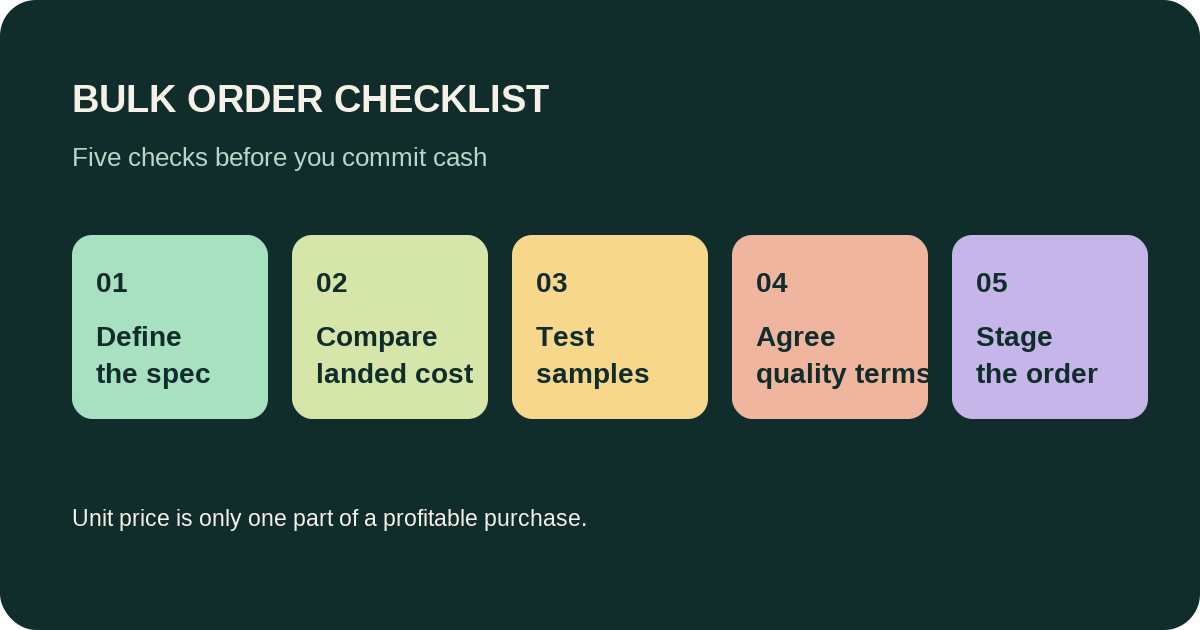
If you import consumer products into the European Union, the General Product Safety Regulation sets obligations for importers. Importers must ensure covered products meet the general safety requirement and keep required technical documentation available to authorities. The exact rules depend on product and role, so confirm the requirements that apply to each SKU before sale (Regulation (EU) 2023/988, Article 11). For U.S. shipments, duty depends on the correct product classification and other shipment details; U.S. Customs and Border Protection explains that the final duty rate is determined by CBP (CBP: determining duty rates). Bulk order decision gatesSpecQuoteSampleInspectOrder Set a decision gate at each stage before committing to the next.
Frequently asked questions
What is a typical MOQ for bicycle components?
There is no single standard. MOQ depends on the component, stock status, customization, packaging, and supplier. Tyride says stocked parts may have flexible minimums, while its custom OEM/ODM orders typically start at 50 to 200 units per item. Ask for a product-specific written quotation.
Should I order a sample before buying wholesale bicycle parts?
Yes. Approve a representative sample against written dimensions, materials, finish, packaging, and functional criteria. Confirm whether sample charges can be credited to the production order and whether the production run must match the approved sample.
How do I compare bicycle parts suppliers fairly?
Give each supplier the same specification, order quantity, destination, Incoterm, packaging requirement, and delivery window. Compare landed cost, quality controls, payment terms, defect remedies, and repeat-order capability alongside unit price.
Request a comparable quotation
Prepare your SKU list, target quantity, required customization, destination postal code, preferred shipping terms, and desired delivery date before contacting suppliers. Tyride supports wholesale sourcing and OEM/ODM bicycle components; use the Tyride sourcing service to submit requirements for a product-specific quotation.
Editorial note: The Reddit example above concerns electric off-road motorcycles and is used only as an adjacent example of quote comparison and supplier verification. It is not evidence about bicycle-component prices or terms.