
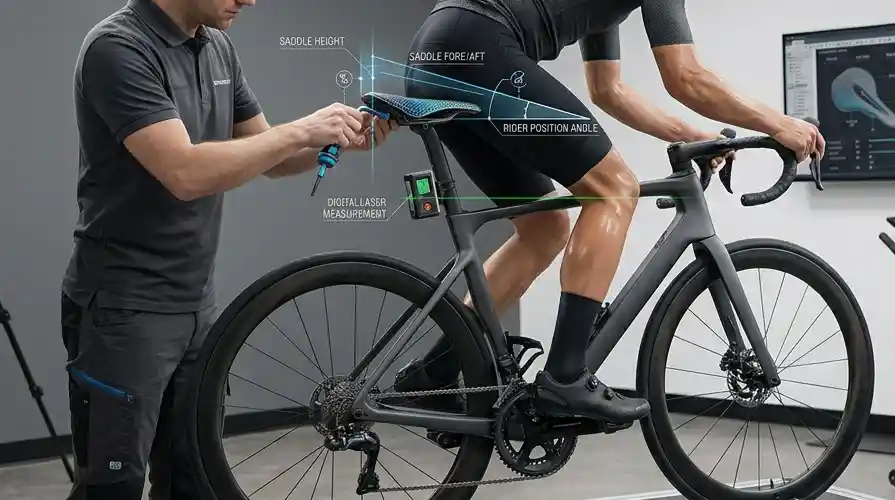
The core problem for brands, product managers and sourcing teams is not finding “a comfortable saddle.” It is matching saddle geometry, materials and construction to the intended rider position, use case and cost target so that returns stay low and the complete bike meets its comfort and durability claims. The variables that most strongly influence outcomes are sit-bone support width, shell shape and flex, rail material and geometry, padding density and cover durability. Surface parameters such as advertised softness or a single “best” model rarely predict real-world performance across a product line. This guide explains the mechanisms, trade-offs and verification steps that let buyers write clearer specifications, evaluate bicycle saddle manufacturers and reduce both product and supply-chain risk.
Why Shape and Width Come Before Padding
Rider contact pressure is governed primarily by pelvic orientation and sit-bone spacing. In a more upright position the pelvis sits more upright and the sit bones carry a greater share of the rider’s weight; a wider support platform is usually required. In an aggressive forward position the pelvis rotates and more weight shifts onto soft tissue; a narrower shape, often with a shorter nose and a pressure-relief channel or cut-out, tends to work better.
Most professional fit systems begin with a center-to-center measurement of the ischial tuberosities and then recommend a saddle width that is wider than that measurement. Industry practice commonly adds roughly 20–30 mm as a starting heuristic, but the exact margin varies with riding posture, pelvic rotation, saddle shape, intended movement on the saddle and individual preference. Sit-bone measurement is therefore a useful filter, not a universal sizing formula. Offering multiple widths within the same shell family is more practical for an OEM programme than relying on a single width.
Excessively soft padding can allow the sit bones to sink, raising pressure on soft tissue and accelerating compression set. Firmer, zoned foam or lattice structures that remain supportive under the sit bones while staying compliant elsewhere generally produce more consistent results over time.
Shell, Rails and Construction as a System
The shell (typically injection-moulded nylon or a carbon-reinforced composite) sets overall shape and flex characteristics. A more flexible shell can absorb some vibration but may feel less precise under high power. A stiffer shell transfers power efficiently yet can transmit more high-frequency input unless the rails or padding compensate.
Rails connect the saddle to the seat post and influence weight, stiffness and vibration transmission. Overall ride feel, however, is a system result that also depends on shell construction, padding, cover, clamp design, seat-post and tyre pressure. Common rail options include:
- Chromoly or steel alloys: durable and cost-effective, higher mass. Suitable for city, hybrid and many entry-level platforms.
- Titanium or similar lightweight alloys: lower mass; can contribute to improved vibration characteristics depending on geometry and the complete system, higher cost. Frequently used on mid-to-upper road and gravel models.
- Carbon fibre: lightest option with tunable stiffness, highest cost and more sensitive to clamp torque and design. Typical on performance road and XC platforms.
Rail diameter and profile must match the intended seat-post clamp (standard 7 mm round, oversize, oval carbon or proprietary systems). For platforms that carry higher sustained loads, such as certain e-bikes or heavier riders, reinforced rails and robust shell-to-rail junctions help reduce the risk of creaking or long-term deformation.
Cover materials range from weather-resistant synthetics (easy to clean, no break-in) to traditional leather (which moulds over time but requires more care). High-volume programmes usually favour consistent synthetic covers with reinforced edges.
Matching Specification to Bike Category
Bike geometry and intended riding posture should drive the specification; the presence of electric assistance alone does not dictate width or padding.
- Road and performance gravel: narrower or short-nose shapes, minimal padding, titanium or carbon rails, flexible or carbon shells. Priority is low mass and stable power transfer.
- Mountain and trail: durable cover, moderate padding under the sit bones, shape that allows easy fore-aft movement, often oversize rails.
- City, hybrid and recreational: wider platforms, more padding or dual-density foam, steel or alloy rails, weather-resistant covers.
- E-bike platforms: specification follows the intended posture and use case (commuter, trekking, performance, cargo or MTB). Higher average system mass often favours more supportive platforms, dual-density padding and reinforced construction, but width remains posture-dependent.
Prototype validation, including pressure mapping where available, converts subjective comfort claims into more objective data and helps reduce early returns.
Cost Engineering and Specification Trade-offs
Every material and construction choice carries a cost-performance implication. Approximate directional effects include:
- Carbon rails: higher cost, lower weight.
- Titanium rails: medium-to-high cost, weight reduction and often improved vibration characteristics for a given design.
- Chromoly rails: lower cost, higher weight.
- Carbon-reinforced shell: medium-to-high cost, improved stiffness-to-weight.
- Dual-density or lattice padding: medium cost increase, potential comfort and durability gains, higher process complexity.
- Exclusive tooling: higher NRE and MOQ impact, greater design exclusivity.
Buyers should treat these as relative levers rather than fixed prices, because actual quotations depend on volume, tooling ownership and supplier capability.
A good RFQ defines performance requirements and critical dimensions clearly while leaving room for the supplier to propose alternative constructions that can improve cost, durability or manufacturability. Over-specifying every construction detail can limit useful engineering input from an experienced bicycle saddle manufacturer.
OEM, ODM and Writing a Useful RFQ
Decide early whether the programme is private-label (supplier platform, fastest to market), OEM (buyer-controlled design and tooling) or ODM (supplier-led development with branding). Tooling ownership, sample lead times and IP clarity must be explicit in the contract.
A practical bicycle saddle RFQ should include at minimum: intended bike category and primary rider position; target rider weight range and use case; required saddle width range and length; shell material and flex targets; rail material, diameter and profile; foam or padding construction; cover material and durability requirements; target weight (if relevant); testing and acceptance criteria; packaging and branding requirements; MOQ, target annual volume and sample approval process; tooling ownership and IP terms.
Example specification summary (illustrative):\
Application: Performance gravel | Rider position: Moderate forward | Width: 145 mm range | Shell: Nylon + glass fibre | Rail: CrMo 7 mm | Padding: Dual-density PU | Cover: Synthetic, abrasion-resistant | Testing: Applicable ISO 4210-9 methods with documented results | MOQ and tooling: As agreed, ownership defined.
Ask suppliers for material certifications, batch traceability, documented results against applicable ISO 4210-9 test methods (security, static strength and fatigue for saddles and seat-posts) and clear QC checkpoints. Consistent foam density, rail alignment and cover adhesion are among the variables that can contribute to field issues if poorly controlled.
From Prototype to Mass Production
Typical flow: concept and CAD → prototype samples → rider or pressure-map validation → design revision → engineering validation → tooling approval → pilot production → mass production. Prototype approval and tooling approval are separate decision gates; locking tooling too early increases change costs.
Supplier Red Flags
Watch for suppliers that cannot provide consistent material specifications, cannot explain rail-to-shell construction, lack documented QC checkpoints, cannot control foam density variation, offer no traceability, avoid tooling ownership or IP questions, focus solely on lowest FOB price, or cannot describe test methods and acceptance criteria with documented results.
Decision Framework
- Define the primary rider position and bike category.
- Establish a width range using sit-bone data as a starting point, adjusted for posture and intended movement.
- Select shell flex and rail material according to weight, vibration and cost priorities.
- Specify padding density and cover durability for expected ride length and weather exposure.
- Require prototypes and, where practical, pressure-mapping or rider validation before locking tooling.
- Confirm applicable test methods (including ISO 4210-9), documented results, QC process and packaging.
- Evaluate supplier engineering support, sample iteration capability and process control rather than unit price alone.
A supplier quotation is only useful once geometry, materials, testing requirements and acceptance criteria are already defined. Clear specifications reduce both product risk and the likelihood of costly mid-programme changes when working with a bicycle saddle manufacturer or OEM partner.