
Bicycle retailers cannot stock every frame size, model, and specification at the same depth. A useful wholesale assortment balances likely local demand against the cash and space tied up in slow-moving variants. The right size mix should come from the shop’s own sales, customer requests, and fit records, not from a single national rule.
This article is for bicycle brands, distributors, and retailers planning complete-bike or component assortments. A Reddit discussion from August 2024 offers a concrete case, while the decision method below shows how to turn that kind of signal into a local purchasing plan.
Key takeaways
- Stock depth by exact model and size, not by broad bicycle category.
- Treat one Reddit thread as a prompt for research, not a demand forecast.
- Track lost requests, special orders, sell-through, and fit outcomes by size.
- Keep low-confidence variants available through a smaller trial or customer order.
What the Reddit discussion says, and what it does not say
In an August 20, 2024 Reddit industry Q&A, a question asked why shops often lacked 49 to 52 cm road or gravel bicycles. One reply, shown with 111 votes, said shops tended to carry more 54 to 58 cm bikes because smaller sizes could take multiple inventory turns to sell. Other commenters noted that size availability depends on the local market. Read the discussion.
This is a practitioner comment, not a survey of shops or sales records. It concerns complete bikes, so it cannot establish which component sizes any retailer should buy. It does point to a familiar wholesale decision: a variant that serves fewer local customers may have a slower sell-through and a higher cost of holding stock.
Use the thread to form a question for your own data: which sizes are repeatedly requested, and which sizes occupy stock for longer? Tyride’s existing first stock order guide covers the broader process of setting quantities and a replenishment plan. This article focuses on size and variant allocation.
Build a size curve from local evidence
A size curve is the share of demand assigned to each size within a defined model or product family. Calculate it from a consistent time period and a consistent demand measure. For example, a retailer might compare units sold, fit appointments that resulted in a purchase, and special orders by size over the last selling season. Keep those measures separate before combining them, because one customer may appear in more than one record.
Record at least four signals for each size:
- Units sold or delivered in the period.
- Customer requests that could not be fulfilled from stock.
- Special orders and their conversion to completed sales.
- Days in stock for units that did sell.
A size with few sales may still deserve a small display unit if repeated customer requests show a service gap. A size with one sale and a long holding period may be better handled by special order. The data should explain the decision, not mechanically dictate it.
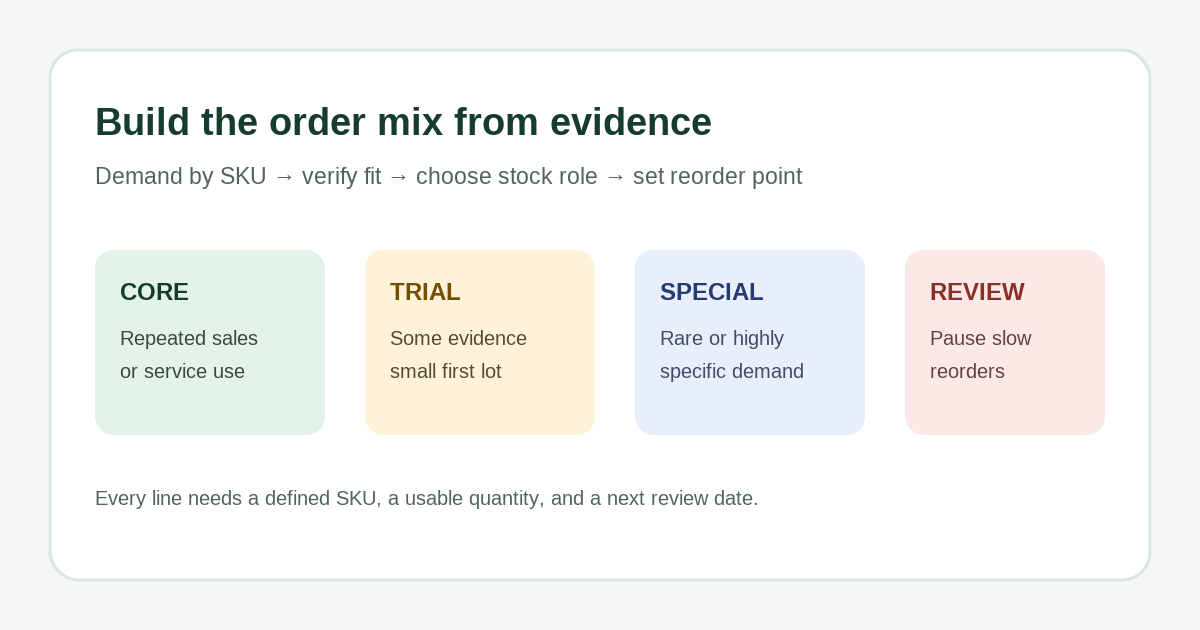
Match stock depth to confidence
| Evidence level | Example signal | Buying approach |
|---|---|---|
| Established demand | Repeat sales across seasons | Keep planned depth and set a reorder trigger |
| Emerging demand | Requests rise, but sales history is short | Trial a limited quantity and review after a set period |
| Low or uncertain demand | Few requests and long holding time | Special order or display only if strategically useful |
| Declining demand | Slow movement or specification change | Pause replenishment and make an exit plan |
The quantities should also reflect supplier pack sizes, replenishment time, and the cost of a stockout. A retailer with fast replenishment may carry less depth than one facing a long order lead time. Compare the full purchasing terms with Tyride’s wholesale bulk supply information and confirm the exact SKU, available sizes, and minimums for the proposed order.
Separate frame sizes from component compatibility
Frame size and component size are not interchangeable concepts. A frame size mix reflects rider fit and model demand. Component sizes may depend on a separate interface or bicycle specification. Before buying a component variant, confirm the exact application and manufacturer documentation. Tyride’s compatibility checklist covers the fields to record before committing to volume.
A retailer might use one demand curve for complete bicycles and a different one for replacement parts. Do not copy the frame-size ratio into a tire, saddle, or drivetrain order without evidence. For components that fit a system, compatible stock is useful only when the target models and configurations are known.
Review the mix instead of repeating it automatically
Set a review date for each trial and core assortment. Compare the forecast with actual movement, special orders, customer wait times, and the age of unsold stock. If a variant performed poorly, check whether the issue was size selection, price, product positioning, fit advice, or simply too little exposure. One season of data may not support a lasting conclusion.
Illustrative example: A shop sells 20 units across two sizes and receives repeated unfilled requests for a third size. It could reserve a small part of the next order for that size, then review completed sales and stock age after one season. The example shows a test method; it is not a recommended market ratio.
For broader market context, European Cycling Industries reported in 2026 that 50% of its survey respondents said overstocking of complete bicycles continued to affect their businesses, while some also reported shortages in parts and frames. The survey describes its respondents, not every market or SKU. Read the ECI update.
A practical size-mix review
Before placing the next wholesale order, ask:
- Which exact models and sizes sold in the last comparable period?
- Which customer requests were lost, delayed, or converted to special orders?
- How long did each size remain in stock?
- What are the minimum order, pack size, and replenishment lead time?
- Which low-confidence variants can be tested in a smaller quantity?
- When will the team review the results?
The purpose of an assortment is to serve the market a retailer actually has, while keeping inventory risk visible. Share a size-and-model demand summary with Tyride’s sourcing team if you want to discuss a wholesale requirement.
Evidence note: The Reddit comment is an individual practitioner observation about complete bicycles, not representative sales data. ECI’s 2026 result refers to its survey respondents. The example is hypothetical. See About us to understand Tyride’s stated sourcing role. Contact questions are welcome through the contact page.