
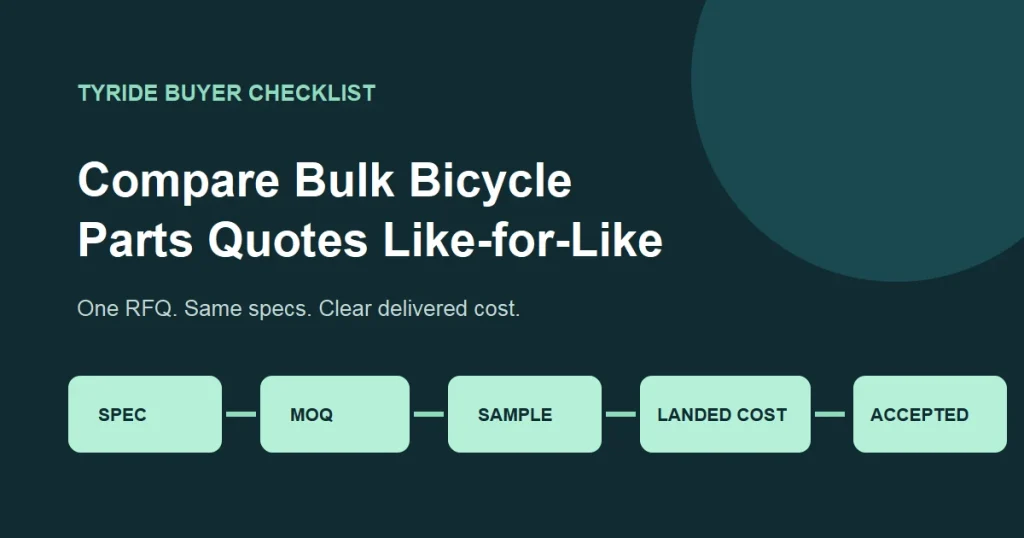
Two bicycle parts quotes are not comparable just because both name the same part type. A fair comparison holds the spec, order mix, delivery point, check plan and shipping terms constant. It also shows what happens if the sample and shipped parts differ, or the order arrives late. That care matters. The bike trade has had too much stock and gaps in the models buyers want. In a 2024 analysis, Bicycle Retailer & Industry News described the market as having too many inventory dollars at suppliers while retailers still faced shortages of in-demand models. The article reported supplier inventory-to-sell-in at 4.1:1 in June 2024, compared with 2.9:1 in 2018, based on PeopleForBikes data. Read the analysis.
Key takeaways
- Send every supplier the same product specification and order scenario.
- Compare landed cost and cost per accepted unit, not the headline unit price.
- Treat sample approval, production consistency and defect remedies as quote terms.
- Ask for quantity breaks that match demand, not only the supplier’s preferred MOQ.
Build one RFQ before asking for prices
A request for quotation (RFQ) asks each supplier to price the same need. For a bike part, state what it is, where it will be used, which fit rules apply and what changes need your approval. If key details are missing, each supplier may quote a different part that looks like the same offer.
Use a specification table that fits the component:
| RFQ field | Example information to provide |
|---|---|
| Product identity | Part name, intended bicycle system, internal SKU or reference drawing |
| Critical specification | Material, dimensions, interface, finish, performance requirement |
| Quantity | Initial order, repeat-order estimate and quantity breaks to quote |
| Mix | Quantity by size, color, model, packaging or destination |
| Branding | Logo method, artwork file, label and packaging requirements |
| Evidence | Sample, inspection record, test report or certificate required for this product |
| Delivery | Destination, requested window, shipping term and named receiving location |
| Commercial terms | MOQ, tooling, sample fees, payment schedule, quote validity, remedy terms |
Start with one shared file. Send the same version to each supplier. Keep replies beside the matching quote.
For safety-relevant components, have the responsible technical person approve the specification and acceptance criteria. Do not treat a supplier’s generic certificate or a marketplace description as proof that a part fits a particular bicycle or meets a specific performance requirement.
Ask each supplier to quote the same quantity ladder
Request prices at quantities that reflect your likely consumption, such as the first order, expected quarterly use and a credible annual volume. The exact levels depend on the buyer; they are not universal thresholds. Ask whether the MOQ applies per part, model, color, size, logo or packaging version. A total order of 500 units can still trigger separate minimums for each variant.
The 2024 Roland Berger report on the European bicycle industry described retailers as cautious with new orders while manufacturers carried high stock. Its survey covered 34 executives at bicycle manufacturers in Germany, Austria and Switzerland, plus six managing directors and industry experts. In that sample, more than half of manufacturers reported over six months of inventory, and more than a quarter reported over nine months. This is not a universal market estimate. It is a useful reminder that a large quoted discount does not tell you whether a specific SKU is worth committing to.
Ask suppliers to separate product price, tooling or setup, samples, packaging, inspection, freight and other quoted charges. Then compare the same cost boundary for every offer. When a supplier gives a price break only above your current need, calculate the extra cash tied up and whether the parts can be used before the next design, season or model change.
Compare total cost, then compare usable cost
Landed cost estimates the expense of getting the shipment to the named destination. State whether your calculation includes freight, insurance, duties, taxes, brokerage, delivery and inspection. Some charges may be recoverable or handled separately, so label them instead of blending them into one unexplained unit price. The U.S. International Trade Administration’s export pricing guide describes landed cost as product price plus insurance, freight, tariffs, taxes and other fees. Its Incoterms overview explains that delivery terms allocate tasks, costs and risks between buyer and seller. These are U.S. export resources; confirm local customs rules for your own destination.
Cost per accepted unit = total nonrecoverable order cost ÷ quantity accepted for use.
That denominator matters. If two offers have similar invoice totals but one has a different sample standard, inspection plan or remedy process, the real cost of usable stock may diverge. For each offer, record:
- Price at each requested quantity and variant mix.
- One-time charges and which quantities they apply to.
- Estimated delivered cost to the same destination.
- Inspection and testing scope, including who performs it.
- Defect process, evidence deadline, replacement or credit and freight responsibility.
- Lead time basis, shipment milestones and consequences of delay.
Keep each answer beside its quote. Mark open points before comparing totals.
A low quote may still be the right choice. The purpose of this comparison is to make the trade-off visible so the buyer can decide whether lower price comes with more risk, a different scope or a larger commitment.
Make sample approval specific and repeatable
A sample is only useful when both sides know which product it represents. Assign it an ID, retain the specification revision and record the dimensions, finish, packaging and checks that were approved. State what remains unapproved, such as branding artwork, an alternative material or a second size.
For a production order, ask the supplier how the approved sample will be tied to the production lot. Confirm whether changes to the factory, material, process or sub-supplier require notice and approval. If the order includes multiple colors or sizes, decide whether one sample covers the whole run or whether each variant needs review.
Tyride’s supplier qualification checklist covers production identity, sample quality, traceability and delivered cost. For a custom saddle program, the road saddle OEM/ODM specification guide helps convert fit and construction choices into a documented brief. Use product-specific testing and acceptance criteria; a general sample check is not a replacement for engineering review.
Read the Reddit case as a warning about order capacity
On November 8, 2024, a U.S. shop owner asked Reddit peers whether they were considering larger orders of common consumables in response to possible future tariffs. The thread drew a practical counterpoint: one commenter said shops and distributors might not have the capital to build stock buffers, especially when credit was expensive. Another shop owner said they planned to speak with brand representatives. The Reddit thread does not represent all bicycle businesses, and its tariff scenario is historical, not current guidance. It does show why an RFQ should include more than price: quantity, payment timing, delivery flexibility and the cost of carrying stock all affect whether an offer is workable.
Use the case to ask better commercial questions: Can the order be split? Is the price locked for later releases? Is there a deposit? Can several compatible items share a shipment? What happens if a forecast changes? Get each answer in writing and compare like-for-like.
Use a one-page quote comparison sheet
| Decision item | Supplier A | Supplier B | Supplier C |
|---|---|---|---|
| Exact spec and revision match | |||
| MOQ and variant-level minimums | |||
| Unit prices by quantity | |||
| Sample and setup costs | |||
| Estimated delivered total | |||
| Production lead time and validity | |||
| Inspection and quality records | |||
| Defect remedy and freight owner | |||
| Payment and staged-release options | |||
| Estimated accepted-unit cost |
Mark any unconfirmed term as “unknown.” Do not fill gaps with guesses, then treat the totals as firm offers. If suppliers use different delivery terms, ask them to restate the quote on a common basis or keep the differences visible.
Release the order only when the open points have owners
Before issuing a purchase order, make sure that:
- The buyer and supplier refer to the same specification revision.
- Sample approval and any open technical decisions are documented.
- MOQ, quantity mix, substitution rules and price validity are clear.
- Delivery scope and the destination are stated.
- Inspection, acceptance and remedy steps are agreed.
- Someone has approved the cash commitment and the expected stock cover.
- The next review or reorder date is on the calendar.
Tyride’s bulk bicycle parts and sourcing service lists bulk supply, OEM/ODM customization and sample options. Its public page notes that MOQ varies by component and that custom OEM/ODM orders typically start from 50 to 200 units per item; confirm the current terms for the exact product and configuration before relying on that range. For first-order quantities and replenishment planning, use the separate wholesale stock-order guide. When the key unknown is how much cash to tie up, use the bulk-buy decision framework. Custom saddle buyers can also compare configuration, sample and accepted-stock considerations in the bulk saddle purchasing guide.
Frequently asked questions
What should a bicycle parts RFQ include?
At minimum, list the exact part, key specs, order size and mix, brand or pack needs, delivery point and date, sample needs, quality proof and payment terms. Include the same fields for every supplier so their offers remain comparable.
Should I choose the supplier with the lowest unit price?
Only after confirming the quote covers the same product, quantity mix, delivery scope and quality requirements. Compare landed cost and estimated cost per accepted unit, and consider whether the MOQ leaves stock you can use.
How can I compare quotes when suppliers have different MOQs?
Ask each supplier for a price ladder at common quantities and identify whether minimums apply per SKU or variant. If a supplier cannot quote the same volume, show the quantity difference as a separate cost and inventory commitment.
What should happen when production differs from the approved sample?
The purchase order or quality agreement should define evidence, notification timing, review, corrective action and who pays for replacement, return or reinspection. Do not leave the remedy to an informal message after goods arrive.
A better quote is one you can actually execute
The best bulk quote is not always the lowest price. Choose the offer that matches the approved part, fits the buyer’s order plan, shows the cost to the door and states what happens when plans change. Standardizing the RFQ makes those differences visible before inventory and cash are committed.
Request for quotation (RFQ) means a structured request that asks suppliers to price the same defined product and delivery plan. Minimum order quantity (MOQ) is the smallest quantity a supplier will accept under specified commercial terms.
Evidence and method: This guide combines a dated November 2024 Reddit discussion with a 2024 industry report based on interviews with 34 bicycle-industry executives in Germany, Austria and Switzerland, plus six managing directors and experts. Those sources show examples and surveyed conditions, not a universal purchasing rule. The quote worksheet is an original decision template, not supplier performance data.
For company information and buyer support, see About us at TYRIDE or contact TYRIDE.
[UNIQUE INSIGHT] A quote only compares fairly when the spec, order mix, destination and remedy terms match.
Editorial note: Industry survey findings above apply to the respondent group and geography stated by Roland Berger. The Reddit thread is a single historical practitioner discussion from November 2024. Tyride service descriptions and MOQ examples are company-published information; buyers should confirm product-specific terms directly. This guide is informational and does not replace technical, customs or legal review.