
A reliable bicycle parts reorder plan starts with item-level demand and replenishment time, not a blanket target for how many weeks of stock to hold. This matters in a market where some categories may be discounted or overstocked while specific products remain difficult to find.
For each SKU, estimate demand during replenishment, add a deliberate buffer for uncertainty, and review the result against actual sales and supplier performance. Keep the calculation simple enough to maintain and specific enough to expose assumptions.
Key Takeaways
- Calculate reorder points separately for each SKU and variant.
- Use confirmed sales, open orders and actual lead-time history instead of relying on industry sentiment alone.
- Treat safety stock as a chosen buffer, not a magic number or universal percentage.
- Count incoming orders and committed customer demand consistently to avoid duplicate purchasing.
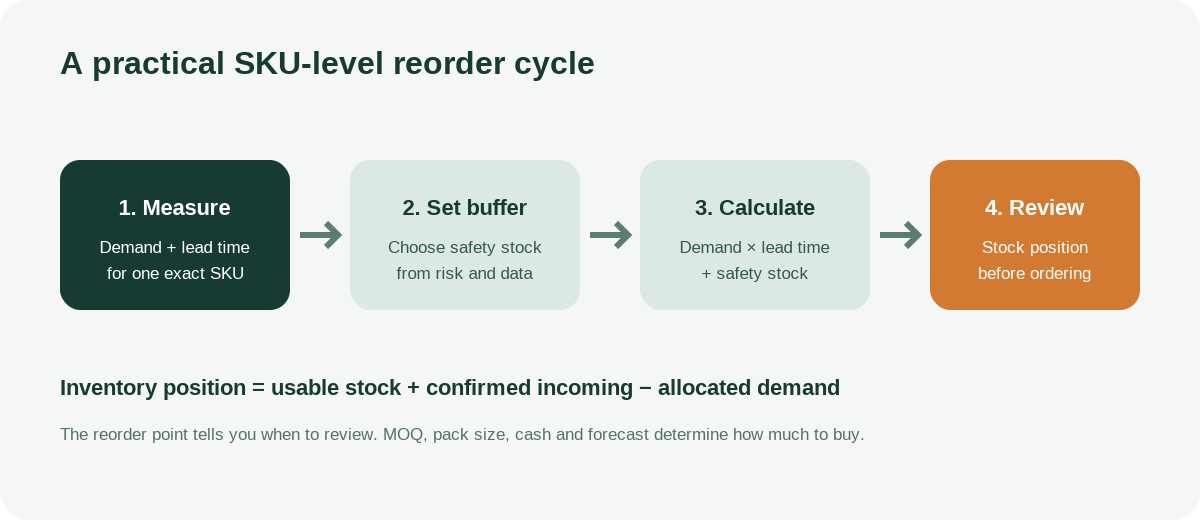
Reorder point is the inventory-position threshold that triggers a replenishment review. Safety stock is the additional usable quantity a buyer chooses to buffer demand or lead-time uncertainty; it is a policy input, not a universal industry constant.
A single inventory total hides the stockout risk
Two component categories can have the same on-hand value but very different service risk. A fast-moving tube size with predictable replenishment is not equivalent to a specialized saddle or fit-sensitive component with irregular demand. A useful inventory view therefore tracks product identity and variant, sales rate, replenishment lead time, confirmed incoming stock, allocated stock and the date of the last review.
A July 2024 Reddit discussion offers a small but relevant example of that mismatch. In r/bicycling, a buyer reported difficulty finding particular models in stores and online, while commenters described different availability by brand, product and location (Reddit thread). This is consumer-market evidence, not a distributor stock dataset. Its practical lesson is narrower: “bikes are available” is not enough information to plan a specific product line.
Likewise, a high-level forecast can hide demand concentration. If a wholesaler sells several saddle widths or multiple product revisions, total category sales do not show which exact variants need replenishment. Track variants separately and keep a record of approved substitutes.
Calculate a reorder point by SKU
For continuous review, a common starting formula is:
Reorder point = expected demand during replenishment lead time + safety stock.
Virginia Cooperative Extension defines safety stock as inventory held to protect against late deliveries and uncertain demand, and expresses the reorder point as demand during supplier lead time plus safety stock (Virginia Tech Extension inventory guide). The formula below applies that general inventory method to a bicycle parts SKU; it is not a bicycle-industry benchmark.
Suppose a wholesaler sells 12 units of a particular part each week. If replenishment usually takes three weeks and the buyer chooses a buffer of 10 units, the initial trigger is 46 units: (12 × 3) + 10. This is an illustrative calculation, not a benchmark. Replace the assumptions with the buyer’s own demand and observed receipt dates.
The trigger should use inventory position rather than shelf count alone:
Inventory position = usable on-hand stock + confirmed incoming stock − allocated or committed stock.
If the buyer has 30 usable units, 20 confirmed incoming and 8 units allocated to customer orders, inventory position is 42. With a reorder point of 46, a replenishment review is due. The buyer still needs to select an order quantity based on the next review period, pack sizes, MOQ, cash plan and forecast.
Keep damaged, quarantined or unapproved stock out of usable on-hand quantity. Do not subtract a customer order twice if it is already reflected in sales data. Record the date and assumptions so another team member can reproduce the decision.
Choose the buffer based on the cost of being wrong
Safety stock is a policy choice. A larger buffer may reduce stockout risk but ties up cash and warehouse space. A smaller buffer preserves working capital but may increase emergency shipments or missed sales if demand rises or supplier lead times slip.
Consider these factors for each line:
- Demand variability: Is weekly demand stable, seasonal or driven by one-off projects?
- Lead-time variability: Do actual deliveries arrive consistently, or is the quoted time only a target?
- Substitution options: Can a technically approved alternative serve the same use case?
- Failure impact: Would a stockout delay a repair, fleet deployment or production schedule?
- Obsolescence risk: Could a model, finish or specification change make the stock harder to sell?
A buyer can start with a chosen number of weeks or units, but the policy should be reviewed when actual data changes. Avoid applying the same buffer to every SKU just because the spreadsheet is easier to maintain.
Use market discussion to challenge assumptions
The July 3, 2024 r/MTB thread about bike discounts attracted substantial discussion, but replies disagreed about whether bargains would persist and which models were available (Reddit thread). The conversation is anecdotal, and consumer bike discounts do not directly establish wholesale component prices. It can still prompt useful procurement questions: Are suppliers discounting only slow-moving variants? Are popular sizes excluded? Is the offer current stock or a future production commitment?
The Associated Press also reported in May 2024 that manufacturers were discounting excess inventory after the pandemic surge, while individual retailers described very different business conditions (Associated Press report). The account is helpful context for volatility, but it is not a forecast for a particular parts category. A reorder plan should translate that context into questions for suppliers, then rely on the buyer’s own sales and receipt data.
The AP article also reported Circana’s estimate that U.S. bicycle sales rose 64% to $5.4 billion in 2020, then fell as pandemic demand normalized (Associated Press report). Those are historical U.S. retail figures, not a current forecast or a measure of wholesale components; they help explain why buyers should avoid projecting an exceptional demand period indefinitely.
A December 2024 review in German cycling publication BIKE described full warehouses alongside shortages in some popular gravel and road models, and reported a July dealer survey in which 75% said warehouses were unusually full (BIKE market review). This evidence reflects that article’s reported market and survey; it should not be generalized to every country or component category. Use it to understand market complexity, then base order quantities on your own line-level data.
The U.S. Census Bureau’s inventory data is also an aggregate measure: the bureau describes inventories-to-sales ratios as a relationship between the value of stock and monthly sales (Census Bureau methodology). It is useful context for retail trends, but it cannot set a bicycle wholesaler’s reorder point because it does not identify the wholesaler’s individual part numbers, demand or supplier lead times.
Set a practical monthly review cadence
A monthly review is enough for some slow-moving lines; faster products may need weekly or continuous monitoring. During each review:
- Reconcile physical stock, sales, allocations and confirmed purchase orders.
- Update average demand and demand variability using a defined lookback period.
- Compare the latest supplier lead time with the planned lead time.
- Recalculate the reorder point for lines where demand or supply conditions changed.
- Review open quotes, backorders and substitutions before creating another order.
- Record the reason for any manual override.
If a supplier offers a volume tier or free-freight threshold, compare the incremental stock cost with the value of the cash and storage it consumes. Tyride’s first stock order guide includes an illustrative reorder-point calculation and shows how to retain an allowance for later verified demand. For specifications and sourcing terms, see the bicycle component sourcing service.
Distinguish the reorder point from the order quantity
A reorder point answers when to review or trigger a purchase. It does not answer how many units to buy. Order quantity depends on pack sizes, MOQ, price breaks, demand through the next review, storage capacity and available cash.
A buyer might trigger at 46 units but order 60 to reach a case-pack minimum, or order 30 if cash is constrained and supplier delivery is fast. These decisions should be visible in the purchasing record. If a minimum forces an order much larger than expected demand, compare alternatives such as a smaller standard pack, a distributor, a split delivery or a customer-backed purchase. Confirm commercial terms rather than assuming suppliers will accept them.
Frequently Asked Questions
How often should a bicycle parts buyer review inventory?
Match review frequency to sales speed and replenishment risk. Fast-moving, high-impact SKUs may need weekly or continuous monitoring; slower lines may fit a monthly review. Use actual stock movement and supplier lead times to set the cadence.
Should every bicycle part have the same safety stock?
No. Demand, lead-time variability, substitution options, obsolescence and the cost of a stockout differ by item. Set the buffer at SKU level and document the assumptions.
What if supplier lead time changes after the order is placed?
Update the expected arrival date and inventory position, then assess whether the order still covers committed demand. Ask the supplier to confirm revised timing and available remedies. Do not count an unconfirmed shipment as incoming stock.
Keep the plan simple and reviewable
A useful reorder system does not require perfect forecasting. It requires consistent SKU definitions, visible assumptions and a habit of comparing the plan with actual results. Start with the products that matter most, adjust buffers when lead times or sales change, and record exceptions so the next order improves on the last one.
For a product-specific purchasing list or replenishment inquiry, Tyride’s wholesale sourcing service can review the required component, quantity and destination. For first-order budgeting, use the wholesale bicycle parts stock-order guide.