
A B2B bicycle saddle assortment should reflect distinct rider positions and product uses, not simply maximize the number of SKUs. Brands and wholesalers can reduce avoidable inventory risk by defining who each saddle serves, validating the specification with representative users, and adding variants only when evidence supports them.
The July 2024 Reddit conversations about bike inventory offer a reminder: buyers discussed discounts and overall surplus while also describing specific models and sizes that were hard to find (r/MTB discussion, r/bicycling discussion). These posts concern complete bicycles, not saddle sell-through. They should not be used as a saddle demand forecast. They do illustrate why broad market claims cannot replace product-level assortment decisions.
Broader reporting also shows why an assortment should be based on the products a business can actually sell and replenish. The Associated Press described discounts following excess inventory alongside different conditions at individual U.S. shops (AP report). A BIKE review reported that dealers described full warehouses while selected popular categories remained short of stock (BIKE market review). Neither source measures saddle demand; they support using specific product evidence instead of a market-wide assumption.
The BIKE review says a July 2024 dealer survey found 75% of respondents had unusually full warehouses, although the article does not disclose the survey sample size (BIKE market review). The AP reported Circana’s estimate that U.S. bicycle sales rose 64% to $5.4 billion in 2020 (AP report). Forbes reported U.K. bicycle unit sales fell 2% year over year in 2024 using Bicycle Association data (Forbes report). These market figures do not measure saddle sell-through; they reinforce the need to validate each planned variant with the brand’s own channel evidence.
Key Takeaways
- Define the target rider and position before selecting foam, shell or rail options.
- Use a small number of clearly differentiated platforms, then validate width and fit needs.
- Treat every additional size, color or branding option as a separate demand and MOQ decision.
- Approve production samples against written specifications and acceptance criteria.
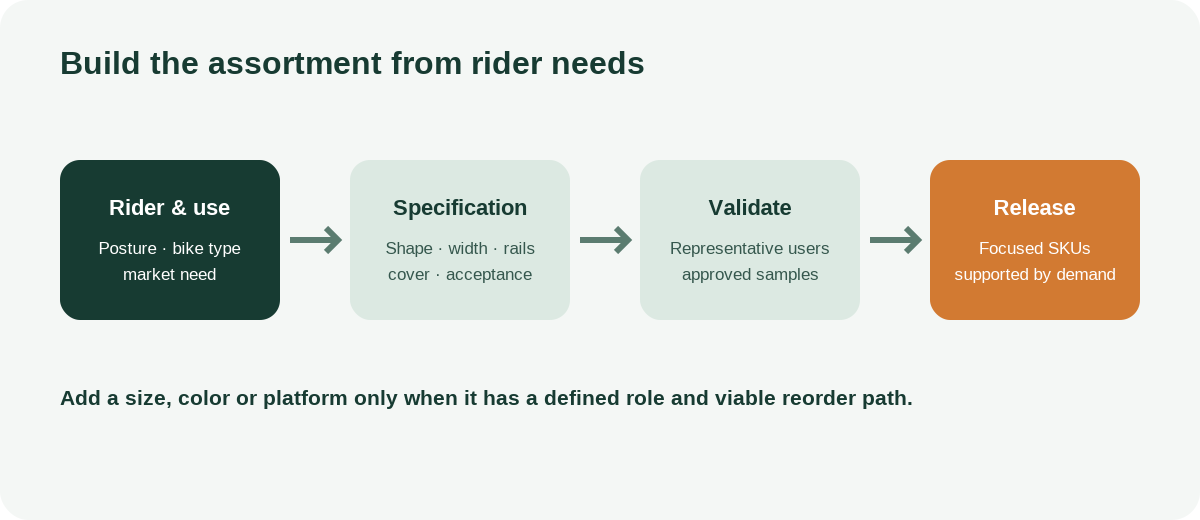
B2B saddle assortment means the planned set of saddle platforms and variants a brand or wholesaler offers to business customers. Fit validation is a structured check that a product’s dimensions and use characteristics work for a defined rider and bicycle application; it does not mean that one sample represents every rider.
Start with rider position and product use
A saddle should be selected in relation to the bicycle and how the rider sits. A forward-leaning road position, an upright city posture and a technical mountain-bike position place different demands on shape, width, freedom of movement, support and durability.
Tyride’s B2B saddle sourcing guide describes saddle selection as a system involving geometry, shell, rails, padding and cover. It also differentiates road, gravel, mountain, city and e-bike applications. Use those categories as a starting brief, then confirm the fit and performance requirements for the intended product rather than treating the category label as a finished specification.
Research supports treating width as a fit variable, but not using a single measurement as a universal design rule. A 2023 study of ten healthy female cyclists found that saddle width changed measured pressure distribution; the small, specific sample does not establish one ideal width for all riders (Lin, Wang and Chen, Journal of Sports Science and Medicine). For product planning, the practical implication is to validate relevant variants with representative users and avoid turning a limited study into a universal sizing formula.
A separate 2018 ergometer study tested three saddle designs with 19 female cyclists and found that width and cutout changed pressure distribution and discomfort measures (Applied Ergonomics study record). The study’s participant group and test setup limit how broadly the result can be applied. Together, the studies support testing fit-related variants, not prescribing one geometry for every customer.
The article tested four saddle widths with a small participant group, so its results are evidence that width can affect pressure in that study setting, not a market-wide sizing prescription. A brand should combine user trials with the intended posture, bicycle geometry, fit advice and applicable engineering requirements.
For each proposed saddle platform, write a short product brief:
- Intended bicycle category and rider posture
- Primary customer and expected price tier
- Target width and length range, where relevant
- Shell and rail requirements
- Padding and cover characteristics
- Durability, testing and acceptance requirements
- Branding, packaging and service parts
This document lets suppliers respond to the product need, not just to a photograph or a price target.
Keep the range understandable
A good assortment lets the sales team explain why one saddle differs from another. If two models serve the same rider, at the same price tier, with no clear fit or functional difference, they may create complexity without improving customer choice.
A useful first structure might contain a comfort-focused city option, a performance-oriented road option and a versatile gravel or all-road option. That is an example of product architecture, not a universal recommended lineup. A brand with a cargo-bike customer base or a specialized fleet may need a different set of products.
Map every planned variant to a specific role. Use separate evidence for the need to add another width, color or rail material. Color preference can be tested with a small market sample; fit changes may require a more formal trial because they affect the user experience and possibly the product’s intended application.
For example, a wholesaler serving upright city bikes and performance road bikes could first test a comfort platform and a lower-profile platform, each with a clear target rider. It should add a second width or special cover only when customer requests, fitting feedback or sales evidence support that variant. This is a planning example, not a validated Tyride assortment or a forecast.
Tyride’s OEM saddle size-range guide discusses width and range planning. The saddle cover sourcing guide can support material discussions. Confirm current product options and commercial terms with the supplier before using them in a launch plan.
Validate with samples before volume
A catalog image cannot show how a saddle feels under load, fits a bicycle, or holds up in the intended use. Select a sample that represents the expected production configuration. Record the model, revision, material, dimensions, finish and branding. Note which details the sample does not yet demonstrate.
Test with riders who match the intended market. Collect structured feedback about position, pressure points, movement, comfort over the expected ride duration and compatibility with the target seatpost or clamp. Avoid treating a small informal test as proof of broad rider satisfaction. It is a way to find issues and refine the brief before committing to a larger order.
Agree on the sample approval gate and what happens if the production version changes. If the supplier changes the shell, padding, cover, rail or production site, determine whether a new sample or technical review is required. The approved sample and the written specification should travel together through the order process.
For commercial planning around sample costs and quantity tiers, see Tyride’s bulk saddle MOQ and true-cost guide. For general supplier review, use the low-cost parts supplier checklist.
Tie the SKU count to the order economics
Every variant can create inventory and replenishment work. Before adding a size or color, check how the supplier applies minimum quantities, whether the variants can share a production run, and what the next reorder would require. Confirm packaging and branding charges separately, since a low product price may exclude setup or artwork.
Compare each proposed range under more than one demand scenario. For example, estimate a conservative, expected and strong case for the first sales period. These are buyer planning scenarios, not market data. Ask what inventory remains if the conservative case occurs and whether the supplier can replenish a popular option without forcing excess volume in slower variants.
| Variant decision | Evidence to collect | Release condition |
|---|---|---|
| New saddle platform | Target rider, price tier and use case | Technical brief approved |
| Additional width | Fit requirement and trial feedback | Sample or fit validation accepted |
| New color | Customer request or channel evidence | MOQ and color cost confirmed |
| Premium rail or shell | Performance need and cost impact | Specification and claim support reviewed |
| Custom branding | Brand assets and packaging need | Artwork, tooling and ownership terms agreed |
Tyride’s stock-order planning guide explains how to distinguish core stock, limited trials and special orders. Apply the same logic to a saddle program: keep proven variants in the core plan and stage uncertain options until demand is clearer.
Write measurable quality and change controls
Before volume production, define what counts as an acceptable unit and how the buyer will verify it. The plan may include visual inspection, dimensional checks, fit confirmation, functional testing or applicable third-party standards. The method must suit the product and market. Do not use a generic “passes all safety tests” statement without identifying the relevant product, requirement, method and report.
For saddle and seat-post assemblies, ISO 4210-9:2023 specifies test methods used with ISO 4210-2 (ISO standard overview). Identify the target market and ask a qualified compliance specialist which requirements apply to the finished bicycle and component. A standard’s existence is not evidence that a particular product or production lot has passed it.
For the U.S. market, CPSC identifies bicycle requirements in 16 CFR Part 1512, including assembly and mechanical safety areas (CPSC bicycle guidance). Use the current applicable requirements for the finished product; do not infer a saddle’s compliance from a supplier’s general quality statement.
Record lot identity and specify how material or construction changes are approved. Define the inspection window, defect reporting evidence and remedy route. If a nonconforming batch arrives, the buyer should know how to identify affected units, hold them from sale and request the agreed resolution.
Tyride outlines its stated inspection and quality support on its quality control page. Buyers should confirm the scope, applicable tests, warranty and remedies in their own quotation and purchase order. A public service description does not establish the performance of a particular lot.
Frequently Asked Questions
How many saddle models should a new bicycle brand launch with?
There is no universal number. Start with the rider positions and product uses the brand can support, then add models only when they serve a clear role and the buyer can support their MOQ, fit validation and replenishment.
Should e-bikes always use a wider or softer saddle?
No. “E-bike” alone does not specify rider posture, bicycle type or fit. A commuter, mountain and cargo-bike application can have different requirements. Define the actual use case and validate the saddle accordingly.
Can a sample guarantee that bulk production will match?
No. A sample is one approval input. The buyer should also control the production specification, change process, inspection plan and lot records, then verify incoming goods against the agreed criteria.
Build a range that you can explain and replenish
The strongest saddle assortment is not the longest one. It is a set of products with distinct rider purposes, clear specifications and demand evidence strong enough to justify each commitment. Use samples to test assumptions, keep optional variants staged and agree on quality and change controls before volume production.
For an OEM or private-label discussion, send Tyride the target rider, bicycle category, product brief and quantity assumptions through its bicycle component sourcing service.