
A lower-inventory bike retail model works when the shop deliberately chooses which products to hold, which to display for evaluation, and which to order after a customer commits. The choice should balance cash exposure, fit and test-ride needs, supplier availability, assembly capacity, and the delivery time customers will accept.
The January 2025 Reddit discussion about leftover bicycles shows the cost of a stock-heavy model when certain bikes stop selling. In a later 2025 LinkedIn post, INTENSE described its Frame First program as a way for dealers to configure complete builds while the brand retains frames. These are useful case examples, not a universal prescription or independent proof of higher profitability.
The European Cycling Industries 2026 market profile reports 15.618 million bicycle and EPAC sales in Europe in 2025, down 2.6% year over year. That market-level context does not determine a shop’s assortment, but it reinforces why each retailer should use its own sales, customer requests, and supplier availability when choosing what to stock.
Key Takeaways
- Stock products customers need immediately and that the shop can replenish predictably.
- Use display units to answer fit, touch, and comparison questions without duplicating every configuration.
- Special-order uncertain models only when the supplier’s availability and customer delivery expectations are clear.
- A frame-first or build-to-order program still requires compatibility, service, and warranty controls.
What are the main bicycle retail inventory models?
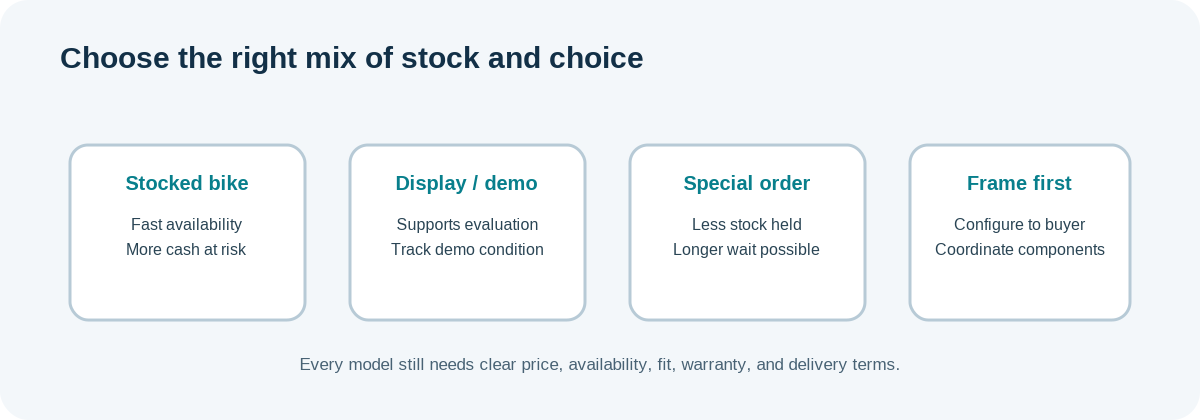
Most shops combine four approaches: stocked ready-to-ride bikes, display or demo models, customer-specific special orders, and configurable or build-to-order bikes. Each approach moves inventory exposure and customer responsibility to a different point in the buying process.
| Model | What the shop holds | Main advantage | Main risk to manage |
|---|---|---|---|
| Stocked complete bike | Finished bike ready for sale | Immediate availability and test ride | Cash tied up in model, size, and year mix |
| Display or demo model | Sample for fit and evaluation | Supports customer choice with less duplicated stock | Damage, insurance, setup, and future resale |
| Special order | Little or no stock before commitment | Avoids guessing on uncommon variants | Longer wait and supplier availability risk |
| Frame-first or custom build | Frame or selected parts, then customer configuration | Wider choice with fewer full builds held | Component compatibility and assembly coordination |
The stocked-bike and frame-first ends of this comparison are visible in the January 2025 Reddit inventory discussion and INTENSE’s 2025 LinkedIn description of Frame First. The other rows are common operating choices to assess against a retailer’s own supplier terms and service model.
What does the January Reddit case tell bike shops?
It shows how aged complete-bike inventory can constrain subsequent purchasing and create a brand-policy question. In the January 28, 2025 Reddit r/BikeMechanics thread, a shop owner asked how to sell leftover full-suspension bikes while avoiding trouble with brand restrictions on third-party sales. Replies suggested talking to the brand representative, discounting, demo use, and other selling approaches. One reply stated that unsold “dead stock” meant the shop was buying fewer bikes.
The thread had visible votes and concrete shop-owner replies, but it is not a representative survey. Its value is as a prompt for a dealer to ask: which products require immediate availability, and which ones can be demonstrated or ordered after the rider chooses?
What can a frame-first program change?
It can change which complete-bike inventory a dealer holds before a sale. INTENSE’s LinkedIn announcement describes the company retaining frame inventory and using a QBP relationship to support configurable component builds. The company states its intended benefits and cost comparisons; those are company claims rather than an independent assessment.
Before adopting any similar model, a dealer should confirm:
- Which frames and sizes are actually available and where they are held.
- Whether a customer deposit or order is required before components are sourced.
- Which component combinations are approved for each frame.
- Who handles the build, final inspection, delivery, warranty, and service follow-up.
- How price, discount, cancellation, and returns differ from a stocked complete bike.
- What happens when one selected component becomes unavailable.
For parts and accessories, Tyride’s first wholesale stock-order guide covers separating core inventory from trial and special-order lines. Retailers considering a display-led saddle category can also review the saddle demo-kit framework, which treats trial records as inputs to future stocking decisions.
How should a shop decide what to stock?
Stock items that solve frequent customer needs, have confirmed specification and fitment, and can be replenished within the service or sales window. Use the shop’s own transactions and service records to set categories instead of importing another retailer’s assortment unchanged.
Create three groups:
- Core stock: repeat sellers or parts required to complete common repairs and builds.
- Display or trial stock: representative samples that support fit, touch, and test rides.
- Special order: uncommon variants, premium configurations, or items without enough local demand evidence.
Review each group against cash, space, staff time, supplier lead time, and model-year obsolescence. A demo item still has costs: acquisition, setup, wear, servicing, and eventual sale or replacement. A special order still needs a clear delivery promise and cancellation policy.
When does a lower-stock model fail?
It fails when customers require immediate availability, supplier stock cannot be confirmed, or the shop cannot deliver the fit and service experience expected from the product. A shop can also lose sales if its display range is too narrow to support meaningful comparisons.
Use a monthly review to compare stocked versus special-order sales, wait times, cancelled orders, lost sales that were actually recorded, demo use, and aged stock. Then adjust the next season’s inventory and display plan. For sourcing questions that include multiple components or private-label requirements, Tyride’s bicycle components sourcing service describes the company’s published support scope. Confirm exact availability, MOQ, timing, and commercial terms for the proposed order.
That local review matters even when the wider market improves: the 2025 inventory figures summarized in Bastian Dietz’s LinkedIn post show that some businesses reported excess stock while others considered stock satisfactory or seasonal.
Frequently asked questions
Should every bike shop switch to special orders?
No. A special-order model may suit expensive or low-volume configurations, but it can frustrate customers who need a bike quickly or want to test multiple sizes. Most shops should decide by product group and customer need.
Is a display bike the same as sellable inventory?
Not always. A display bike may be saleable, but its condition, warranty start, demo use, and markdown should be recorded. A shop should define when a demo unit can be sold and how it is inspected.
Does lower inventory automatically improve cash flow?
It can reduce cash tied up in stock, but the result depends on deposits, supplier terms, assembly cost, customer wait time, returns, and lost sales. Compare the full operating model rather than looking only at inventory value.
Match the buying model to the product
Start with the local customer task, then decide whether the product should be on the floor, available as a sample, or ordered to specification. For component or OEM sourcing support, share the category, intended use, target configuration, expected order plan, and destination with Tyride’s team.
Method note: The Reddit thread is anecdotal and the original question reflects one shop. INTENSE’s LinkedIn post is a company explanation of its program and its claimed advantages. The model comparison is a planning framework, not a measured profitability study.