
A bicycle supplier agreement should define the product specification, order commitment, forecast status, delivery window, substitution approval, quality evidence, and remedy before a buyer places a repeat order. These terms help both sides distinguish a planning estimate from a binding purchase and make changes visible before they create excess stock or production gaps.
The January 2025 Reddit discussions in our earlier research showed two practical buyer pressures: shops trying to clear leftover bikes and a prospective retailer struggling to open a first wholesale account. A later LinkedIn example from INTENSE described a different commercial structure that keeps frame inventory with the brand while dealers configure builds. These cases do not prescribe a universal contract. They help identify the questions a purchasing agreement needs to answer.
Key Takeaways
- Label every quantity as forecast, reserved capacity, or firm purchase order.
- Define item-level MOQ, variant rules, tooling, samples, and change approval separately.
- Put delivery milestones and delay notifications in writing.
- Agree how shortages, substitutions, rejected goods, and freight costs will be handled.
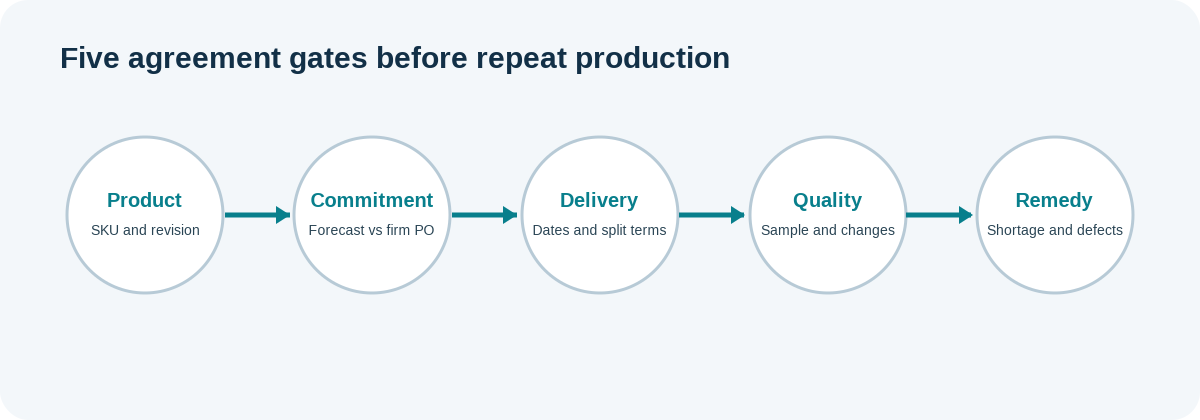
Why should a repeat-order agreement distinguish forecasts from orders?
A forecast estimates possible future demand; a purchase order commits the buyer to a defined quantity under agreed terms. If both parties use the word “order” for a nonbinding estimate and a firm commitment, production, inventory, and payment decisions can diverge.
An earlier LinkedIn post by Silas Obrist on bicycle-industry inventory highlighted the risk of excess stock and the value of better retail sell-through data. This is a practitioner view, not a contractual standard. A practical agreement can respond by specifying what information is shared, how often a forecast is updated, and the point at which a quantity becomes binding.
The January 28, 2025 Reddit r/BikeMechanics thread on selling off inventory also illustrates why the distinction matters downstream: a shop with unsold bicycles may reduce what it buys next. A supplier agreement that treats every projection as a firm order can transfer too much demand risk to the retailer.
Which commercial terms should a bicycle buyer confirm?
Confirm the terms that determine quantity, timing, and liability before approving production. Avoid burying important differences inside a broad “standard terms” document when the project includes several models, colors, or custom configurations.
| Agreement topic | Buyer and supplier should define |
|---|---|
| Product identity | SKU, drawing, specification revision, material, finish, and packaging |
| Forecast | Horizon, update cadence, format, and whether it creates any commitment |
| Firm order | Accepted quantity, price, currency, expiry, payment milestones, and cancellation rules |
| MOQ | Whether it applies per product, model, color, logo, packaging, or shipment |
| Capacity | Reserved production window, allocation method, and release deadline |
| Lead time | Trigger event and the date range each milestone refers to |
| Shipment | Partial shipment permission, named delivery term, and document responsibility |
| Changes | Who approves changes to material, factory, sub-supplier, or design |
| Remedies | Process and responsibility for shortages, damage, and nonconforming goods |
Tyride’s supplier-check guide similarly recommends that buyers make specifications, MOQ, lead time, test scope, and remedies explicit in a component RFQ. An agreement should carry those confirmed decisions forward rather than relying on a quote summary alone.
How should MOQ and capacity commitments be structured?
Ask for itemized minimums and price breaks against realistic order scenarios. “MOQ 500” is incomplete unless the quote states whether 500 means units of one SKU, a model family, a color, or a total mixed order. For custom parts, tooling and artwork may create separate setup quantities or fees.
Tyride’s service page says standard stocked parts may have flexible MOQ support and that custom OEM/ODM minimums vary by item. The published page gives an indicative range for customization, not a guaranteed quote for every product. Buyers should request a written offer with the exact part, configuration, quantity, destination, and desired timing.
Consider three possible agreement structures:
- Firm batch: the buyer commits to a defined quantity and delivery schedule.
- Forecast with release orders: the buyer shares an estimate, then releases smaller firm quantities against an agreed production window.
- Reserved capacity: the supplier reserves capacity under stated conditions, while the agreement defines when the buyer must convert it into a purchase order.
Each structure allocates risk differently. A lower unit price may require a larger cash commitment. Smaller releases can improve flexibility but may carry a higher unit cost or additional setup and freight charges. Compare total cost and liability, not unit price alone.
What did the INTENSE Frame First example change?
In a 2025 LinkedIn post, INTENSE described its Frame First program as retaining frame inventory while dealers configure builds with compatible components. The company said the program was intended to reduce the burden of stocking complete bikes at the dealer. This is a company-described model; the post’s performance and savings claims should not be treated as independent results.
The contract lesson is to state where ownership, inventory, and configuration responsibility sit at each stage. A frame-first arrangement still needs clear terms for frame availability, component selection, compatibility approval, assembly, delivery date, pricing, warranty, and returns. The phrase “build to order” does not answer those questions by itself.
For component quality and release criteria, Tyride’s supplier qualification guide provides a broader evidence checklist. Its quality-control service page describes published inspection and testing services. In a specific agreement, define the actual product, sample, acceptance criteria, report, and remedy rather than relying on general wording.
How should the agreement manage changes and delays?
Require written approval before a change affects an approved product or ship date. A substitution can change fit, performance, branding, packaging, or compliance status. A material change or sub-supplier change can also make a previously approved sample unrepresentative.
Use a change notice with these fields:
- Affected SKU, purchase order, drawing revision, and production lot.
- Reason for the change and the date it takes effect.
- Proposed replacement material, component, factory, or process.
- Updated sample or test evidence, if relevant.
- Impact on MOQ, unit price, lead time, packaging, and approval status.
- Named buyer approver and supplier owner.
For delays, define when the supplier must notify the buyer, what new date is being proposed, and which options are available: continue, split, expedite, substitute, or cancel. Agree who pays incremental freight or rework costs. If the parties have not agreed a remedy, do not imply that a general service statement guarantees one.
The January 2025 Reddit discussion about delayed bicycle orders illustrates why delay and duplicate-order rules matter, although the original post is no longer available. Define the update and approval process before a late shipment creates pressure to improvise.
Frequently asked questions
Is a forecast binding on a bicycle supplier?
Not automatically. The agreement should state whether a forecast is informational, reserves capacity, or creates any obligation. A firm purchase order should identify the quantity and terms that both parties accepted.
Should a buyer require the same MOQ for every reorder?
Not necessarily. The relevant minimum may depend on a stocked item, a custom color, a logo, tooling, or packaging. Ask the supplier to state each minimum and whether mixed variants can share a production run.
What should happen if a supplier proposes a substitute?
Pause the affected line until the buyer reviews the exact substitute, technical evidence, price, delivery effect, and required sample. Record written approval before production or shipment.
Put the order rules into a shared document
Use a concise commercial schedule alongside the controlled product specification. For a Tyride sourcing or OEM inquiry, share your expected volume, forecast window, exact item list, revision status, delivery destination, and questions through the contact page. Tyride can then confirm which published services and project terms apply to that request.
Method note: Reddit posts are community anecdotes. The LinkedIn example is a company description of its own program. Terms in this guide are a buyer-side checklist, not legal advice or a claim about Tyride’s standard contract. Have qualified counsel review a binding agreement for the relevant jurisdiction.