
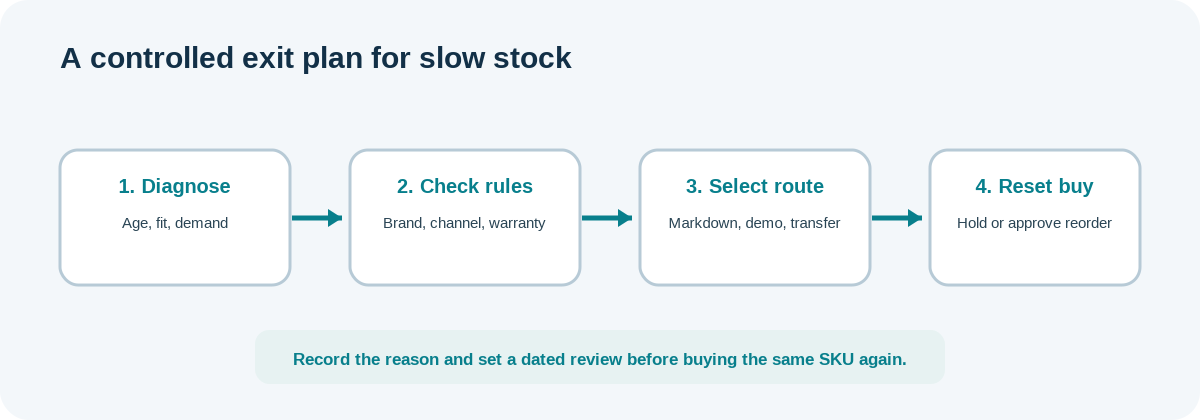
A shop should manage slow-moving bicycle inventory with a documented exit plan: verify the stock and its age, identify why it is not selling, compare approved options, estimate the cash and margin impact, and stop reordering the same configuration until the cause changes. “Discount it” is only one option, and it may not be allowed under the shop’s brand agreement.
The January 2025 Reddit discussion provides a useful case. A shop owner asked how to clear leftover full-suspension bikes while concerned about restrictions on third-party marketplaces. Replies suggested consulting the brand, discounting, running demo events, or breaking bikes into parts. A 2025 LinkedIn post from Bastian Dietz discussing bicycle inventory survey results described some retailers still reporting excess stock while others said levels had normalized. Together, these examples show why an inventory decision needs both product-level evidence and a channel-specific rule.
Key Takeaways
- Review stock by age, model, size, condition, and actual sales history.
- Check brand, marketplace, warranty, and consumer-protection requirements before choosing a resale channel.
- Compare markdown, demo, transfer, parts recovery, and continued holding using realistic cash and cost assumptions.
- Put a reorder hold on a slow-moving configuration until a defined signal justifies buying it again.
How can a shop identify stock that needs an exit decision?
Flag stock that has exceeded its planned selling window, has no recent sales, or is blocking cash or space needed for higher-priority products. Do not classify an item as dead stock based on age alone: a rare size may be strategically important, while a newer SKU can be a poor fit for local demand.
Build a stock-aging report with these fields:
| Field | What to review |
|---|---|
| Receipt date and model year | How long the unit has been held and whether it is aging out |
| Model, size, and configuration | Whether the product matches local customers |
| Cost and current market offer | Whether a realistic sale covers variable selling costs |
| Condition and demo history | Whether it can be sold as new, demo, or used under applicable rules |
| Sales and inquiry history | Evidence of demand, objections, and lost sale reasons |
| Brand and channel restrictions | Permitted discount, marketplace, transfer, and parts options |
| Carrying costs | Floorplan interest, storage, insurance, and opportunity cost where known |
In the January 28, 2025 Reddit discussion, a shop owner asked about unsold mountain bikes and brand rules restricting third-party sales. Replies included talking with the brand representative and obtaining the brand’s blessing for some marketplace listings. The thread is anecdotal and does not establish the rules for another retailer. It does point to a practical first step: check the actual agreement before moving stock to a new channel.
Which exit options should a bicycle retailer compare?
Compare the expected net recovery, time, operational effort, and policy constraints of each option. Include only costs and outcomes that can be supported by the shop’s own records or a written supplier proposal.
| Option | When to consider it | Questions to resolve |
|---|---|---|
| Approved markdown | The bike is still relevant and price is the main barrier | Who approves the discount and how does it affect margin or MAP terms? |
| Demo or event use | Riders need to try the bike before buying | How will demo wear, safety checks, and eventual sale condition be recorded? |
| Transfer to another store | Another location has a matching customer base | Who pays transfer cost and how is inventory ownership updated? |
| Brand return or exchange | The brand offers a written program | What models qualify, and what fees or conditions apply? |
| Marketplace sale | The agreement and law permit the channel | Are product condition, warranty, and listing claims accurate? |
| Parts recovery | Complete-bike demand is weak but usable parts have demand | Is dismantling permitted and will it recover enough value to justify labor? |
| Continue holding | The product has a credible future demand window | What is the cost of waiting and what date triggers a new decision? |
The options are not hypothetical categories only: in the January 2025 Reddit thread, commenters raised brand-approved marketplace sales, discounting, demo use, and breaking bikes into components. These are suggestions from one community discussion, so verify permissions, costs, and demand for your own stock before acting.
What does industry inventory evidence add?
It helps a buyer separate one store’s problem from a wider market pattern, but it cannot decide which individual bicycle to clear. In a 2025 LinkedIn post, Bastian Dietz summarized German bicycle retailer survey data. The post said 42% still reported excess stock, 56% considered stock satisfactory or seasonal, and 2% reported too little stock in the cited April 2025 data. This is a LinkedIn summary of survey results; check the original survey and its sample before using the percentages as a benchmark for another market.
The European Cycling Industries 2026 market profile reports that European bicycle and EPAC sales totaled 15.618 million in 2025, down 2.6% year over year. That aggregate result does not tell a retailer which models to mark down. It reinforces the need to use local sell-through and stock age instead of assuming the whole market is recovering at the same pace.
How should a shop compare markdown against holding?
Use a decision date and compare the cash recovered by selling now with the expected net outcome of holding. A markdown may reduce gross margin but free cash and floor space. Holding may preserve the ticket price, but it carries cost and can increase the chance that the model becomes harder to sell.
Use a simple worksheet:
- Record current acquisition cost and any financing or carrying cost already incurred.
- Estimate the cash proceeds from an approved sale, less selling and delivery costs.
- Estimate the cost of holding through the next review date, using actual financing and space costs where available.
- Document the demand evidence supporting a higher future price.
- Choose an action and set a date to reassess it.
Do not invent a future resale value or count the original purchase price twice. If the bike is financed, use the actual terms. If the shop’s records do not support a precise estimate, label it as a scenario rather than a forecast.
The Roland Berger European bicycle industry report documents heavy inventory and discounting pressure across the market during the correction. That context helps explain why holding is not automatically safer, but the report cannot calculate the right markdown for one shop’s SKU.
For parts attached to a used-bike refurbishment offer, Tyride’s wholesale parts pricing guide for refurbishment offers an adjacent parts-planning example. For any new purchase to replace the stock being cleared, revisit first-order stock planning and distinguish repeat demand from a one-time markdown opportunity.
How can dealers prevent the same stock from building up again?
Record the reason each slow mover failed to sell and use that reason when reviewing the next order. Possible causes include size mix, pricing, poor product fit, weak merchandising, late delivery, a competing model, or lack of customer awareness. The corrective action depends on the cause; simply lowering the next order quantity may not fix an assortment mismatch.
Set a reorder gate for the affected model or product family. For example, require a sell-through review, supplier availability confirmation, and a written buyer approval before restoring the SKU to the next seasonal purchase. The gate is an internal control, not an industry standard. If the product changes materially, recheck its specification and presentation.
In a comment on Bastian Dietz’s LinkedIn inventory post, a practitioner described the next challenge as moving from stock quantity to stock relevance, since slow movers can delay investment in better-fitting products. Use that as a discussion prompt, then test the issue against your own SKU-level records.
Frequently asked questions
Can a bicycle shop sell old stock on any online marketplace?
Not necessarily. Review the brand agreement, marketplace rules, warranty representation, consumer laws, and the bike’s actual condition. Get written guidance from the brand where the policy is unclear.
Is discounting always better than holding a slow seller?
No. Compare the expected net cash from a sale with the cost and demand case for continued holding. A discount can release cash, but the level and channel may be restricted or commercially harmful.
Should old bikes be dismantled for parts?
Only when parts are saleable, the brand or ownership terms permit dismantling, and expected recovery exceeds labor and handling costs. Record the bike’s disposition and update stock records so components are not counted twice.
Review inventory before the next purchase window
Bring the aged-stock report, proposed exit actions, and remaining demand forecast into the next supplier conversation. For component purchasing or sourcing support, Tyride’s service page outlines its published wholesale, OEM/ODM, sampling, and logistics capabilities. Confirm the item-specific terms, samples, availability, and destination costs before committing to a new order.
Method note: The Reddit thread is one shop owner’s question with community replies. The LinkedIn post summarizes a German industry survey and should be checked against the source study before broader use. The ECI market figure describes Europe, not a local retail catchment. The decision steps are a proposed framework, not a measured Tyride customer outcome.