
未分类

Saddle Rail and Seatpost Clamp Compatibility: A Buyer Verification Guide

To check saddle rail seatpost clamp compatibility, identify the exact saddle and seatpost models, record the rail’s shape and dimensions, find the approved clamp hardware, and compare both makers’ installation instructions. A rail that seems to sit inside a clamp is not enough evidence to approve the combination. If either maker’s instructions are missing or […]

Saddle Rail and Seatpost Clamp Compatibility: A Buyer Verification Guide Read More »
Bicycle Pedal Thread Compatibility: A Replacement Check for Bike Shops

Bicycle pedal thread compatibility starts with the crank, not the pedal listing. Identify the crank’s pedal-thread size, confirm which pedal belongs on the left and right, inspect the crank threads, and compare the proposed pedal’s exact variant with the maker’s instructions. If the size or thread condition is uncertain, hold the order or installation until

Bicycle Pedal Thread Compatibility: A Replacement Check for Bike Shops Read More »

Are Cheap Carbon Bike Saddles Safe? A Practical Buyer’s Checklist

Learn how to assess a cheap carbon bike saddle by checking rail compatibility, safety testing, installation instructions, warranty terms, and warning signs.

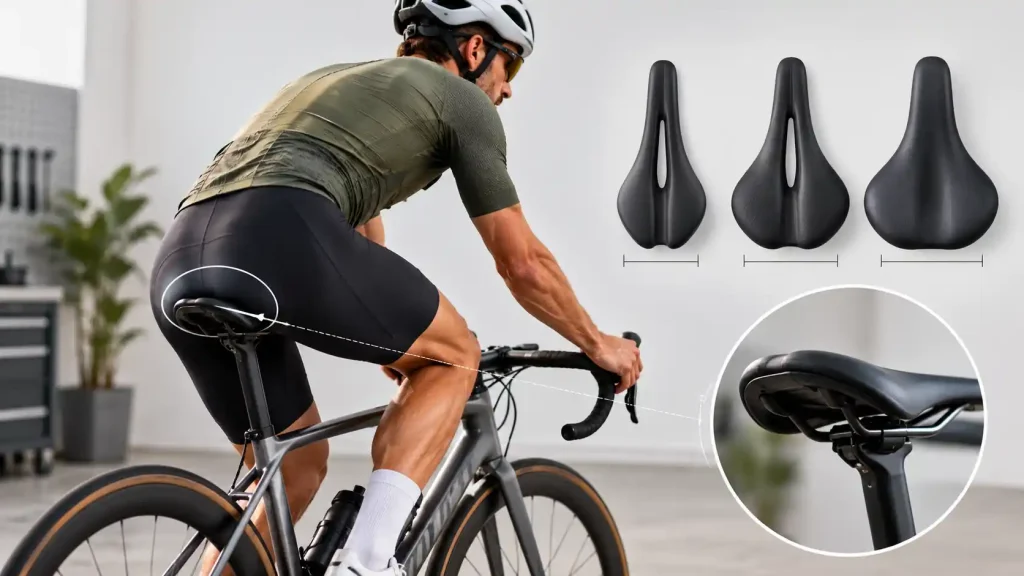
A cheap carbon bike saddle is not automatically unsafe, and an expensive saddle is not automatically suitable. The real question is whether the specific saddle has a documented design, compatible rails, appropriate installation requirements, and credible evidence of durability.

The difficulty is that some product listings emphasize low weight, carbon construction, and 3D-printed padding without explaining how the saddle was tested or which seatpost clamps it requires.

Before buying, look beyond the price and the star rating. The following checklist helps you identify what can be verified, what remains uncertain, and when to walk away.

Are Cheap Carbon Bike Saddles Safe? A Practical Buyer’s Checklist Read More »

How to Choose a Bike Saddle for Your Body and Riding Position

Learn how to choose a bike saddle by matching sit-bone support, width, shape, riding position, and pressure symptoms. Includes a practical testing checklist.
Choosing a bike saddle is not just about finding the right width or buying a softer seat. The saddle must support your pelvis in your normal riding position without creating excessive pressure, thigh rubbing, numbness, or instability.

A saddle that feels comfortable for ten minutes may become painful after an hour. Before buying another one, consider your sit-bone support, pelvic rotation, saddle position, riding duration, and the way the saddle surface interacts with your cycling shorts.

How to Choose a Bike Saddle for Your Body and Riding Position Read More »

How to Evaluate Facebook Groups for Bicycle Parts Sourcing

Facebook groups can help bicycle sourcing research, but activity alone does not make a group useful. A community with 40,000 members may be dominated by second-hand sales. A smaller specialist group may reveal the exact terminology buyers, distributors, and manufacturers use for bearings, frames, saddles, or other components. The goal is therefore not to find

How to Evaluate Facebook Groups for Bicycle Parts Sourcing Read More »

Using Facebook Groups to Research Carbon Bicycle Components

Facebook groups can be useful when researching carbon bicycle components, but not for the reason many sourcing guides suggest. Their strongest value is not finding a supplier you can immediately trust. It is learning how products are described, which compatibility questions keep appearing, and which companies or product terms deserve further investigation. For carbon frames,

Using Facebook Groups to Research Carbon Bicycle Components Read More »

How to Separate B2B Sourcing Signals from Buy-and-Sell Noise on Facebook

Facebook bicycle groups can look commercially active without being useful for sourcing. A group may contain thousands of members, dozens of daily posts, product photos, “factory direct” claims, used bikes, workshop questions, and supplier promotions—all mixed into the same feed. The mistake is treating all of that activity as the same kind of evidence. For

How to Separate B2B Sourcing Signals from Buy-and-Sell Noise on Facebook Read More »

Finding Bearing and Small-Part Supplier Leads in Facebook Bicycle Groups

Facebook bicycle groups can surface useful supplier names, bearing codes, application terms, and product language that may never appear in a conventional supplier search. The challenge is separating a useful sourcing clue from a sales post. For bearings and other small bicycle components, a better workflow is: application → terminology → specification → supplier verification

Finding Bearing and Small-Part Supplier Leads in Facebook Bicycle Groups Read More »